How to Grow Horseradish
Armoracia rusticana

By Efraín Vega · Published November 19, 2026
Sun
Full sun (6+ hours of direct sunlight daily; tolerates partial afternoon shade)
Water
1–1.5 inches per week (consistent moisture yields juicy, tender roots; drought causes woody, bitter cores)
Spacing
18–24 inches apart in rows 3 feet apart (or isolated in sunken 24-inch chimney tiles to contain invasive root runners)
Soil pH
6.0–7.5 (loose, stone-free sandy loam enriched with aged compost; avoid high-nitrogen fertilizers)
Days to maturity
140–180 days (harvest in late autumn after hard frosts kill top foliage)
Hardiness zones
Zones 3–9 (extremely cold-hardy; root crowns survive frozen ground down to -30°F)
When to plant: Early spring as dormant root sets (thongs) 4 to 6 weeks before your average last frost • Calculate planting dates for your city →
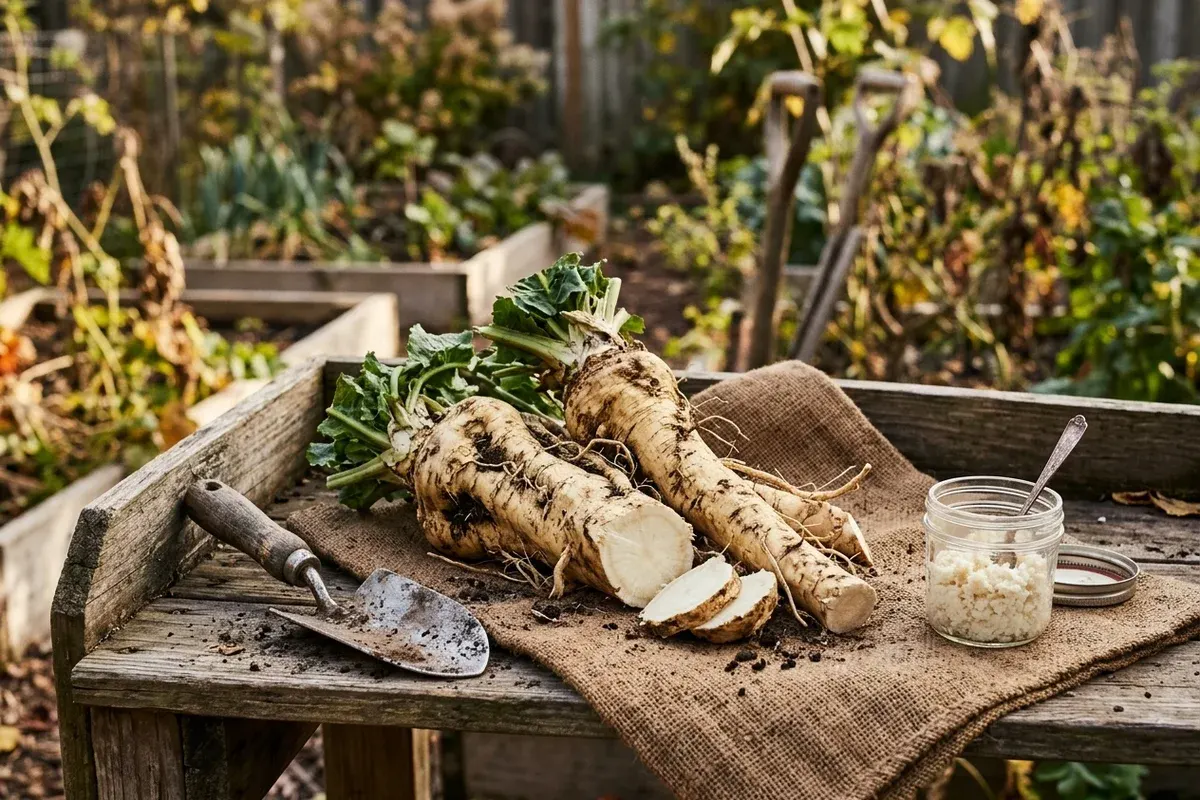
Horseradish (Armoracia rusticana) is the undisputed heavyweight of the culinary root world. A rugged, indestructible perennial member of the Brassicaceae (mustard) family native to Southeastern Europe, horseradish produces massive, thick, pale tan taproots hiding snow-white interior flesh with legendary sinus-clearing volatility.
While store-bought jarred horseradish often tastes stale, vinegar-heavy, and dull, freshly dug homegrown horseradish is an explosive gastronomic revelation: crisp, intensely spicy, and aromatic with clean wasabi heat.
Because it is an exceptionally hardy perennial that survives sub-zero northern winters with zero protection, an established patch of horseradish will provide fresh gourmet condiments, cocktail sauces, and prime rib accompaniments for decades.
The Containment Rule: How to Prevent Garden Takeover
Before planting, every gardener must heed this warning: never plant horseradish loose in your main vegetable garden or raised beds.
┌────────────────────────────────────────────────────────┐
│             THE SUNKEN TILE CONTAINMENT METHOD         │
├────────────────────────────────────────────────────────┤
│           ◄─── 12" x 12" Chimney Flue Tile ───►        │
│   ┌────────────────────────────────────────────────┐   │
│   │ [Lush Green Foliage & Leaf Crown]              │   │
│   ├────────────────────────────────────────────────┤   │
│   │ 2" Ground Mulch Layer                          │   │
│   ══════════════════════════════════════════════════   │
│   │                                                │   │
│   │  Rich Sandy Loam & Aged Compost Soil           │ ▲ │
│   │  (Loose, Stone-Free Mix)                       │ │ │
│   │                                                │24"│
│   │     /                                          │ │ │
│   │    /  ◄── Thick Straight Taproot               │ │ │
│   │   /       (Harvested Completely in Fall)       │ ▼ │
│   │                                                │   │
│   └────────────────────────────────────────────────┘   │
│   ◄────── Gravel Sump Base (Blocks Deep Escape) ──────►│
└────────────────────────────────────────────────────────┘
- The Rototiller Nightmare: If you attempt to dig horseradish and leave small root fragments in the soil, you will create a weed problem for life. Every piece of root down to the size of a pencil eraser contains adventitious buds that generate new crowns.
- The 3 Proven Containment Methods:
- Sunken Chimney Flue Tile: Sink a 12" × 12" × 24" clay or concrete chimney liner vertically into the ground, leaving 2 inches protruding above the garden soil. Fill with stone-free sandy loam. In autumn, digging out the taproot is simple and 100% contained.
- 15-Gallon Heavy Fabric Grow Bag: Grow on top of a concrete patio, paver path, or gravel pad. The fabric air-prunes lateral roots, preventing underground escape while making end-of-season harvest as simple as dumping the bag onto a tarp.
- Dedicated Remote Corner: Plant in an isolated border bed surrounded by regular lawn mowing. Weekly lawn mower passes will scalp and kill any wandering surface shoots that attempt to spread.
Sowing & Cultural Management
Horseradish rarely produces viable seeds; it is almost exclusively propagated from dormant 8- to 12-inch pencil-thick lateral root cuttings known as "sets" or "thongs".
┌─────────────────────────────────────────────────────────┐
│               SPRING SLANT-PLANTING TECHNIQUE           │
├─────────────────────────────────────────────────────────┤
│   Top End (Flat Cut) - Buried 2" Deep                   │
│   ┌──────┐                                              │
│   │ ==== │ ◄── Pointing toward the surface             │
│   └─┬──┬─┘                                              │
│      \  \   45° Planting Angle                          │
│       \  \  (Encourages One Massive Main Root)          │
│        \  \                                             │
│         \  \                                            │
│          \  \  Slender End (Angled Cut)                 │
│           └──► Buried 4"–6" Deep                        │
└─────────────────────────────────────────────────────────┘
The 45-Degree Slanted Planting Secret
Commercial horseradish growers in Illinois and Oregon use the slant-planting technique to produce large, unbranched taproots:
- When you buy root sets, the grower typically cuts the top end flat and the bottom end at a diagonal angle so you know which end is up.
- Dig a trench 4 inches deep in loose, compost-amended soil (calculate bed requirements with our Raised Bed Soil Calculator).
- Lay the root thong at a 45-degree angle, spacing sets 18 to 24 inches apart.
- Cover with soil so the top flat crown is buried under 2 inches of soil, and the bottom tip sits 5 to 6 inches deep. Firm the soil and water thoroughly.
Soil Chemistry & Fertility Management
Horseradish develops deep, straight roots in light, well-aerated soils:
| Soil Property | Target Requirement | Impact on Root Quality |
|---|---|---|
| Soil Texture | Deep sandy loam (Stone-Free) | Heavy, clumpy clay forces roots to fork into tangled, unpeelable root webs. Work in sand and perlite. |
| Soil pH Range | 6.5 – 7.2 (Near Neutral) | Slightly sweet soils support optimal mineral absorption. Apply agricultural lime if native soil is acid. |
| Nitrogen Warning | LOW to Moderate Nitrogen | Excessive nitrogen fuels giant, elephantine green leaves while keeping the underground root skinny, watery, and hollow. |
| Potassium & Phosphorus | High (K & P) | Feed with bone meal (0-10-0) and sulfate of potash (0-0-50) to fuel dense, solid root expansion. |
Harvesting & Fall Root Cellaring
- Wait for the Foliage to Die: Never harvest in late summer. Wait until late October, November, or December after multiple killing frosts have withered the large green paddle leaves.
- Excavation Technique: Using a heavy garden fork or spade, dig a trench 12 inches away from the plant stem and pry outward to avoid snapping the brittle main taproot. Lift the entire root system.
- Saving Next Year's "Sets":
- The central large root (2 to 3 inches in diameter) is your eating crop.
- Snip off the slender pencil-thick lateral roots (8 to 10 inches long). Store these thongs in damp sand over winter to replant next spring!
- Long-Term Root Cellar Storage:
- Brush off loose dirt (do not wash).
- Pack unpeeled roots into wooden crates or buckets filled with slightly damp sand or sawdust.
- Store in a dark root cellar, basement, or refrigerator crisper at 33°F to 38°F with 90% humidity. Roots will remain crisp, juicy, and rock-hard for 6 to 8 months.
The Chemical Secret to Fiery Homemade Prepared Horseradish
Making homemade prepared horseradish requires strict control of cellular enzyme chemistry:
┌────────────────────────────────────────────────────────┐
│            THE ENZYMATIC VINEGAR CLOCK                 │
├────────────────────────────────────────────────────────┤
│ Step 1: Peel and cube root; place in food processor.   │
│ Step 2: Add 2 tbsp cold water; pulse to fine puree.    │
│         (Myrosinase enzyme reacts with sinigrin).      │
│                                                        │
│ Step 3: WATCH THE CLOCK BEFORE ADDING VINEGAR:         │
│ • 1 Minute:  Mild, sweet, gentle warmth.               │
│ • 3 Minutes: Hot, traditional steakhouse heat.         │
│ • 4 Minutes: Fiery, eye-watering, sinus-clearing blast!│
│                                                        │
│ Step 4: Add 2 tbsp white vinegar & 1/2 tsp salt.       │
│         (Acid stops the reaction & locks the heat).    │
└────────────────────────────────────────────────────────┘
[!WARNING] Open Processor Away from Face: Never look directly into the food processor bowl when removing the lid! The vaporized allyl isothiocyanate gas will instantly sting your eyes and respiratory tract like tear gas. Always open the container in a well-ventilated room facing away from your face.
Companion Planting Synergies
- Potatoes (Potato Profile): Horseradish is one of the premier companion allies for Solanaceae. Its potent glucosinolates deter the Colorado potato beetle and enhance disease resistance.
- Fruit Trees & Apples: Planted near the drip line of young apple trees, horseradish roots help protect against fungal apple scab and subterranean grubs.
- Avoid: Keep away from common brassicas (cabbage, broccoli, rutabaga) to avoid concentrating shared flea beetles.
Related Guides & Planning Tools
- Companion Planting Chart & Checker: Verify safe and conflicting crop pairings across 35+ garden vegetables.
- How to Grow Rutabaga: Companion cool-season root brassica for rich autumn homestead harvests.
- How to Store Root Vegetables for Winter: Traditional sand-box root cellaring techniques for winter food storage.
- Raised Bed Soil Calculator: Design the ideal loose, stone-free sandy loam bed for massive straight roots.
Beneficial Companion Plants for Horseradish
Plant horseradish near: Potato, Strawberry, Apple.
FAQ
Why is horseradish considered an invasive garden plant?
Horseradish spreads aggressively through deep underground lateral root runners. If you rototill or haphazardly spade an established patch, every single 1/2-inch root fragment left behind in the soil will sprout into a vigorous new plant, rapidly overrunning a raised bed. To prevent invasive takeover, grow horseradish in 15-gallon fabric containers, half-whiskey barrels, or inside vertical 24-inch concrete chimney flue tiles sunken flush with the garden bed.
Why should you wait until after a hard freeze to harvest horseradish?
Horseradish harvested in warm summer weather tastes bitter, woody, and weak. Exposure to multiple hard autumn freezes (below 28°F / -2°C) kills the top foliage and triggers the plant to pump concentrated sugars and sinigrin oils into the primary taproot. This cold shock produces the signature explosive pungency and crisp, sweet undertone prized by gourmet chefs.
How does the timing of vinegar affect homemade prepared horseradish heat?
When you grate or puree raw horseradish, cell walls rupture, allowing the enzyme myrosinase to react with sinigrin to produce spicy allyl isothiocyanate. Adding acid (white vinegar) denatures the enzyme and permanently locks in the heat level. Adding vinegar immediately after blending produces mild, sweet horseradish; waiting 3 to 4 minutes before adding vinegar produces maximum, eye-watering, sinus-clearing fiery heat. Waiting longer than 5 minutes causes oxidation, bitterness, and discoloration.
What is the best way to plant root sets (thongs) in spring?
Plant pencil-thick root cuttings (thongs) at a 45-degree angle in a shallow trench 3 to 4 inches deep, with the thicker top end pointing toward the soil surface (buried 2 inches deep) and the slender root tip pointing down. Planting at a slant produces a straighter, thicker main taproot that is vastly easier to dig and peel in autumn.
Does horseradish help repel pests from potatoes?
Yes. Horseradish root exudates and airborne sulfur aromatics act as a potent biological deterrent against Colorado potato beetles (Leptinotarsa decemlineata) and blister beetles. Planting a contained container of horseradish at the corner of your potato patch significantly reduces foliar beetle infestations without invading the potato tuber zone.