Cinder Block Raised Bed Guide: Layout, Block Count & Core Soil

By Efraín Vega · Published November 7, 2026 · Last updated November 16, 2026
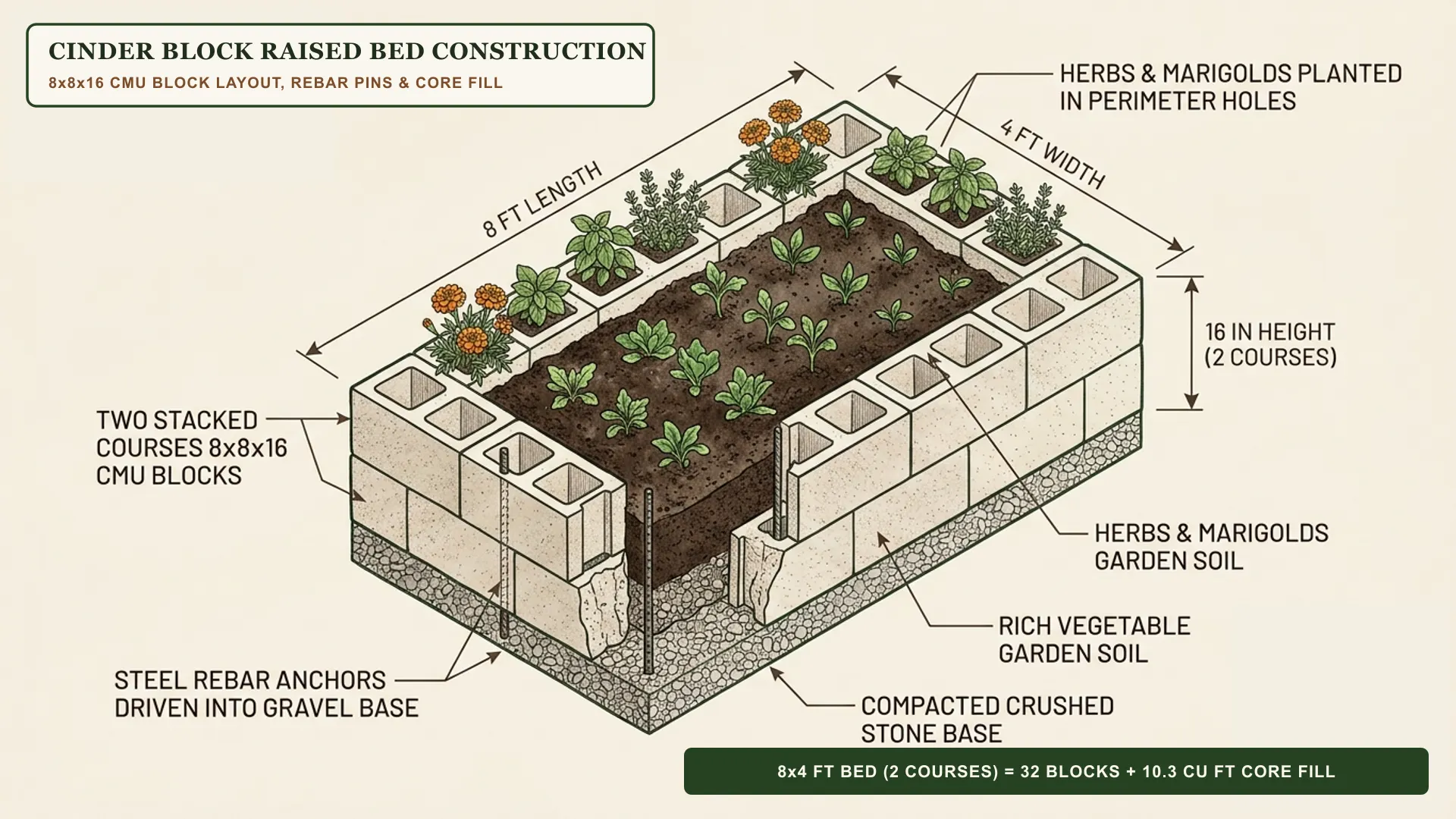
A cinder block raised garden bed built from standard 8×8×16-inch concrete masonry units (CMUs) costs roughly half as much as heavy cedar timber and never rots, warps, or invites termites. Even better, the hollow vertical cells around the perimeter form built-in 6×6-inch mini planters for pest-repelling marigolds, thyme, and basil.
Use our interactive Cinder Block Raised Bed Calculator for custom bed dimensions, or use the standard layout tables below.
Cinder Block & Soil Count for Standard Bed Sizes
Because each standard CMU block is 16 inches long (1.33 ft) and 8 inches wide (0.67 ft), the two thick walls subtract 16 inches from your interior growing length and width. In addition, each block's two hollow cores hold 0.32 cubic feet of soil:
| Exterior Bed Footprint | Wall Height (Courses) | Exact 8×8×16 Blocks | Interior Bed Soil (+10%) | Hollow Core Fill Soil | Total 2 cu ft Soil Bags |
|---|---|---|---|---|---|
| 4 × 4 ft (Takeoff) | 8 in (1 Course) | 10 blocks | 5.3 cu ft | 3.2 cu ft | 5 bags (8.5 ft³) |
| 4 × 4 ft (Takeoff) | 16 in (2 Courses) | 20 blocks | 10.6 cu ft | 6.4 cu ft | 9 bags (17.0 ft³) |
| 8 × 4 ft (Takeoff) | 8 in (1 Course) | 16 blocks | 13.2 cu ft | 5.2 cu ft | 10 bags (18.4 ft³) |
| 8 × 4 ft (Takeoff) | 16 in (2 Courses) | 32 blocks | 26.4 cu ft | 10.3 cu ft | 19 bags (36.7 ft³) |
| 12 × 4 ft | 16 in (2 Courses) | 44 blocks | 42.3 cu ft | 14.1 cu ft | 29 bags (56.4 ft³) |
How the 8×4 ft Corner Layout Works (No Cutting Required)
To build a clean 8-foot by 4-foot exterior bed without cutting a single block with a masonry saw:
- Long sides (96 inches): Lay 6 blocks end-to-end along each 8-foot side (6 × 16 in = 96 in).
- Short ends (48 inches): Because the two long walls already consume 8 inches on each corner (2 × 8 in = 16 in), the remaining gap on each short end is exactly 32 inches—which fits 2 full 16-inch blocks between the long walls (6 + 6 + 2 + 2 = 16 blocks per course).
- Second course (running bond): Rotate the corner blocks 90 degrees on the second layer so every vertical joint is bridged by a solid block above it.
Keep soil from washing out of the bottom block cores
Before setting the first course of blocks, lay a 10-inch strip of non-woven landscape fabric (or 1/4-inch galvanized hardware cloth) along the perimeter trench. When you fill the hollow block cores with potting mix, the fabric holds the soil in place while letting excess water drain freely.
Step-by-Step Construction for a 2-Tier Cinder Block Bed
- Trench & level a gravel footing. Lawn turf is never level enough for stacked masonry. Skim off a 12-inch wide perimeter trench 2 inches deep and tamp in 2 inches of crushed paver base gravel. Check every first-course block with a 4-foot spirit level.
- Dry-fit the first course (16 blocks for 8×4). Lay all 16 blocks with the hollow cells facing straight up. Tap high corners down with a rubber mallet.
- Glue and stagger the second course. Apply two beads of exterior polyurethane construction adhesive along the top webs of the first course, then set the second course with staggered corner overlaps.
- Drive rebar anchor pins. For a 2-tier (16-inch) or 3-tier (24-inch) bed, drive a 24-inch length of 1/2-inch steel rebar down through one hollow core of every corner block and every second side block until the rebar sits 1 inch below the top rim (anchoring 8 inches into the subsoil).
- Fill the cores first, then the center bed. Fill the perimeter block holes with soil first—this locks the blocks heavy and prevents them from shifting inward when you dump wheelbarrows of soil into the center bed.
What to Plant in the Outer Cinder Block Holes
Because the 6×6-inch block cells warm up quickly in spring sun, dry out faster than the main bed, and have a slightly alkaline pH (7.0–7.5) from the concrete walls, they are ideal for:
- Pest-deterring border flowers: French marigolds, nasturtiums, and sweet alyssum.
- Mediterranean culinary herbs: Thyme, oregano, rosemary, sage, and chives.
- Aggressive spreaders you want to contain: Mint and lemon balm (the concrete walls stop underground runners from invading the main vegetable bed).
Looking for more heavy-duty masonry builds? Check out our step-by-step plans to build an outdoor pizza oven base with cinder blocks and reinforced concrete.
FAQ
How many cinder blocks do I need for a 4x8 raised bed?
A 4×8-foot cinder block raised bed requires 16 standard 8×8×16-inch blocks for a single 8-inch tier (6 blocks on each 8-ft side, and 2 blocks tucked between the corners on each 4-ft end). For a 2-tier (16-inch tall) bed, double that to 32 blocks.
Are cinder blocks safe for vegetable gardens?
Yes. Modern concrete masonry units (CMUs) sold at home improvement stores are made of Portland cement, sand, and stone aggregate—not coal fly-ash cinders. Avoid salvaged blocks from pre-1970 industrial buildings.
Do cinder blocks change garden soil pH?
Cured concrete slowly leaches trace calcium hydroxide, which slightly raises soil pH (makes it more alkaline) within 1 to 2 inches of the block wall. Plant acid-loving crops in the center of the bed and plant alkaline-tolerant herbs (rosemary, thyme, oregano, lavender) and marigolds in the outer block holes.
How do you keep a 2-tier cinder block raised bed from shifting?
Level a 2-to-3-inch crushed gravel trench under the bottom course, stagger the corner seams like brickwork, bond the second tier with exterior polyurethane masonry adhesive, and drive 24-inch lengths of 1/2-inch rebar through the hollow cores into the subsoil.