How to Build a DIY Corrugated Metal Raised Bed (Cedar Framed)

By Efraín Vega · Published November 16, 2026
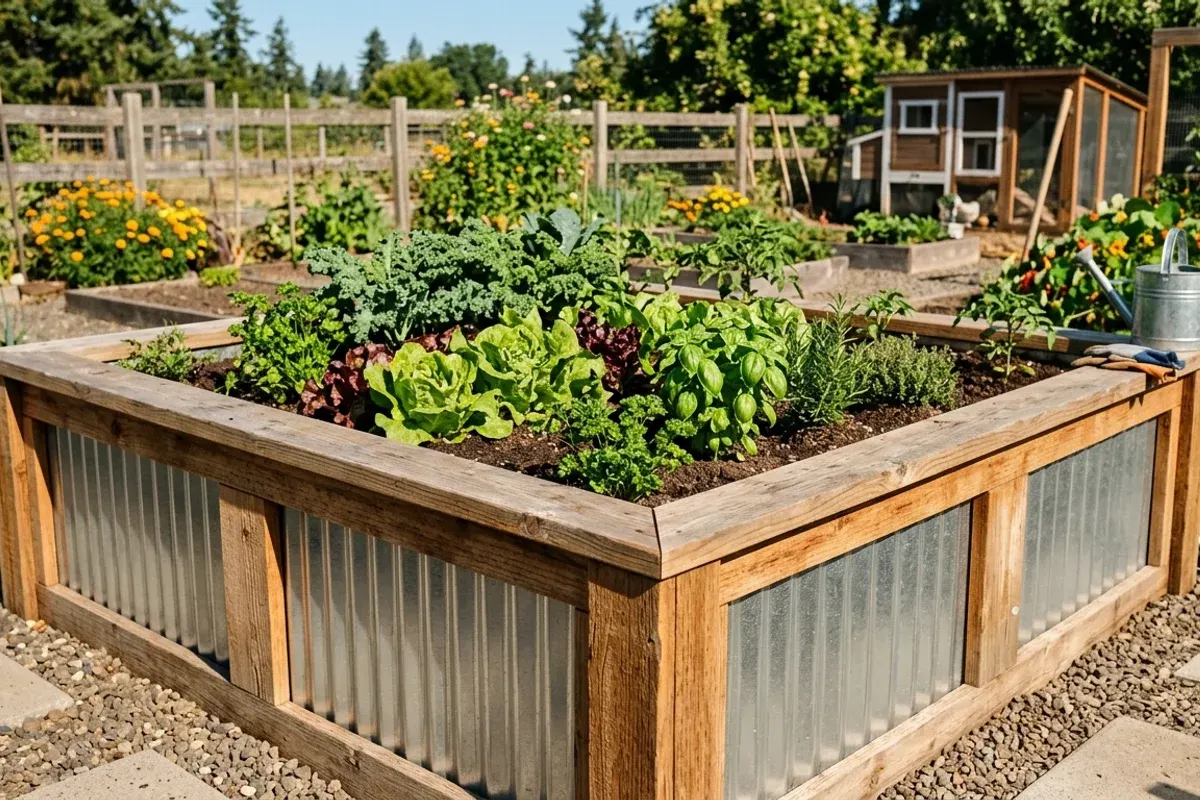
Corrugated galvanized metal and cedar raised beds have surged in popularity across modern homesteads for a practical reason: they solve the timber rot problem permanently. Traditional 2x10 lumber beds rarely survive beyond 6 to 8 seasons before fungal rot, carpenter ants, and moisture compromise the sidewalls.
By encasing 26-gauge corrugated steel panels within a rot-resistant Western Red Cedar framework, you build an industrial-strength, 24-inch tall growing container with a 30-year lifespan. The elevated 24-inch depth eliminates bending and kneeling strain, deters crawling pests and rabbits, and accommodates deep-rooting heirloom vegetables.
Galvanized Steel Safety & Soil Chemistry
Before building, gardeners often ask if metal panels leach chemicals into organic vegetables:
- The Zinc Barrier: Hot-dipped galvanization coats structural steel with an outer layer of 99% pure elemental zinc. In normal vegetable garden soils (pH 6.2 to 7.0), zinc insoluble carbonates form a stable protective patina that releases microscopic trace amounts—well within natural background soil concentrations.
- Thermal Dynamics: Because corrugated steel features a ribbed, undulating profile with high reflective albedo, it bounces solar heat away from the bed. Soil temperatures inside corrugated beds closely match timber beds, with the added benefit of warming 2 to 3 weeks earlier in early spring.
- Galvalume vs. Traditional Galvanized: Standard galvanized steel uses pure zinc; Galvalume incorporates 55% aluminum, 43.4% zinc, and 1.6% silicon. Galvalume offers twice the corrosion resistance in damp maritime or high-rainfall climates.
CORRUGATED METAL RAISED BED (4' x 8' x 24" DEEP)

         ◄────────────────── 96" Length ──────────────────►
      =========================================================== ◄── 2x6 Cedar Top Cap Ledge
      │[#]                                                 [#]│       (Mitered / Overhanging)
      │ ║  =============================================  ║ │
      │ ║  │ ~~~~~~~~~~~~~~~~~~~~~~~~~~~~~~~~~~~~~~~~~ │  ║ │ ▲
      │ ║  │ ~~~ GALVANIZED CORRUGATED STEEL ~~~~~~~~~ │  ║ │ │ 24" Working
      │ ║  │ ~~~~~~~~~~~~~~~~~~~~~~~~~~~~~~~~~~~~~~~~~ │  ║ │ │ Depth
      │ ║  =============================================  ║ │ ▼
      │[#]                                                 [#]│
      ===========================================================
       ▲                                                    ▲
     4x4 Cedar Corner Post                                4x4 Corner Post
Materials & Lumber Cut List (4' x 8' x 24" Bed)
Using standard off-the-shelf 8-foot lumber and 8-foot corrugated metal roofing panels minimizes waste:
Lumber Requirements (Western Red Cedar or Redwood):
- Corner Posts (4 pieces): 4x4 cedar cut to 23-1/2 inches.
- Center Support Posts (2 pieces): 4x4 cedar cut to 23-1/2 inches (stops 8-foot sidewall bulge).
- Long Horizontal Framing Rails (4 pieces): 2x4 cedar cut to 93 inches (top and bottom long rails).
- Short End Horizontal Rails (4 pieces): 2x4 cedar cut to 45 inches (top and bottom short rails).
- Exterior Corner Trim Face (8 pieces): 1x4 cedar cut to 24 inches (conceals sharp metal edges).
- Top Seating Cap Rim:
- Long Cap Rails (2 pieces): 2x6 cedar cut to 98 inches (mitered 45° at ends).
- Short Cap Rails (2 pieces): 2x6 cedar cut to 50 inches (mitered 45° at ends).
Hardware & Metal Panels:
- Corrugated Roofing Panels: Two 8-foot by 26-inch corrugated steel panels (cut one panel in half to create the two 4-foot end walls).
- Screws for Wood Framing: 3-inch #9 exterior ceramic-coated star-drive wood screws.
- Screws for Metal Panels: 1-inch self-tapping metal roofing screws with built-in neoprene rubber EPDM sealing washers.
- Anti-Bow Hardware: One 48-inch threaded steel rod (3/8" diameter) with heavy washers and nuts.
- Hardware Cloth (Gopher Shield): 4x8 ft roll of 1/2-inch galvanized 19-gauge hardware cloth for the bed base.
Use our Raised Bed Lumber Calculator to estimate board feet and fastener counts across multiple beds.
Step-by-Step Construction Guide
Step 1: Cutting the Corrugated Metal Safely
Corrugated roofing sheets arrive in standard 8-foot or 12-foot lengths by 26 inches wide.
- Leave the two 8-foot panels untouched for your long sidewalls.
- For the two 4-foot end walls, measure and mark an 8-foot sheet at exactly 48 inches.
- Cutting Technique: Clamp a straight board across the corrugations as a cutting fence. Fit a circular saw with a metal-cutting carbide blade (e.g., Diablo Steel Demon) or use heavy-duty aviation offset shears. Always wear heavy leather work gloves, wrap-around eye protection, and hearing protection.
- Smooth cut raw edges with a 10-inch bastard metal file to remove burrs.
CORNER ASSEMBLY CROSS-SECTION (TOP VIEW)

                  Outside of Bed
          ┌──────────────┬────────────────┐  ◄── 1x4 Cedar Exterior Trim
          │              │ 1x4 Trim       │      (Conceals Raw Metal Edges)
          │  4x4 Cedar   └────────────────┘
          │  Corner Post │  ~~~~~~~~~~~~~ ◄── Corrugated Metal Sheet
          │              │  [2x4 Framing] ◄── Interior 2x4 Rail
          └──────────────┴────────────────┘
                    Inside Soil Zone
Step 2: Assemble the Wooden Framing Ladder
- Lay two 4x4 corner posts parallel on a flat level driveway or workbench.
- Pocket-screw or face-screw the 2x4 horizontal rails flush with the top and bottom of the posts to construct a rigid picture frame.
- For the 8-foot long sides, install a center 4x4 post at the 48-inch midpoint. This center post provides the structural anchor to prevent soil pressure from pushing the metal outward.
Step 3: Fastening the Corrugated Metal Panels
- Set the corrugated metal sheet into the wooden frame against the interior shoulder of the 2x4 rails.
- Fasten the sheet using self-tapping roofing screws fitted with EPDM rubber washers.
- Fastener Rule: Drive screws through the valleys (flats) of the corrugation into the wood framing every 8 to 12 inches. Do not over-torque: compress the rubber gasket until it mushrooms slightly without tearing.
- Nail the 1x4 cedar trim over the exterior corners to completely seal raw metal edges away from clothing and hands.
Step 4: Installing the Anti-Bow Center Tie
Soil weighs approximately 90 to 110 pounds per cubic foot when saturated with rain. In an 8-foot bed at 24 inches depth, soil exerts over 1,500 pounds of lateral thrust:
- Drill a 7/16-inch hole through the center 4x4 post on each long side at half-height (12 inches up from ground).
- Feed a 3/8-inch threaded steel rod straight across the interior of the bed.
- Slip 2-inch fender washers and double nuts onto the exterior threads and tighten until snug. This internal bridge makes sidewall blowouts physically impossible.
ANTI-BOW THREADED ROD DETAIL (CENTER BED CROSS-SECTION)

    Left Long Wall                               Right Long Wall
  ┌──────────────┐                             ┌──────────────┐
  │ 4x4 Center   │                             │ 4x4 Center   │
  │ Post         │                             │ Post         │
  │     [Nut]    │                             │    [Nut]     │
  │       ║      │                             │      ║       │
  │   [Washer]   │   3/8" Threaded Steel Rod   │  [Washer]    │
  │       ╠══════╪═════════════════════════════╪══════╣       │
  │              │ (Spans 48" Across Interior) │              │
  └──────────────┘                             └──────────────┘
Step 5: Fastening the 2x6 Mitered Top Cap
The top cap provides structural rigidity and doubles as a comfortable 5-1/2-inch wide seating bench for weeding and harvesting:
- Cut 2x6 cedar boards with 45-degree miter cuts at each corner.
- Center the board over the 4x4 posts so it overhangs the interior and exterior by 1 inch.
- Fasten down into the posts and framing rails using 3-inch exterior ceramic screws countersunk 1/8 inch below the surface.
How to Fill a 24-Inch Bed Without Breaking the Bank
Filling a 4x8x24-inch bed entirely with bagged potting mix requires 64 cubic feet (32 large bags), costing $250 to $400 per bed.
Instead, use the 4-Layer Hugelkultur Method:
- Bottom 10 Inches (Wood Core): Lay thick decaying hardwood logs (oak, maple, alder) and large tree branches directly on top of your bottom gopher wire.
- Next 4 Inches (Carbon Cushion): Pack wood chips, inverted sod clumps, and shredded autumn leaves into the voids between logs.
- Next 4 Inches (Nitrogen Barrier): Layer composted barnyard manure, grass clippings, and kitchen compost.
- Top 8 to 10 Inches (Active Root Zone): Fill with a premium 60/30/10 blend of screened topsoil, aged compost, and perlite. Calculate your exact bagged or bulk cubic yard requirements with our Raised Bed Soil Calculator.
The buried wood acts like an underground moisture reservoir, wicking water upward to vegetable roots and reducing irrigation needs by 50% during dry summer heat. Looking for an all-timber walk-in alternative with built-in seating benches? See our complete step-by-step plans for How to Build a DIY U-Shaped Raised Garden Bed.
FAQ
Does corrugated metal make raised bed soil too hot in summer?
No. Extensive field trials by university extensions show that corrugated metal reflects the vast majority of ambient solar radiation. While the outer metal surface feels warm to the touch, soil conductivity is poor: only the outermost 1 to 2 inches of soil directly touching the metal warms up, while the interior core remains up to 10°F cooler than unshaded surface ground. In cooler spring and fall months, the slight thermal transfer actually warms the root zone early, extending your growing season.
What gauge corrugated metal sheet is best for garden beds?
Use 26-gauge or 29-gauge galvanized or Galvalume corrugated steel roofing panels. 26-gauge provides exceptional rigid strength with zero flex against soil weight, while standard 29-gauge is lighter and easier to cut with heavy-duty aviation snips.
Does galvanized metal leach toxic chemicals into organic garden soil?
No. Modern hot-dip galvanized steel is coated with pure zinc. Zinc is an essential plant micronutrient that only dissolves under extreme acidity (pH below 5.5). Normal garden soil (pH 6.2–6.8) causes negligible zinc breakdown over decades. Avoid antique salvaged metal manufactured before the 1970s, which may contain trace lead impurities.
How long does a corrugated metal and cedar raised bed last?
Expect 25 to 35+ years of service. Galvanized sheet steel does not rot, crack, or degrade from soil microbes. When paired with naturally rot-resistant Western Red Cedar or Redwood for the corner posts and top cap, the structure will outlast standard pine or fir beds four times over.
Why do long corrugated raised beds bow outward, and how do you stop it?
Wet saturated soil exerts tremendous hydrostatic lateral pressure against the long walls. On any bed longer than 6 feet, you must install an internal anti-bow center tie: either a threaded 3/8-inch stainless steel tie rod or a cross-bracing cedar 2x4 connecting the opposing center posts.
What is the best way to cut corrugated metal sheets at home?
The cleanest, safest tool is a circular saw or angle grinder fitted with a specialized non-ferrous metal-cutting carbide blade (like a Diablo Steel Demon) or heavy-duty manual left/right aviation snips. Avoid high-abrasive friction disks, which generate sparks that melt the protective zinc galvanization along the cut seam and cause premature edge rust.