How to Build a Dry-Laid Flagstone Patio on Sand and Gravel

By Efraín Vega · Published November 15, 2026 · Last updated November 16, 2026
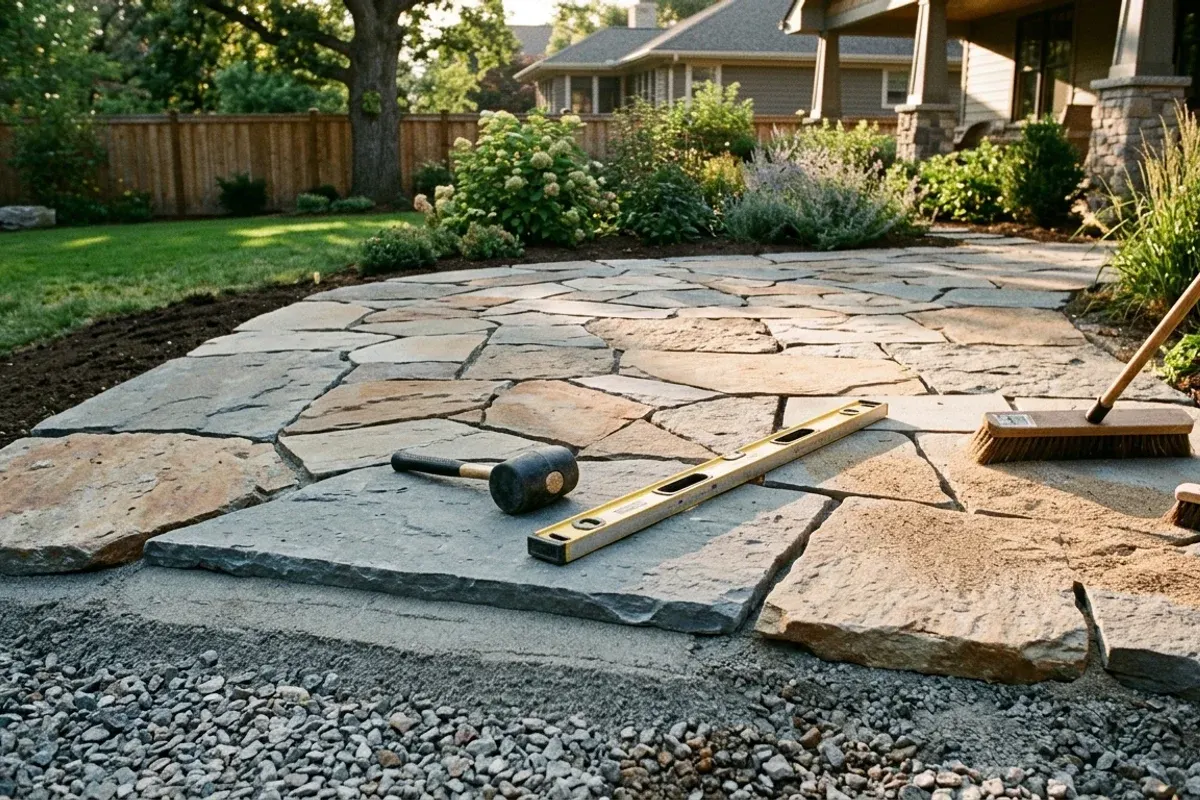
A natural flagstone patio brings an organic, timeless craftsman aesthetic to any outdoor living space. Made from split quarried sedimentary or metamorphic rock—such as Pennsylvania bluestone, Tennessee fieldstone, slate, or Colorado red sandstone—each flagstone possesses unique mineral veining, cleft textures, and earth-toned coloring.
Unlike mortared stone patios laid over rigid concrete slabs (which crack when winter frost heaves the ground), a dry-laid flagstone patio rests on a flexible aggregate foundation. It accommodates ground movement naturally, drains surface water freely, and can be constructed by a patient DIY homeowner over a single weekend.
Follow this engineer-approved process to build a rock-solid, weed-resistant irregular flagstone patio.
Dry-Laid Flagstone Patio Cross-Section
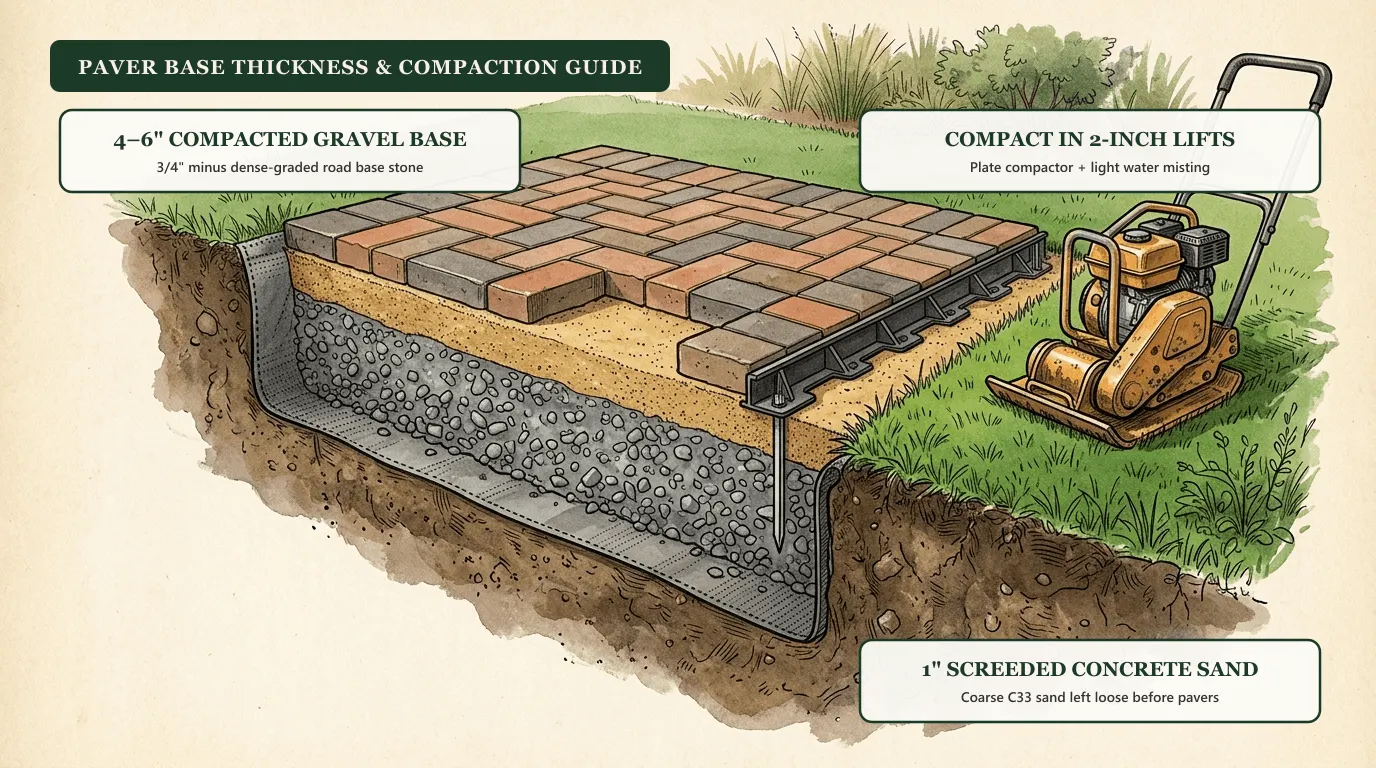
A lasting flagstone patio depends entirely on subterranean drainage and compaction layers:
    DRY-LAID FLAGSTONE PATIO STRUCTURAL LAYERS:

    Finished Patio Grade (Sloped 2% away from house)
    ════════════════════════════════════════════════════
    [██████]  ::  [█████████]  ::  [██████]  ◄── 1.5"–2.5" Natural Flagstone
    ───────────────────────────────────────  ◄── 1" Coarse Bedding Sand (ASTM C33)
    ░░░░░░░░░░░░░░░░░░░░░░░░░░░░░░░░░░░░░░░  ◄── 4"–6" Compacted Crusher Run Base
    ═══════════════════════════════════════  ◄── Non-Woven Geotextile Fabric
    Undisturbed Native Subsoil (Compacted)

    :: = Polymeric Stone Dust in 3/8" to 1" Joint Voids
- Total Excavation Depth: Dig down 7 to 9 inches: 4 to 6 inches of compacted crushed stone base + 1 inch of bedding sand + roughly 2 inches for flagstone thickness.
- Subsoil Protection: Line the raw excavated trench with non-woven geotextile landscape fabric. This prevents soft underlying clay and mud from migrating upward into the gravel pad over time.
- Slope Away from Foundations: Maintain a consistent 1/4-inch drop per linear foot (2% slope) away from all walls and structures.
Calculate your exact aggregate and sand quantities using our Gravel Calculator, Sand Calculator, and Paver Path Calculator.
Material Specifications & Sizing Guide
Natural stone is sold by weight (tons) rather than square footage. Understanding coverage rates prevents costly under-ordering:
| Flagstone Thickness | Typical Material | Square Foot Coverage Per Ton | Recommended Sub-Base |
|---|---|---|---|
| 1.0" to 1.25" | Thin Bluestone / Slate | 110–130 sq ft / ton | Not recommended for dry-laying (cracks easily; requires wet-set mortar on concrete) |
| 1.5" to 2.0" | Standard Irregular Bluestone | 80–100 sq ft / ton | 4"–6" compacted crusher run + 1" coarse sand |
| 2.0" to 2.5" | Heavy Fieldstone / Sandstone | 60–75 sq ft / ton | 6" compacted crusher run + 1" coarse sand |
| Stepping Stones | 2.5"+ Massive Slabs | 45–55 sq ft / ton | Can be set directly into sand pockets in turf |
For detailed base material comparisons, read our guide on What to Put Under Pavers and How Deep to Dig for Pavers.
Step-by-Step Construction Instructions
          THE DRY-LAID PUZZLE ARRANGEMENT:

             ┌──────────────┐     ┌───────────┐
             │  Large Hub   │     │ Companion │
             │  Flagstone   ├──┐  │   Stone   │
             │              │  │  └─────┬─────┘
             └──────┬───────┘  │        │
                    │   3/8"   │  ┌─────┴─────┐
             ┌──────┴──────┐   └──┤ Trailing  │
             │ Corner Stone│      │ Joint     │
             └─────────────┘      └───────────┘
Step 1: Excavate and Compact the Subgrade
- Outline the patio perimeter using garden hose or spray paint. Add 6 inches of over-excavation beyond the perimeter on all sides to support edge restraints.
- Dig down 7 to 9 inches, confirming slope using wooden stakes and a string line with a line level.
- Run a mechanical plate compactor over the native subsoil to eliminate air pockets.
- Roll out heavy-duty non-woven geotextile fabric across the trench, overlapping seams by at least 12 inches.
Step 2: Install and Compact the Crusher Run Base
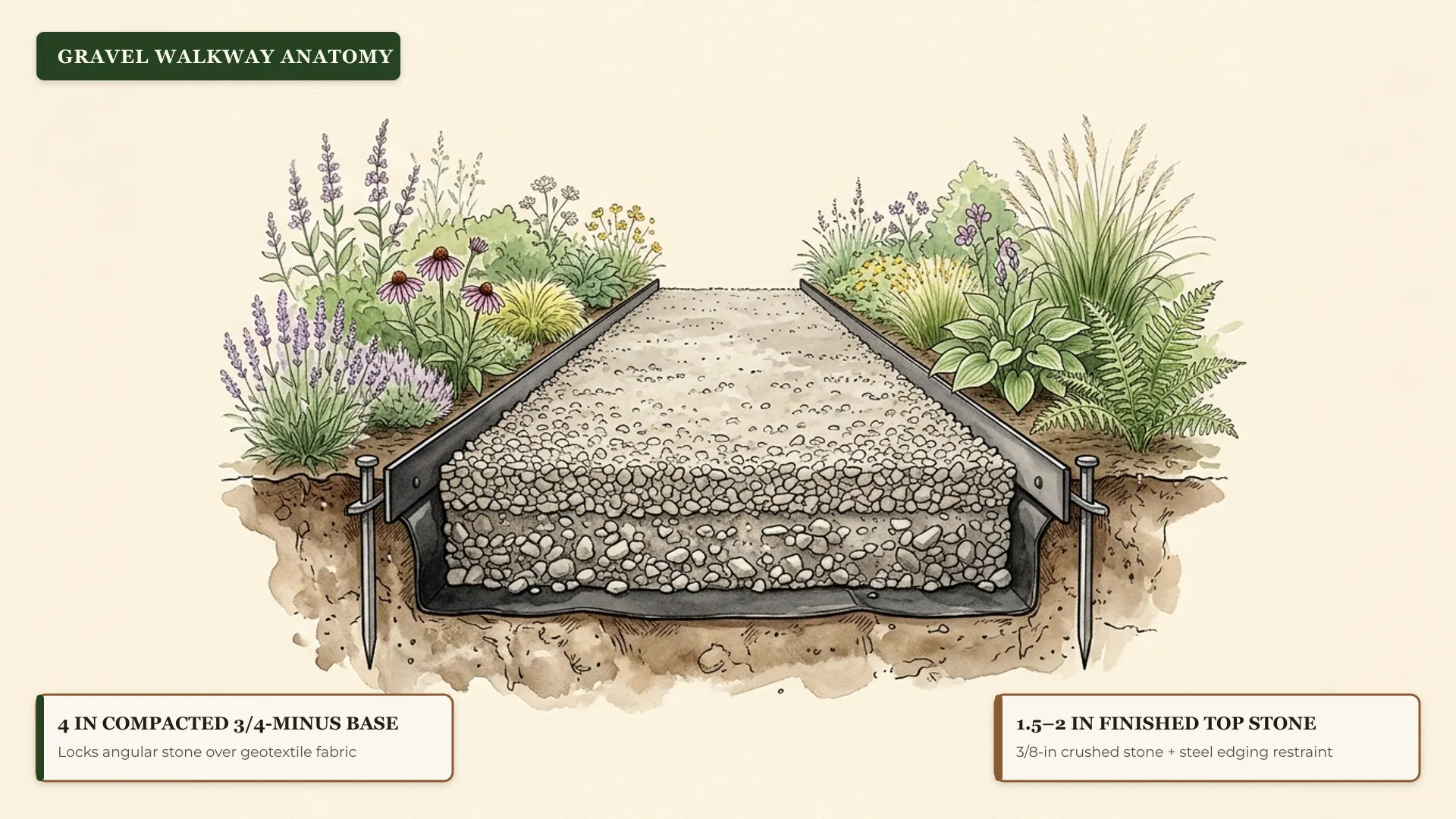
- Spread 2 to 3 inches of dense-grade road base (crusher run or 3/4" minus with stone dust) across the fabric.
- Dampen the stone lightly with a hose and run the plate compactor over it three times.
- Spread a second 2-to-3-inch lift and compact thoroughly until the base is rock-hard and will not deform when walked on. Read our calculation breakdown in How Much Gravel and Sand for a Paver Patio.
Step 3: Screed the Coarse Bedding Sand
- Lay two 1-inch outer-diameter conduit pipes parallel across the compacted base.
- Dump coarse washed concrete sand (ASTM C33) between the pipes.
- Pull a straight 2x4 board across the tops of the pipes to screed a smooth, dead-even 1-inch sand bed. Remove the pipes and fill the voids with loose sand. Do not walk on the screeded sand.
Step 4: The Puzzle-Fitting Technique
- Sort Your Stones: Stage your flagstones on pallets or tarps around the perimeter. Set aside your largest, flattest stones for doorways, steps, and outer perimeter edges.
- Lay the Spine First: Place your largest hub stones across the center and key traffic pathways.
- Fill the Field: Fit smaller irregular pieces around the large hub stones like pieces in a jigsaw puzzle. Maintain joint gaps between 3/8 inch and 1 inch.
- Individual Bedding: Because natural flagstone varies in thickness, test each stone. If a 2-inch stone sits next to a 1.5-inch stone, lift the 2-inch stone and scrape out 1/2 inch of bedding sand with a margin trowel. Tap each stone firmly into place with a dead-blow rubber mallet until it aligns flush with its neighbor.
Step 5: Trimming and Chiseled Shaping
- When a stone overlaps or creates an unsightly 3-inch gap, mark the stone with chalk.
- Score along the line 1/4 inch deep using an angle grinder fitted with a diamond masonry blade, or score with a brick set chisel.
- Strike the waste edge sharply with a 3-lb mason's club hammer to break away clean, chiseled natural stone edges.
Joint Filling Options: Polymeric Dust vs Living Greenery
           TWO POPULAR JOINT FINISHING METHODS:

    Option A: Polymeric Stone Dust        Option B: Living Greenery
    ┌────────────────────────────┐       ┌────────────────────────────┐
    │ Water-activated polymers   │       │ Creeping Thyme or Moss     │
    │ cure into solid rubber-    │       │ fills joints with fragrant │
    │ like weed-proof joints.    │       │ green blossoms & texture.  │
    └────────────────────────────┘       └────────────────────────────┘
Option A: Polymeric Stone Dust (Clean & Weed-Free)
- Ensure the flagstone surfaces are 100% bone dry before opening the bag. Moisture will activate the polymer resins and permanently haze the stone face.
- Sweep polymeric stone dust into the joints with a push broom until joints are filled to 1/8 inch below the stone surface.
- Run a plate compactor fitted with a protective rubber pad (or tap stones vigorously with a wood block) to settle the dust deep into the gaps, then top off.
- Blow every trace of stray dust off the flagstones using a leaf blower on low idle.
- Mist the joints lightly with a garden hose spray nozzle three times over 30 minutes to activate the polymer binders. Follow our complete walkthrough on How to Apply Polymeric Sand.
Option B: Living Greenery Joints
If you desire an English cottage garden aesthetic, fill the joints with a mixture of topsoil and coarse sand, and plant dwarf, drought-tolerant perennials such as Creeping Thyme (Thyme Profile) or Irish moss. When stepped on, the herbs release a delightful aromatic fragrance.
Related Guides & Calculators
- Gravel Calculator — Calculate cubic yards and tons for base pads.
- Sand Calculator — Determine bedding sand and leveling volumes.
- Paver Path Calculator — Size materials for walkways and paths.
- How to Apply Polymeric Sand — Avoid stone haze and lock joints solid.
- How to Build an Outdoor Pizza Oven Base — Masonry blueprints for wood-fired ovens on stone patios.
- What to Put Under Pavers — In-depth aggregate base engineering.
- How Much Gravel and Sand for a Paver Patio — Volume formulas and material tonnages.
FAQ
What is the best base for a dry-laid flagstone patio?
The most durable base consists of 4 to 6 inches of compacted dense-grade aggregate (crusher run or road base with stone dust), topped with a smooth 1-inch bedding layer of coarse washed concrete sand (ASTM C33). Never lay flagstone directly on native soil or pea gravel, which causes severe shifting and rocking.
How thick should flagstone be for a backyard patio?
For dry-laid sand and gravel installations, select flagstone that is 1.5 to 2.5 inches (38mm–64mm) thick. Stones thinner than 1.5 inches lack the gravitational mass needed to resist shifting under foot traffic and crack easily under freeze-thaw cycles without a concrete foundation.
What should you put between flagstone joints: polymeric sand or stone dust?
Specialty polymeric stone dust (designed for wide joints up to 2 inches) is the superior choice. Unlike ordinary sand or stone dust that washes out in rainstorms, polymeric dust contains activated polymer binders that harden into a flexible, rubber-like joint that repels weeds, deters ants, and flexes during winter freeze-thaw heave.
How much slope does a flagstone patio need for drainage?
Slope the patio at a minimum gradient of 1/4 inch of drop for every 1 foot of horizontal distance (a 2% slope) directed away from home foundations toward lawn drainage or rain gardens. Natural cleft flagstones have surface undulations; a 2% slope prevents water from pooling in low pockets.
How do you level irregular flagstones with varying thicknesses?
Because natural cleft flagstone slabs vary in thickness by up to 1/2 inch, you cannot lay them on a flat surface like uniform manufactured concrete pavers. Level each stone individually: place the stone, check with a 2-foot level, lift it, and either trowel away excess bedding sand under thick edges or pack extra sand beneath thin edges before reseating with a heavy rubber mallet.