What to Put Under Pavers: The 4-Layer Base Formula (No Sinking or Ruts)

By Efraín Vega · Published October 14, 2026 · Last updated November 15, 2026
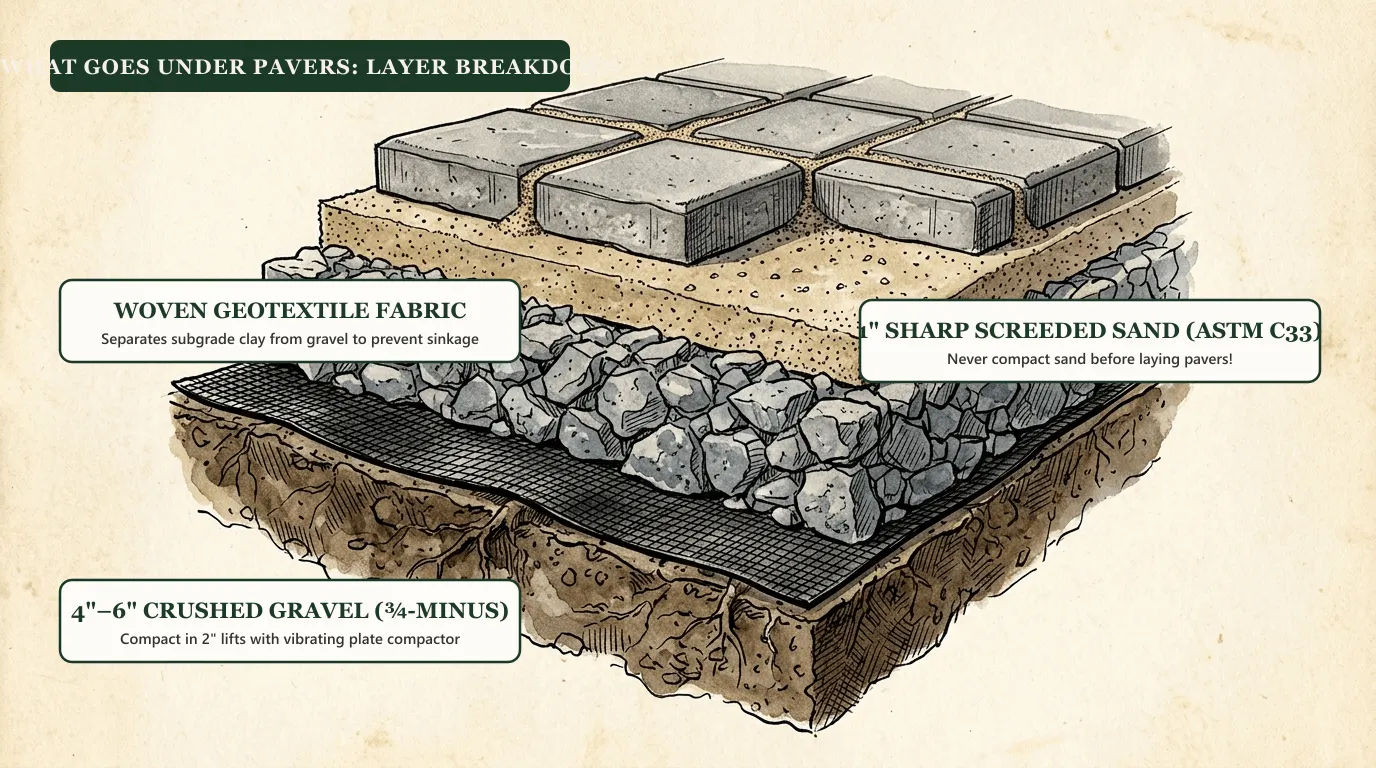
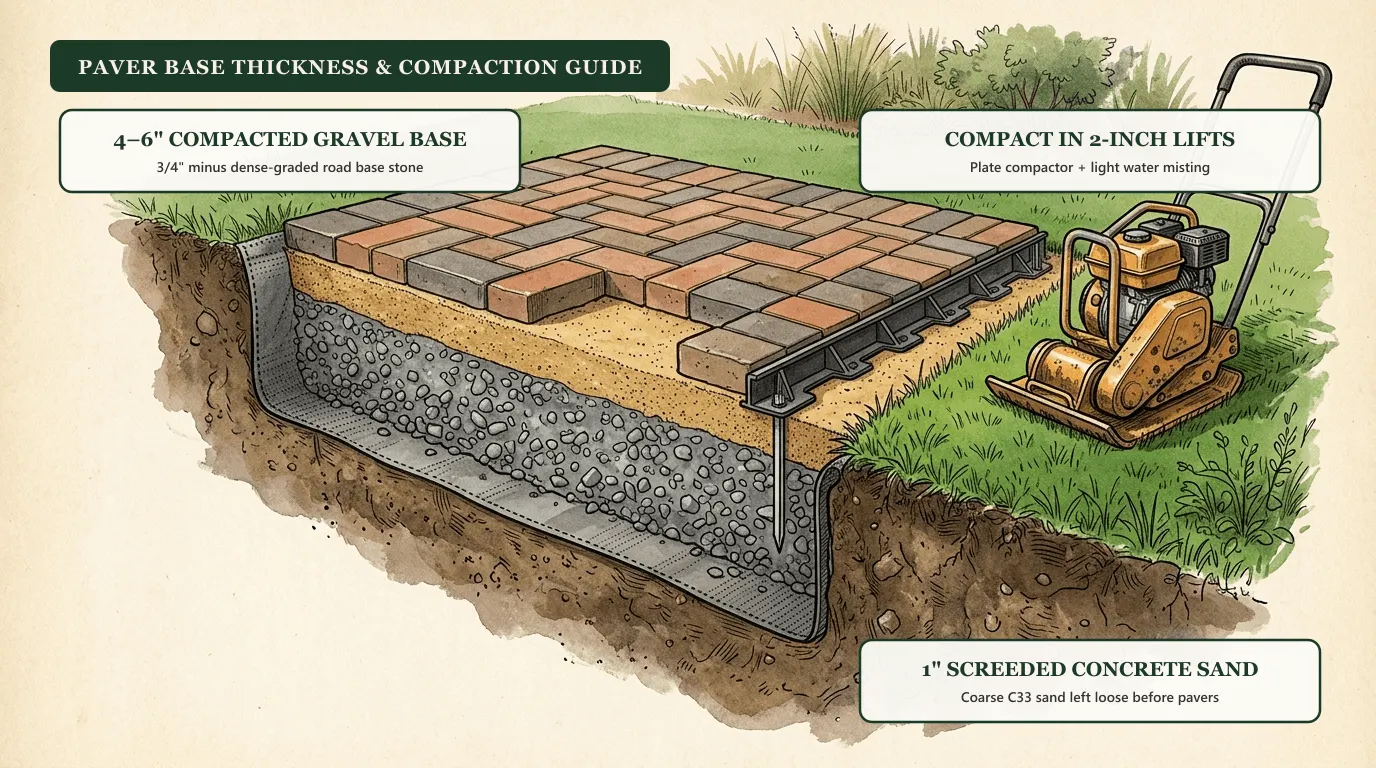
Under a lasting paver patio or walkway go two distinct layers: 4–6 inches of compacted crushed gravel (3/4-minus or "paver base") over compacted soil, followed by exactly 1 inch of coarse washed concrete sand screeded flat. The pavers sit directly on the screeded sand. Stone dust, rounded pea gravel, and fine masonry sand are the three common DIY mistakes that cause sinking and uneven ruts after winter.
Planning a standard patio? See our instant material takeoffs for a 10×10 Paver Patio or 12×12 Paver Patio, or calculate exact bulk yardage in our Sand & Sandbox Calculator and Gravel Calculator.
The 6 layers under a paver patio (Top to Bottom Cross-Section)
Following the Interlocking Concrete Pavement Institute (ICPI / CMHA) standard specification:
| Layer # | Layer Component | Material Specification | Exact Thickness | Primary Function |
|---|---|---|---|---|
| 6 | Paver Surface | Concrete, clay brick, or natural flagstone | 2⅜ in (60 mm standard) | Durable, slip-resistant wearing surface |
| 5 | Joint Locking | Polymeric joint sand or ASTM C144 sand | Swept into 1/8″ joints | Locks pavers via interlock friction; blocks weeds & ants |
| 4 | Bedding Sand | Washed concrete sand (ASTM C33) | Exactly 1 inch (screeded) | Cushions pavers and allows final compaction setting |
| 3 | Compacted Base | Crushed angular gravel (3/4-minus / Crusher Run) | 4–6 inches (compacted in 2″ lifts) | Distributes structural weight and drains groundwater |
| 2 | Separation Fabric | Non-woven 4 oz geotextile underlayment | 1 sheet (overlapping seams) | Prevents soft clay subsoil from mixing into gravel base |
| 1 | Native Subgrade | Native soil, cleared of roots & topsoil | Compacted firm, 1/4″/ft slope | Solid foundation pitched away from house foundation |
Pro Rule on Overhang: Always extend your gravel base 6 to 8 inches past the outer edge of the pavers on all sides so your perimeter snap-edge restraints have a solid stone ledge to spike into.
What are the layers under pavers?
From the top down:
| Layer | Material | Thickness | Its job |
|---|---|---|---|
| Pavers | Concrete, brick or stone | Usually 2⅜ in (check yours) | Wearing surface |
| Joint sand | Fine sand or polymeric sand | Fills the joints | Locks pavers together |
| Bedding sand | Washed concrete sand (ASTM C33) | 1 in, screeded | Smooth bed to set pavers in |
| Base | Crushed gravel with fines (3/4-minus) | 4–6 in, compacted in layers | Carries the load, drains water |
| Fabric (optional) | Woven geotextile | — | Keeps clay or silt from mixing into the base |
| Subgrade | Native soil | — | Compacted before the base goes in |
The base should also run about 8 inches past the edge of the pavers so the edge restraint has support, per Oregon State Extension.
What is paver base?
Paver base is crushed stone with a full range of sizes, from about 3/4 inch down to dust. The big pieces carry weight; the small ones fill the gaps. Compacted, it locks into a layer that doesn't shift or wash out. Round stone or clean, single-size stone can't do that.
The same material goes by different names depending on where you buy it:
| Name you'll see | What it usually is | OK as paver base? |
|---|---|---|
| Bagged "paver base" (0.5 cu ft bags) | Crushed limestone or granite, 3/4 in minus | Yes, convenient for small jobs |
| 3/4-minus, crusher run, road base, "21A", "CR-6" | Bulk dense-graded crushed stone | Yes — cheapest per yard |
| #57 stone (clean, no fines) | 3/4–1 in single-size crushed stone | Only for permeable paver systems |
| Pea gravel | Round 3/8 in stone | No |
| Stone dust / screenings | Fines only | No (not as base or bedding) |
A 0.5 cu ft bag weighs about 50 lb, so one cubic yard equals about 54 bags. Bulk delivery is usually far cheaper once you need more than a yard.
What gravel goes under pavers?
Use dense-graded crushed stone: angular pieces from about 3/4 in down to fine particles. Depending on the region, it's sold as 3/4-minus, crusher run, road base or bagged "paver base." The fines fill the gaps between the larger stones, so it compacts into a hard, stable layer. Industry specifications call for a graded base aggregate such as ASTM D2940.
Oregon State Extension recommends 4–6 inches for patios and walkways: 4 in on firm, well-drained soil, more on soft clay. Areas you'll drive on need a thicker base. Spread it in three thinner layers and compact each one with a plate compactor. Slightly damp gravel compacts better.
How deep to dig for pavers turns these layers into a dig depth.
What sand goes under pavers?
Coarse, washed concrete sand, also called sharp sand, meeting ASTM C33. The Concrete Masonry & Hardscapes Association guide specification calls for a nominal 1 in (25 mm) layer, screeded flat. Its angular grains hold their shape under load and let water drain through. Unilock adds that no more than about 1% should pass a No. 200 sieve, which means very little dust.
Keep the sand at 1 inch. A thicker layer can shift under load, and the pavers sink or form ruts. Fix low spots in the gravel base, not by adding sand.
Why not stone dust, pea gravel or masonry sand?
| Material | Problem | Use it for |
|---|---|---|
| Stone dust / screenings | Holds water, drains slowly, can pump up through the joints in freeze–thaw; the CMHA spec says not to use it for bedding | Not recommended under pavers |
| Pea gravel | Round stones roll and never lock together | Loose-fill paths, drainage |
| Masonry sand (ASTM C144) | Too fine for bedding; holds water | Joint sand between pavers |
| Plain topsoil or dirt | Settles and heaves | Planting beds |
Some contractors still set pavers on stone dust and report good results, but it goes against the industry guide specification, so we recommend concrete sand.
How much gravel and sand do you need?
Calculate exact bedding sand yardage, tonnage, and 50-lb bag counts for your patio size:
Total Volume
0.34 yd³
Estimated Weight
0.46 tons
50-lb Bags (0.5 ft³)
19 bags
- 0.46 tons
Bulk Sand (by weight)
917 lbs total
- 0.34 yd³
Bulk Sand (by volume)
9.2 ft³ total
- 19 bags
50-lb Bagged Sand (0.5 ft³)
54 bags per cubic yard
Bagged and bulk options are alternatives — the total uses the cheapest one you price.
Per 100 sq ft of patio:
| Layer | Depth | Cubic yards | Approx. weight |
|---|---|---|---|
| Gravel base | 4 in | 1.23 | 1.7 tons |
| Gravel base | 6 in | 1.85 | 2.6 tons |
| Bedding sand | 1 in | 0.31 | — |
Weights assume 1.4 tons per cubic yard of crushed stone, a common estimate; your supplier's number may differ. Add about 10% for compaction and uneven ground. For your exact size, the Paver Path Calculator works out pavers, gravel and sand together, and the Gravel Calculator gives base gravel alone.
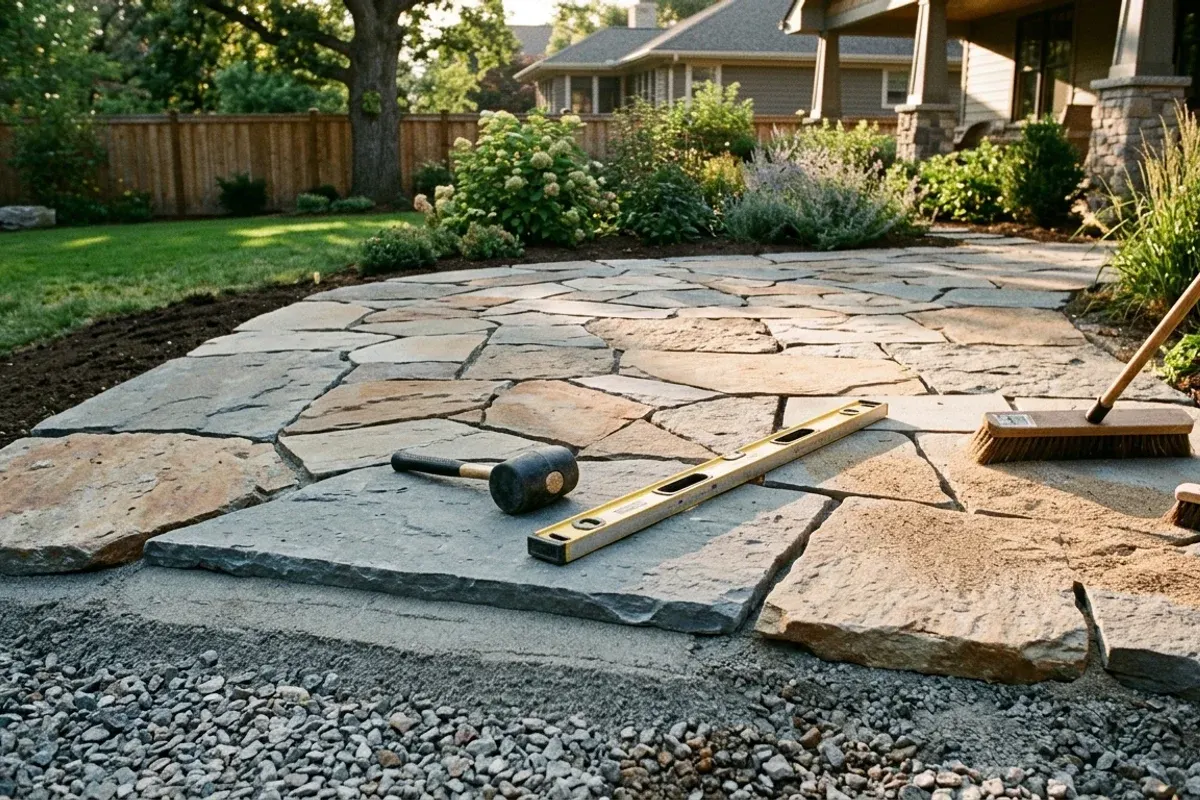
Then follow how to lay pavers for the full installation. If you are working with irregular natural stone slabs rather than dimensional pavers, see our step-by-step guide on how to build a dry-laid flagstone patio.
Complementary Patio & Landscape Structures
Once your paver foundation is compacted and set, consider functional backyard structures built on the same gravel base:
- Patio Screening: Add wind protection and sightline privacy with a freestanding DIY cedar privacy screen mounted securely to patio post brackets.
- Concealing Utility Carts: Build an attractive cedar trash and recycling bin enclosure installed over a matching crushed stone pad.
- Joint Stabilization: Learn how to lock joints permanently in our guide to applying polymeric sand on pavers.
Should you put sand or gravel under a concrete slab?
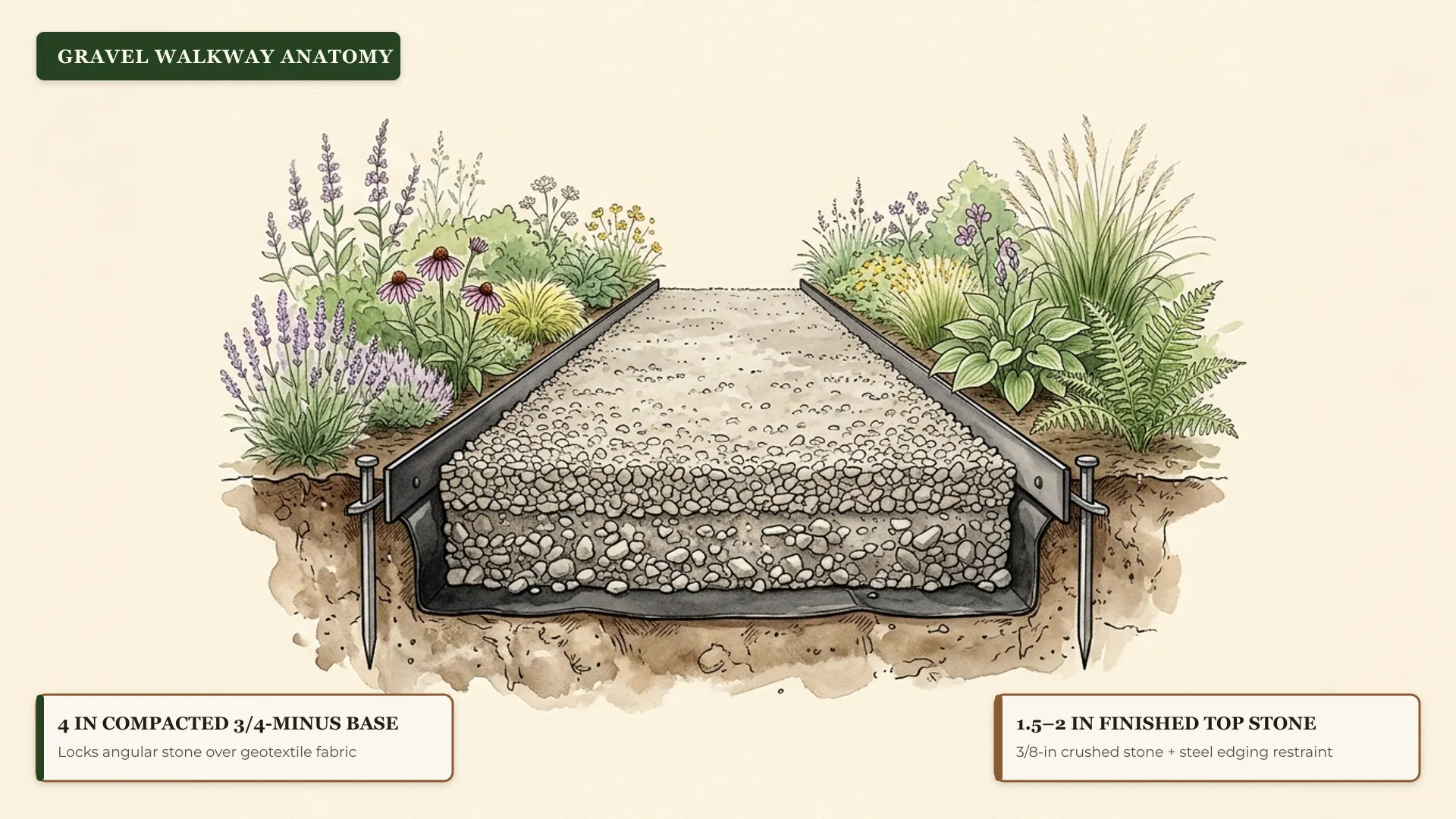
Concrete is a different job, but the answer leans the same way: gravel. For a patio, walkway or shed slab on grade, the common base is about 4 inches of compacted crushed gravel (the same 3/4-minus used under pavers) over compacted soil. It drains water away from the slab and gives even support.
- Sand alone is not a good base under concrete. It shifts and can wash out from the edges, leaving the slab unsupported.
- No bedding sand layer is needed. Concrete is poured directly on the compacted gravel; a thin skim of sand is sometimes used only to fill low spots in the gravel.
- Interior slabs (garage, basement, addition) also need a vapor retarder and must follow your local code. Ask the building department.
The Concrete Slab Calculator works out bags or yards of concrete and the gravel base together.
What about permeable pavers?
Permeable paver systems are different. They let rainwater soak through wide joints into a base of clean, open-graded stone with no fines, so the base can hold water. Don't mix the two systems: a dense-graded base with fines under permeable pavers stops the water from draining the way the system is designed to. Follow the paver maker's installation guide for those.
Sources: 10-Step Guide to Installing Pavers — OSU Extension, Guide Specification for the Construction of Interlocking Concrete Pavement (PAV-TEC-009) — CMHA, Why Stone Dust Doesn't Belong Under Pavers — Unilock.
FAQ
What are the exact layers that go under pavers?
From bottom to top: 1) Compacted native subsoil, 2) Geotextile fabric underlayment, 3) 4 to 6 inches of compacted crushed stone base (3/4-minus / crusher run), 4) Exactly 1 inch of uncompacted washed concrete sand (ASTM C33), 5) Interlocking concrete or brick pavers, and 6) Polymeric sand swept into the joints.
Can I use stone dust under pavers?
No. The Concrete Masonry & Hardscapes Association (CMHA) guide specification strictly prohibits stone dust or limestone screenings for bedding sand. Stone dust fines retain trapped water, drain poorly, and pump up through the joints during freeze-thaw cycles, causing pavers to sink. Always use coarse washed concrete sand (ASTM C33).
Can I put pavers on pea gravel?
No. Pea gravel consists of rounded, smooth stones that roll like ball bearings under weight and never lock together. A stable paver base requires angular crushed stone with mixed particle sizes down to stone dust (3/4-minus, crusher run, or dense grade aggregate).
Is all-purpose sand OK for under pavers?
Only if it is coarse, washed concrete sand meeting ASTM C33 standards. Fine play sand and masonry sand are too fine, hold excess water, and wash out into the underlying gravel base. Check our Sand Calculator for exact yardage.
Do I need both gravel and sand under pavers?
Yes. The 4 to 6 inches of compacted gravel carries the structural load and drains groundwater; the thin 1-inch sand layer provides a smooth screeded bed to seat pavers evenly. Pavers placed directly on rough gravel will rock and crack, while pavers laid on sand alone will rut and sink.
What is paver base made of?
Paver base is crushed, dense-graded angular stone ranging from 3/4-inch aggregate down to fine stone dust. It is sold regionally as 3/4-minus, crusher run, ABC stone, road base, #21A, or bagged paver base. This broad size gradation allows it to compact to 98% Standard Proctor density.
Should you put sand or gravel under a concrete slab?
Gravel. A 4-inch layer of compacted crushed stone is standard under concrete patios and shed slabs to provide uniform support and prevent frost heaving. Sand alone shifts and erodes from the slab edges.