How Deep to Dig for Pavers (+ Gravel & Sand Amounts)

By Rowan Plank · Published September 28, 2026
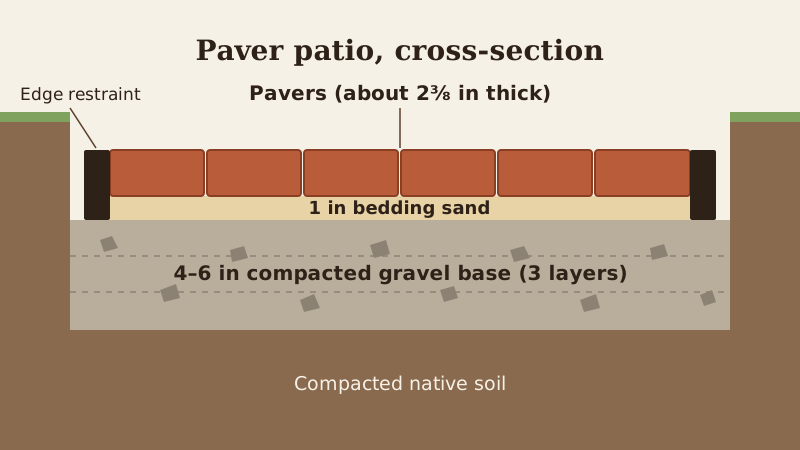
For a paver patio or walkway, dig about 7 to 10 inches deep: 4–6 in of compacted gravel base, 1 in of sand, and the thickness of the paver. With common 2⅜ in patio pavers on a 4 in base, that's 7⅜ in below the finished surface.
How deep to dig for each setup
Excavation depth = gravel base + sand + paver thickness.
| Base | Sand | Paver thickness | Dig this deep |
|---|---|---|---|
| 4 in | 1 in | 2⅜ in | 7⅜ in |
| 5 in | 1 in | 2⅜ in | 8⅜ in |
| 6 in | 1 in | 2⅜ in | 9⅜ in |
| 6 in | 1 in | 3⅛ in (80 mm, heavy-duty) | 10⅛ in |
Measure your actual paver before you dig — thickness varies by product. Also dig about 8 inches wider than the paved area on every side. Oregon State Extension recommends this so the base supports the edges and the edge restraint.
How thick should the gravel base be?
4 to 6 inches of crushed rock, per Oregon State Extension. Use 4 inches for a patio or walkway on firm, well-drained soil. Go to 6 inches, or more, on soft clay. Areas you'll drive on need a much thicker base; ask your supplier.
Use crushed gravel with mixed sizes and sharp edges, such as 3/4-minus or bagged "paver base." It packs into a solid layer. Round pea gravel rolls and never locks together. Spread it in three thinner layers and compact each one with a plate compactor.
How much gravel and sand do you need?
Per 100 sq ft of patio:
| Layer | Depth | Cubic feet | Cubic yards | Approx. weight |
|---|---|---|---|---|
| Gravel base | 4 in | 33.3 | 1.23 | 1.7 tons |
| Gravel base | 6 in | 50 | 1.85 | 2.6 tons |
| Bedding sand | 1 in | 8.3 | 0.31 | — |
Gravel weight uses 1.4 tons per cubic yard, a common estimate for crushed stone. Real weight varies by rock type, size and moisture, so check with your supplier. Add about 10% for compaction and uneven ground.
Example: a 10 × 16 ft patio (160 sq ft) on a 4 in base needs 160 × 4 ÷ 12 = 53.3 cu ft of gravel, which is 1.98 cubic yards (about 2.8 tons), plus 13.3 cu ft of sand (0.49 cubic yards). With 10% extra, order about 2.2 yards of gravel and 0.55 yards of sand.
Bags or bulk?
Bagged paver base usually comes in 0.5 cu ft bags. A 100 sq ft patio at 4 in needs about 67 of them, so for anything bigger than a small path, bulk gravel delivered by the yard is far less work.
Don't forget the slope
Plan for water to drain. Oregon State Extension recommends sloping the surface away from the house about 1 inch every 4 feet. Build the slope into the gravel base, not the sand, so the sand layer stays an even inch everywhere. On a 16 ft patio, the far edge sits 4 inches lower than the house side.
Use the Paver Path Calculator to get pavers, gravel and sand for your exact size, or the Gravel Calculator for base gravel alone. Then follow the full steps in how to lay pavers.
Sources: 10-Step Guide to Installing Pavers — OSU Extension.
FAQ
How deep should a paver base be for a patio?
4 to 6 inches of compacted crushed gravel. Use 4 inches over firm, well-drained soil and go thicker on soft clay. Areas you'll drive on need a much thicker base — ask your supplier.
How much sand goes under pavers?
1 inch, screeded flat. Spread it 1 to 1½ in thick and pull a straight board across 1-inch pipe rails to level it. Too much sand lets pavers shift and sink.
How many tons of gravel do I need for a paver patio?
For 100 sq ft at 4 in deep, you need about 1.23 cubic yards, roughly 1.7 tons at 1.4 tons per yard. Gravel weight varies by type, so confirm the tons-per-yard figure with your supplier.
Do I need landscape fabric under a paver base?
It helps on clay or silty soil, where it keeps the gravel from mixing into the soil below. Lay a woven geotextile on the compacted soil before the gravel.