How Much Paver Base Do I Need? Depth & Compaction Guide

By Efraín Vega · Published November 10, 2026
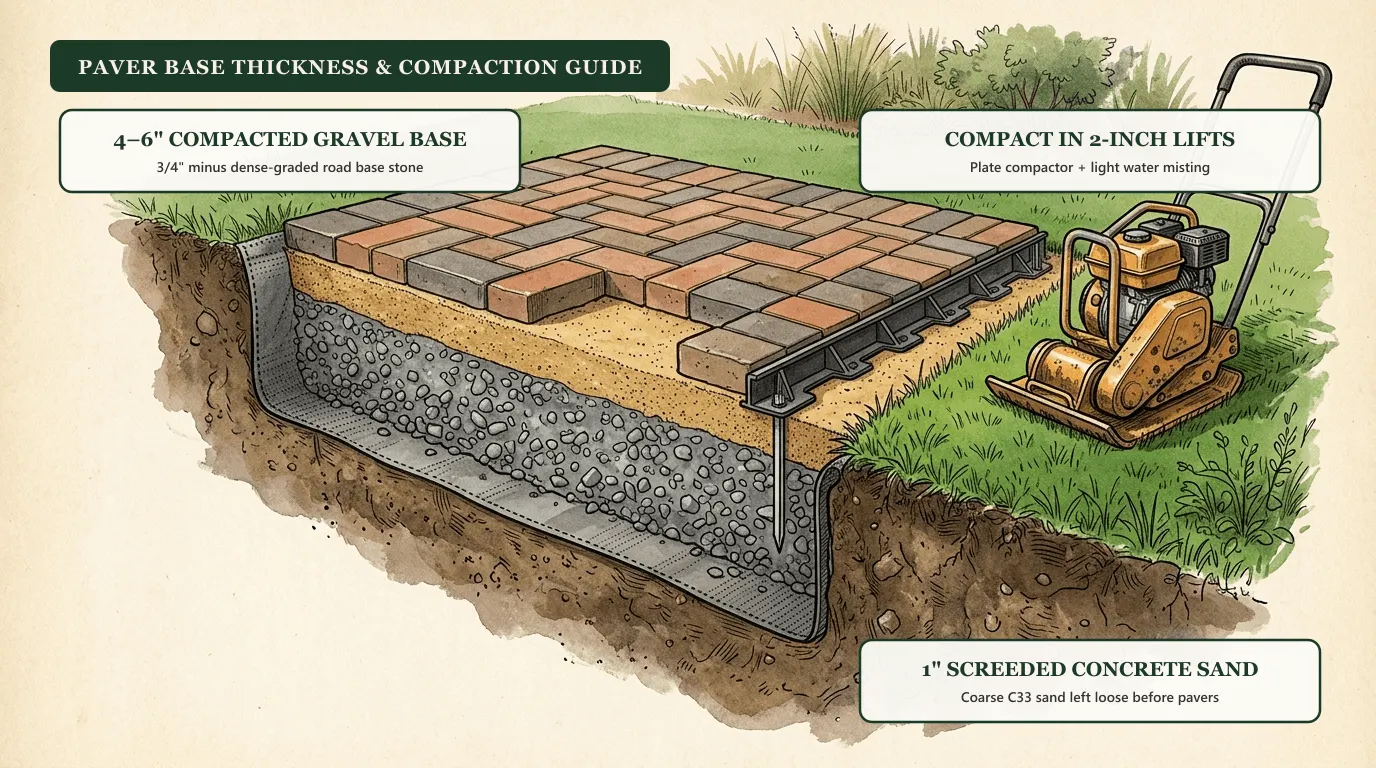
The secret to a paver patio that never settles, sinks, or heaves over winter is the paver base foundation. A standard backyard patio requires 4 to 6 inches of compacted crushed stone over firm soil, followed by 1 inch of washed concrete bedding sand.
Because crushed gravel compacts significantly under mechanical vibration, estimating material requires calculating both the over-dig footprint and a 15% to 20% compaction factor.
How deep should you install paver base?
Base depth is dictated by soil type and the weight the surface must carry:
| Project Type | Subsoil Condition | Compacted Gravel Base | Bedding Sand | Total Excavation Depth |
|---|---|---|---|---|
| Garden Walkway | Well-drained sandy/loam | 4 inches | 1 inch | 7–8 inches |
| Backyard Patio | Standard firm soil | 4 to 6 inches | 1 inch | 8–10 inches |
| Patio / Hot Tub Pad | Heavy wet clay / frost zone | 6 to 8 inches | 1 inch | 10–12 inches |
| Paver Driveway | Vehicle traffic rating | 8 to 12 inches | 1 inch | 12–16 inches |
Note: Total excavation accounts for gravel base + 1 inch sand + standard 2-3/8 inch (60mm) paver thickness.
How to calculate paver base volume and weight
The base gravel must extend 6 to 8 inches beyond the paver perimeter on all open sides. This extension prevents the edge restraints and outer pavers from tipping into surrounding turf.
Formula with 20% Compaction:
[Base Area (sq ft) × Base Depth (ft) ÷ 27] × 1.20 = Required Cubic Yards
Multiply cubic yards by 1.4 tons/yd³ for bulk weight.
| Patio Dimensions | Base Area (with 6" overhang) | 4-Inch Base (Tons) | 6-Inch Base (Tons) |
|---|---|---|---|
| 8 × 10 ft | 9 × 11 ft (99 sq ft) | 1.73 tons (1.23 yd³) | 2.60 tons (1.85 yd³) |
| 10 × 10 ft | 11 × 11 ft (121 sq ft) | 2.11 tons (1.51 yd³) | 3.17 tons (2.26 yd³) |
| 12 × 12 ft | 13 × 13 ft (169 sq ft) | 2.95 tons (2.11 yd³) | 4.43 tons (3.16 yd³) |
| 12 × 16 ft | 13 × 17 ft (221 sq ft) | 3.86 tons (2.76 yd³) | 5.79 tons (4.14 yd³) |
| 16 × 20 ft | 17 × 21 ft (357 sq ft) | 6.23 tons (4.45 yd³) | 9.35 tons (6.68 yd³) |
For an instant takeoff of pavers, edge spikes, bedding sand, and gravel base, use our interactive Paver Path & Patio Calculator.
Step-by-step compaction rules that prevent sinking
Laying gravel without proper compaction is the #1 reason patios develop puddles and wobbling pavers.
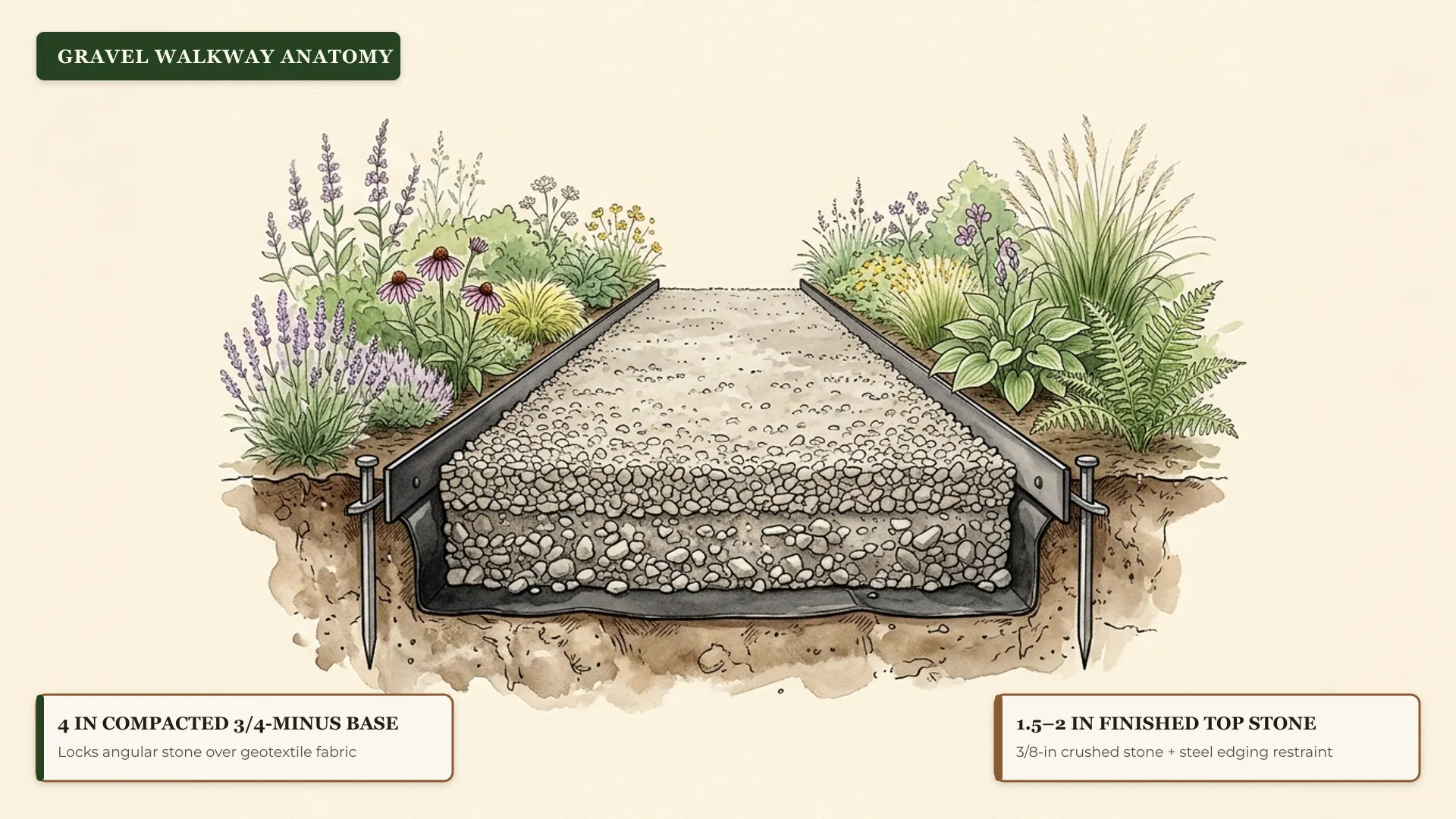
- Expose and Tamp Subgrade: Excavate sod and dark topsoil down to undisturbed mineral subsoil. Run a vibrating plate compactor over the bare soil; soft spots must be dug out and backfilled with stone.
- Lay Geotextile Fabric: Cover the bottom and sides of the trench with woven or heavy non-woven geotextile fabric. This prevents subsoil clay from migrating up into the gravel base under rain pressure.
- Compact in 2-Inch Lifts: Never dump 6 inches of gravel into the trench and try to tamp it at once. Spread 2 inches of loose gravel, lightly spray it with a garden hose (moisture lubricates particles so they interlock tightly), and make 3 to 4 overlapping passes with the plate compactor until it rings hard. Repeat for each lift.
- Pitch the Base for Drainage: Maintain a 1/4-inch drop per linear foot (1% to 2% slope) away from the home foundation on both the subgrade and the gravel base.
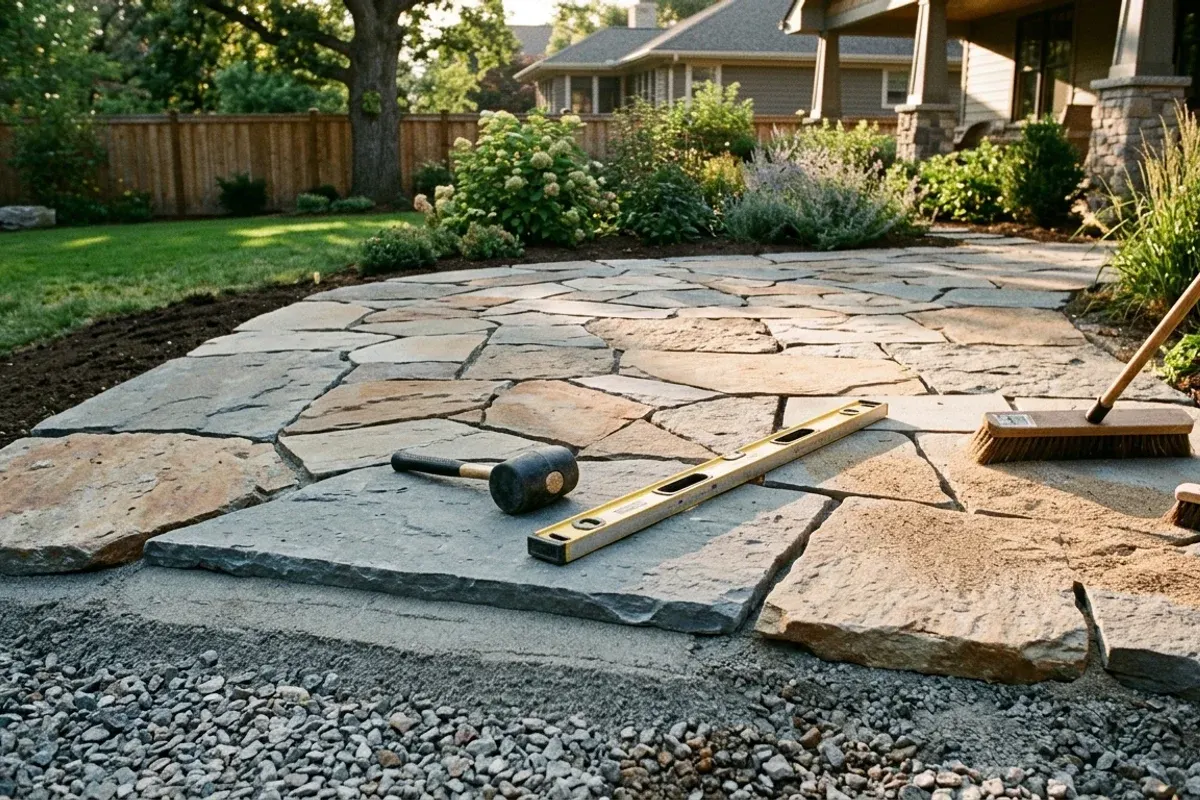
- Screed Sand Uncompacted: Never compact the 1-inch bedding sand layer before placing pavers. Screed coarse concrete sand (ASTM C33) flat using 1-inch PVC electrical conduit pipes as guide rails. Pavers are set directly on the loose sand, then compacted once whole.
Bagged vs Bulk Paver Base
Bagged paver base (0.5 cu ft bags) costs roughly $4 to $5 per bag, which equals over $210 per cubic yard. If your project needs more than 1 cubic yard (approx 54 bags or 1.4 tons), order bulk delivery from a local landscape supply quarry to save 60% to 70% on material costs.
Sources: Interlocking Concrete Pavement Institute (ICPI) Tech Spec 2, Construction of Interlocking Concrete Pavements; ASTM D2940 (Graded Aggregate Material for Bases).
FAQ
How deep should paver base gravel be?
For pedestrian walkways and backyard patios on normal soil, use 4 to 6 inches of compacted crushed stone base. For vehicular driveways, heavy hot tubs, or soft wet clay subsoil, increase the base to 8 to 12 inches.
How much does paver base compact?
Dense-graded crushed aggregate (like 3/4-minus or road base) compacts by approximately 15% to 20% in volume when tamped. Always add a 20% compaction and over-excavation allowance to your raw gravel calculation.
How many inches of gravel for a 10x10 paver patio?
A 10×10 patio (100 sq ft) needs a 4-inch compacted gravel base over an excavated area of roughly 11×11 ft (to support edge restraints). That equals 1.5 cubic yards or approximately 2.1 tons of dense-graded stone.
Can you compact 6 inches of gravel all at once?
No. Gas plate compactors and hand tamps can only effectively compress 2 to 3 inches of gravel per pass. Lay the gravel in two or three separate 2-inch 'lifts', lightly misting each with water before running the compactor.
What is the difference between paver base and bedding sand?
Paver base is 4 to 6 inches of compacted angular crushed stone (3/4-inch down to rock dust) providing structural foundation. Bedding sand is a 1-inch uncompacted layer of coarse washed concrete sand screeded flat on top of the base to bed the pavers.