How to Build a Gravel Walkway: Depth, Base & Edging Guide

By Efraín Vega · Published November 16, 2026
A loose gravel path thrown directly onto grass will turn into a sunken, weed-choked mud pit within two rainy seasons.
Building a gravel walkway that stays firm, crisp, and weed-free for decades requires three structural layers: a compacted native subgrade with geotextile fabric, a dense-grade aggregate base, and a well-contained surface stone layer.
Anatomy of a Long-Lasting Gravel Walkway
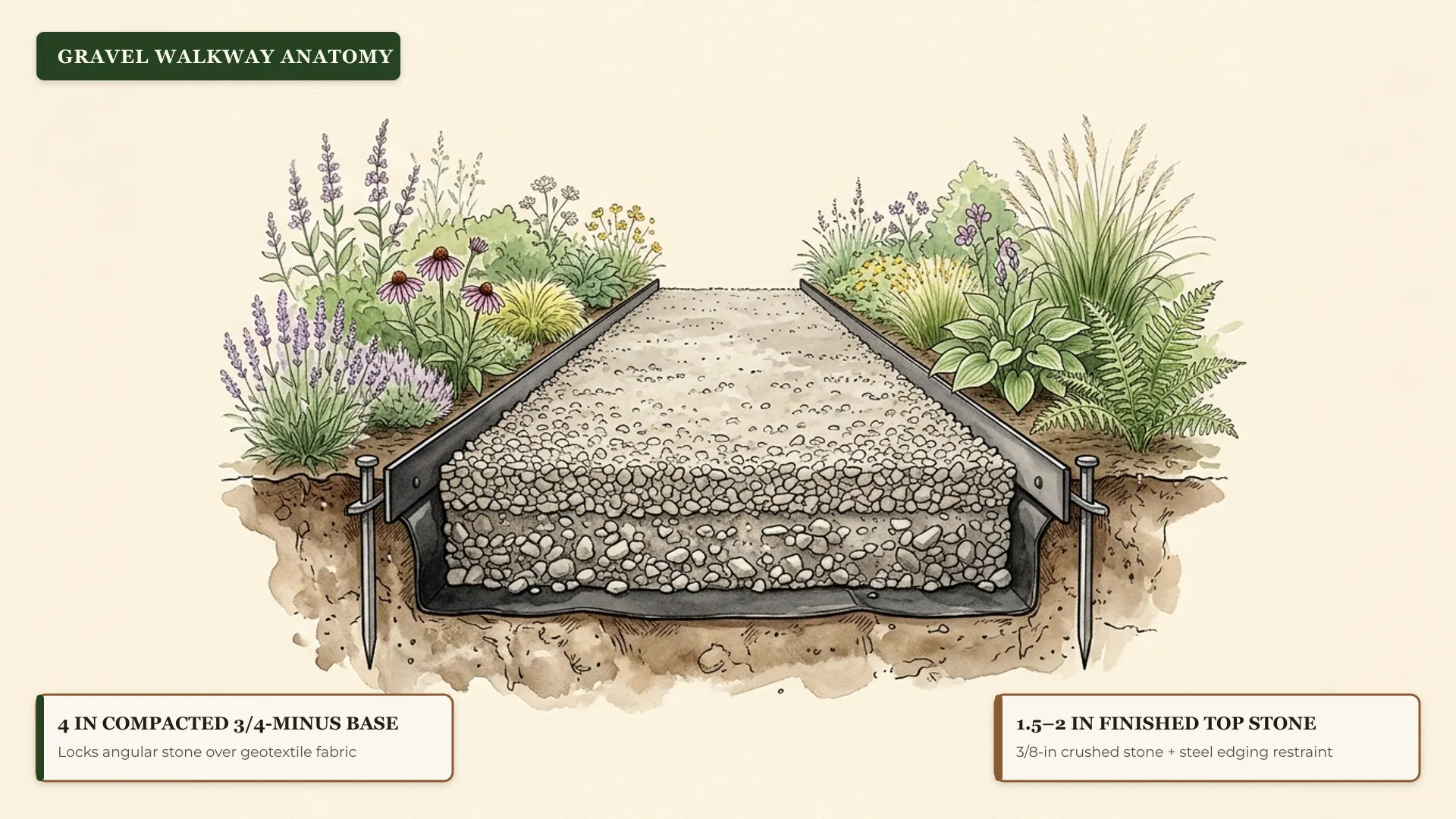
A professional-grade garden walkway consists of three stratified zones:
- Native Subgrade & Fabric: Excavated 5 to 6 inches below adjacent turf, graded with a subtle 1% crown or cross-slope for drainage, and lined with non-woven geotextile fabric.
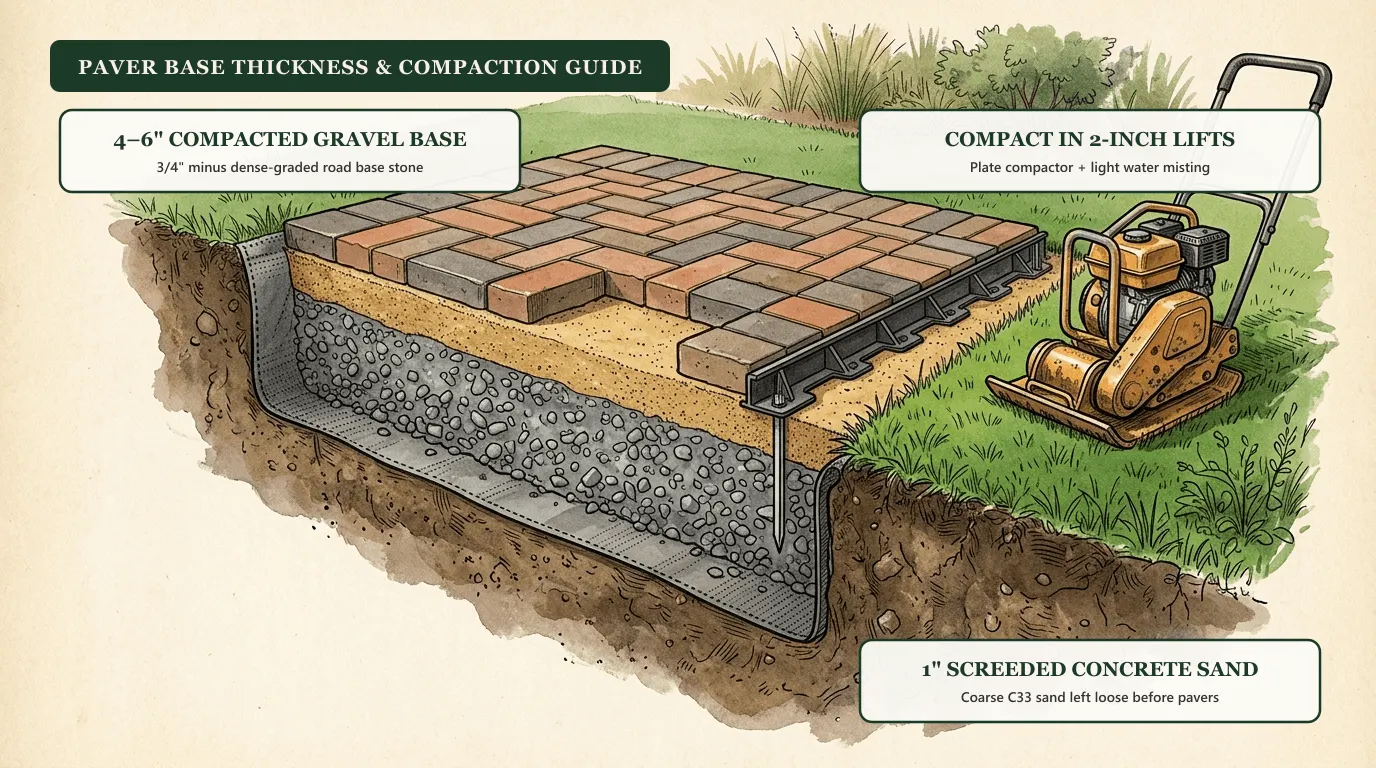
- Compacted Base (3–4 inches): Dense-grade aggregate (#21A, crusher run, or 3/4-inch road base) compacted in 2-inch lifts with a vibrating plate compactor or hand tamper.
- Surface Gravel (1.5–2 inches): Clean angular crushed stone (3/8-inch chips, decomposed granite, or slate chips) contained securely by landscape edging.
Step-by-Step Construction Guide
Step 1: Layout and Excavation
- Mark both sides of the walkway with marking paint or stakes and mason's string. Standard comfortable path widths:
- Single walker: 30 to 36 inches (2.5 to 3.0 ft).
- Two people walking abreast / wheelbarrow access: 42 to 48 inches (3.5 to 4.0 ft).
- Excavate soil to a uniform depth of 5 to 6 inches below adjacent lawn height.
- Tamp the excavated dirt firmly with a hand tamper to eliminate air pockets.
Step 2: Install Landscape Edging
Edging is non-negotiable for gravel paths. Without rigid containment, surface stones migrate into the lawn, where lawn mower blades will launch them as dangerous projectiles.
- Steel or Heavy Aluminum Edging: Best for crisp modern curves; secure with 12-inch twisted steel stakes driven at 24-inch intervals.
- Pressure-Treated 4×4 Timbers: Best for straight borders or rustic aesthetics; pin to the ground using 1/2-inch rebar spikes driven through pre-drilled holes.
- Set the top lip of the edging 1/2 inch above the finished gravel line to catch stray stones.
Step 3: Lay Geotextile Underlayment
Roll out a heavy-duty, 4 to 6 oz non-woven geotextile fabric along the trench.
- Overlap seams by at least 12 inches in the direction of natural slope.
- Extend the fabric up the sides of the trench against the edging.
- Pin in place using 6-inch steel landscape staples every 3 to 4 feet.
Step 4: Install and Compact the Base Layer
Shovel in 3 to 4 inches of crusher run / #21A road base:
- Spread evenly using a bow rake.
- Mist lightly with water from a garden hose (moisture lubricates the stone dust particles, allowing maximum interlock).
- Compact thoroughly with a plate compactor or 8×8-inch hand tamper until the surface is rock-hard and does not yield under a boot heel.
Step 5: Spread the Surface Gravel
Spread a clean 1.5 to 2-inch layer of decorative stone:
- Do not exceed 2.5 inches: If surface gravel is too deep, feet will sink into it like beach sand.
- Rake smooth with a flat landscape lute or leaf rake.
- Run a light lawn roller or hand tamp the surface stone to lock angular chips together.
Gravel Sizing & Selection Guide
| Stone Variety | Size | Texture & Feel | Best For | Stability Rating |
|---|---|---|---|---|
| Crushed Bluestone / Granite | 3/8" clean | Angular, crisp, interlocking | Main walkways & patio paths | Excellent (Locks firmly) |
| Decomposed Granite (DG) | 1/4" minus with fines | Dense, pavement-like | Wheelchair & cart access | Maximum (Packs hard) |
| Pea Gravel (River Rock) | 3/8" rounded | Smooth, rounded pebbles | Barefoot garden accents | Low (Rolls and shifts) |
| Slate Chips | 1/2" to 1" flat | Flat, dark rustic flakes | Forest trails & shaded beds | Good (Lies flat) |
Material Formula for Any Path Size
To calculate the gravel and base needed for your project:
Volume (cu yd) = Length (ft) × Width (ft) × Depth (ft) ÷ 27 × 1.10 (margin)
Weight (tons) = Volume (cu yd) × 1.4 tons/yd³
Use our interactive Gravel Calculator to get instant tonnages, yardages, and retail bag counts for your exact walkway dimensions. Want to frame your walkway entrance with a stunning timber focal point? Pair your crushed stone path with our woodworking plans for a DIY Cedar Walkthrough Garden Arbor.
FAQ
How deep should a gravel walkway be?
A durable gravel walkway requires an excavated depth of 5 to 6 inches: 3 to 4 inches of dense-grade compacted road base (#21A or crusher run) and 1.5 to 2 inches of decorative surface gravel. Digging less than 4 inches leads to gravel sinking into the mud and weeds pushing through.
What is the best gravel for a garden path?
Self-binding crushed stone chips (3/8-inch minus with stone dust) or clean 3/8-inch angular crushed gravel (such as crushed granite or bluestone). Avoid round pea gravel if you want a firm, stable walking surface, as rounded stones roll beneath footsteps like marbles.
Do I need landscape fabric under a gravel path?
Yes. Install heavy-duty non-woven geotextile fabric directly on top of the excavated soil subgrade before spreading your aggregate base. Fabric prevents the crushed rock from sinking into the subsoil over time and stops burrowing weeds, while allowing surface water to drain freely.
How much gravel do I need for a 3x30 ft walkway?
A 3×30 ft walkway (90 sq ft) with a 2-inch surface gravel layer requires approximately 0.61 cubic yards (0.86 tons) of stone. For the 4-inch base layer underneath, you need 1.22 cubic yards (1.71 tons) of crushed run aggregate.