How Much Gravel and Sand for a Paver Patio (10x10, 12x12 & More)

By Efraín Vega · Published October 28, 2026
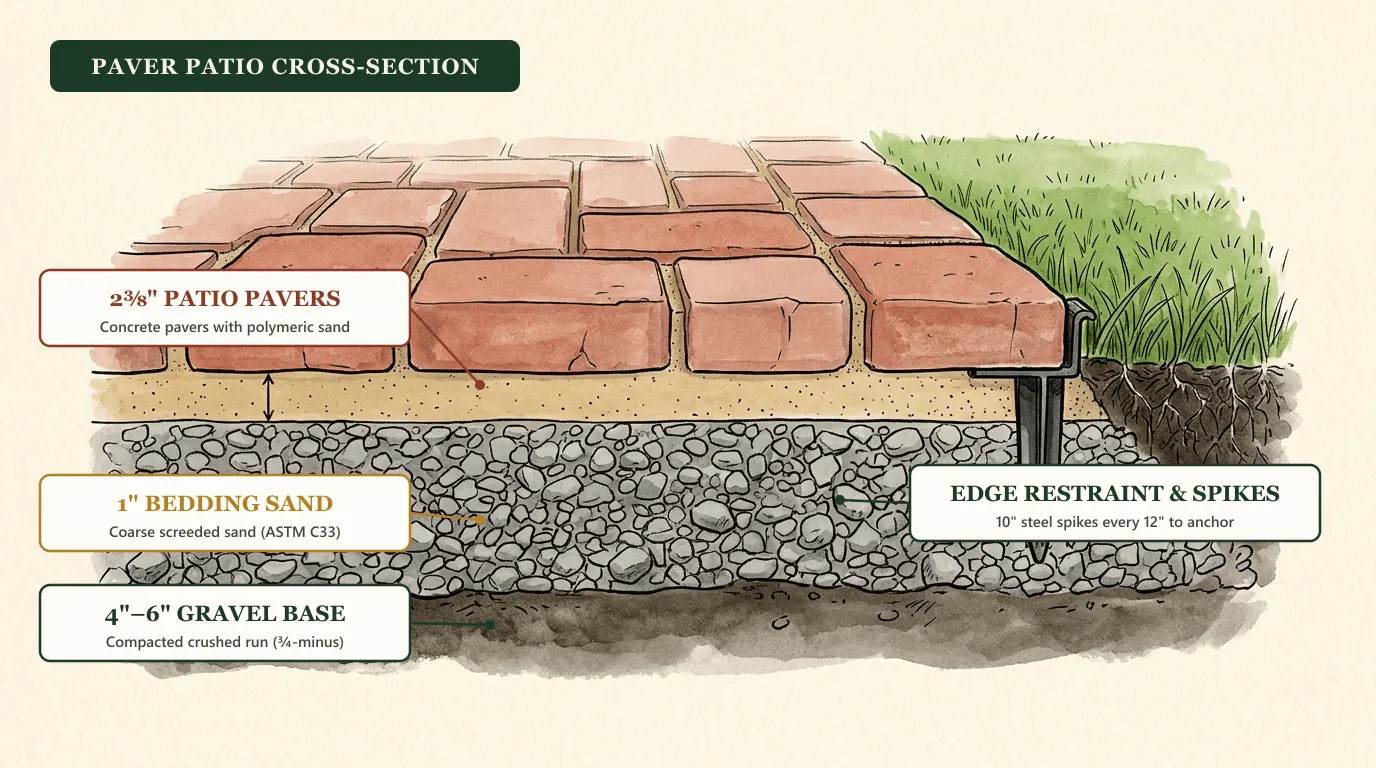
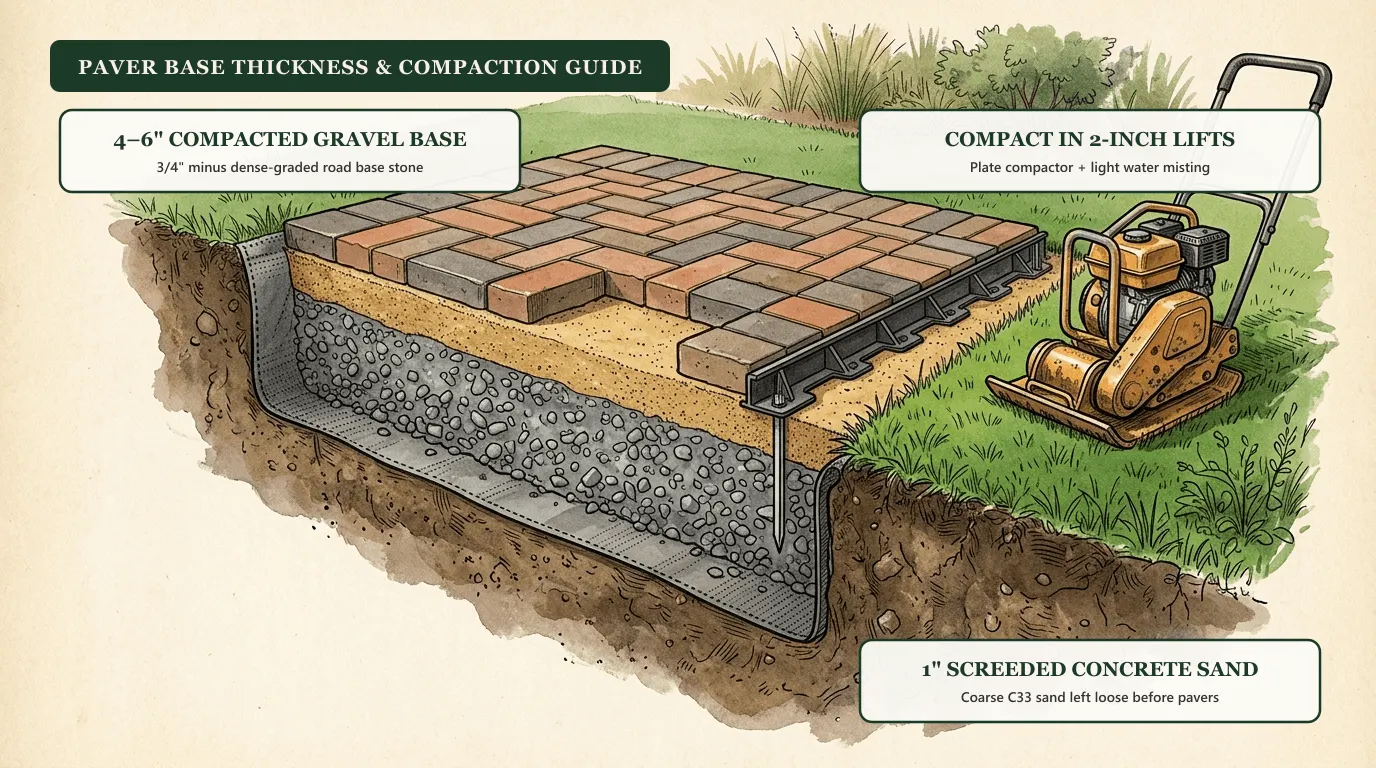
For a standard 10×10 foot paver patio (100 sq ft) with a 4-inch gravel base and a 1-inch sand bedding layer, you need 2.2 tons (1.5 cubic yards) of crushed gravel base and 0.5 tons (10 fifty-lb bags) of coarse concrete sand.
Because the gravel base must extend 6 inches past the paver edge on all sides to support edge restraints, a 10×10 foot patio actually requires preparing an 11×11 foot excavation area (121 sq ft).
How much gravel and sand do you need for a 10×10 paver patio?
For a standard 10×10 foot paver patio (100 sq ft) with a 4-inch base and 1-inch sand bed, you need 2.2 tons (1.5 cubic yards) of crushed stone base and 0.5 tons (10 fifty-lb bags) of bedding sand. This accounts for a mandatory 6-inch border overhang (11×11 ft excavation) to anchor edge restraints.
| Patio dimensions | Surface area | Base excavation (with 6" overhang) | Crushed stone base (4" depth) | Bedding sand (1" depth) |
|---|---|---|---|---|
| 8 × 10 ft | 80 sq ft | 9 × 11 ft (99 sq ft) | 1.8 tons (1.2 yd³) | 0.4 tons (8 bags) |
| 10 × 10 ft | 100 sq ft | 11 × 11 ft (121 sq ft) | 2.2 tons (1.5 yd³) | 0.5 tons (10 bags) |
| 10 × 12 ft | 120 sq ft | 11 × 13 ft (143 sq ft) | 2.6 tons (1.8 yd³) | 0.6 tons (12 bags) |
| 12 × 12 ft | 144 sq ft | 13 × 13 ft (169 sq ft) | 3.1 tons (2.2 yd³) | 0.7 tons (14 bags) |
| 12 × 16 ft | 192 sq ft | 13 × 17 ft (221 sq ft) | 4.0 tons (2.8 yd³) | 1.0 ton (19 bags) |
| 16 × 20 ft | 320 sq ft | 17 × 21 ft (357 sq ft) | 6.8 tons (4.9 yd³) | 1.5 tons (30 bags) |
To customize your project dimensions, calculate exact counts with our Paver Path Calculator and check tonnage in our Gravel Calculator.
The 6-inch overhang rule
The most common installation mistake that causes paver edges to sink and separate is digging the base trench to the exact finished dimensions of the pavers.
When you nail plastic or aluminum snap edge restraints into the ground, the spikes must drive into compacted crushed stone, not loose topsoil. If the base ends flush with the pavers, edge spikes fail, joint sand washes away, and perimeter pavers roll outward within two seasons.
Always add 1 foot to both total width and length when excavating:
- A 10×10 ft paver area needs an 11×11 ft base trench.
- A 12×16 ft paver area needs a 13×17 ft base trench.
Selecting the right materials
Using the wrong grade of gravel or sand under pavers leads to spongy patios, rutting, and standing puddles:
1. The Base: Crushed Run / 3/4-Minus Stone
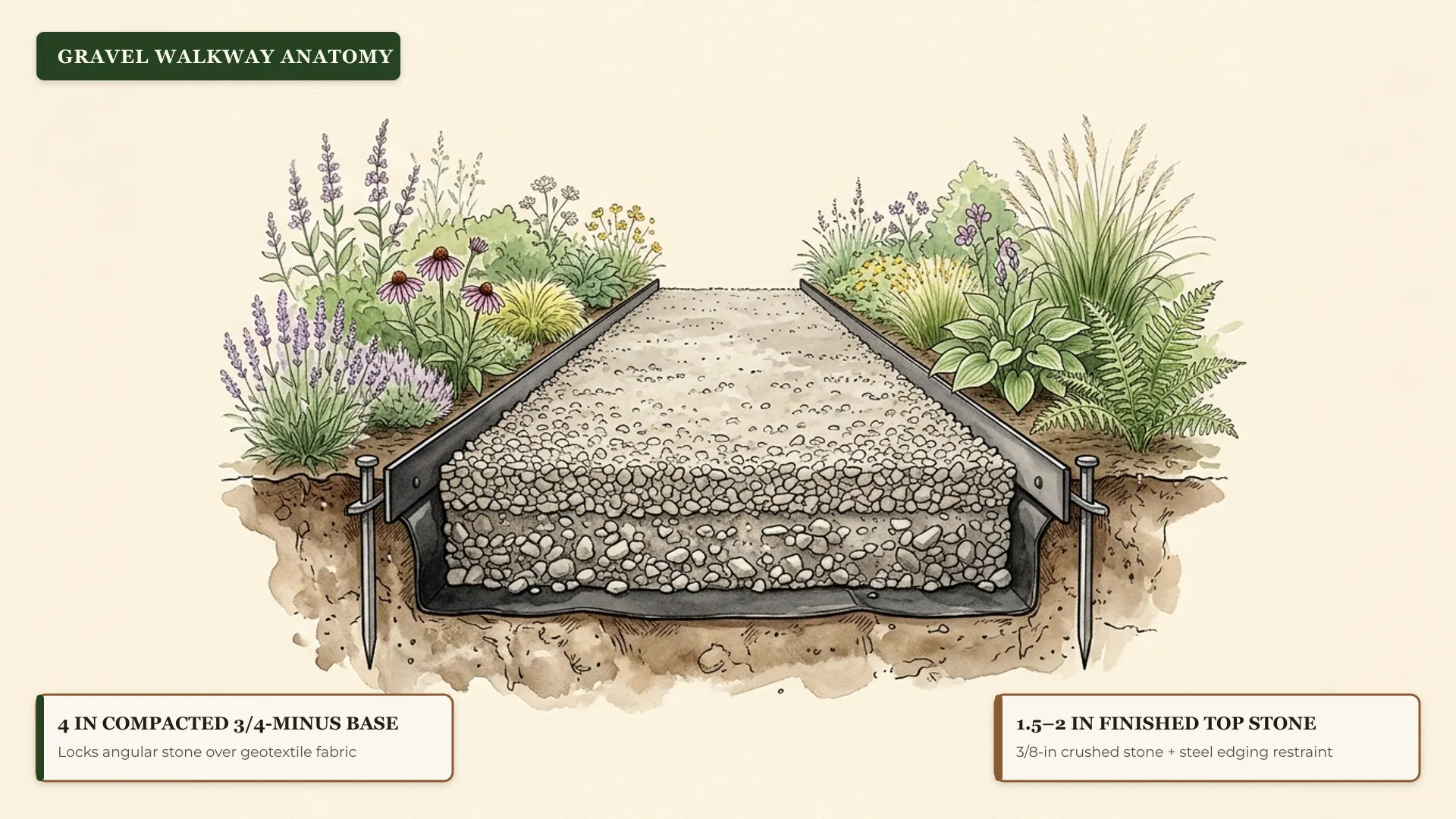
Use crushed limestone, granite, or basalt containing a balanced blend of 3/4-inch angular stones down to fine stone dust (often sold as 3/4-minus, crusher run, ABC stone, or dense grade).
- Why it works: When tamped with a plate compactor, the fine dust particles lock the larger angular stones together, creating a nearly impermeable, rock-solid sub-slab that will not settle under foot traffic.
2. The Bedding Layer: Coarse Washed Concrete Sand (ASTM C33)
Spread an uncompacted, uniform 1-inch layer of coarse concrete sand directly on top of your compacted gravel base. Screed it smooth with 1-inch electrical conduit pipes and a 2×4 straightedge.
- Never use masonry sand: Mortar and masonry sands are rounded and ultra-fine. They retain moisture, squish out from between the joints, and turn into mud during wet winters.
Compact gravel in 2-inch lifts
Do not pour 4 inches of gravel and try to compact it all at once with a hand tamper. Rent a motorized vibrating plate compactor ($60–$80/day). Spread 2 inches of gravel, wet it down lightly with a garden hose, and make 3 to 4 passes with the compactor before adding the final 2-inch layer.
Calculating tons vs. cubic yards
Landscape quarries and material supply yards sell aggregate by the ton rather than cubic yards.
- Crushed stone gravel density: Approximately 1.4 tons per cubic yard (or roughly 100–105 lbs per cubic foot).
- Washed concrete sand density: Approximately 1.35 tons per cubic yard (or roughly 95–100 lbs per cubic foot).
When placing your order, always round up your total by 10% to account for compaction shrinkage and wheelbarrow spillage during transport.
FAQ
How much gravel do I need for a 10x10 paver patio?
For a 10x10 patio (100 sq ft) with a standard 4-inch base, you need 1.5 cubic yards (approximately 2.2 tons) of crushed stone (3/4-minus / crusher run), accounting for extending the base 6 inches beyond the paver edge.
How much sand do I need for a 10x10 paver patio?
A 1-inch bedding sand layer across 100 square feet requires about 0.35 cubic yards (roughly 0.5 tons, or ten 50-lb bags) of coarse washed concrete sand.
What kind of sand goes under pavers?
Always use coarse, washed concrete sand (ASTM C33). Never use masonry sand, play sand, or limestone screenings as a bedding layer—fine sands wash away with water and cause uneven settling.
How deep should the gravel base be under pavers?
A pedestrian walkway or patio on firm soil needs a minimum of 4 inches of compacted gravel. On poorly draining clay soil or in severe freeze-thaw regions, increase base depth to 6 inches.