How Much Gravel for a Shed Foundation? Depth, Border & Tons

By Efraín Vega · Published October 28, 2026
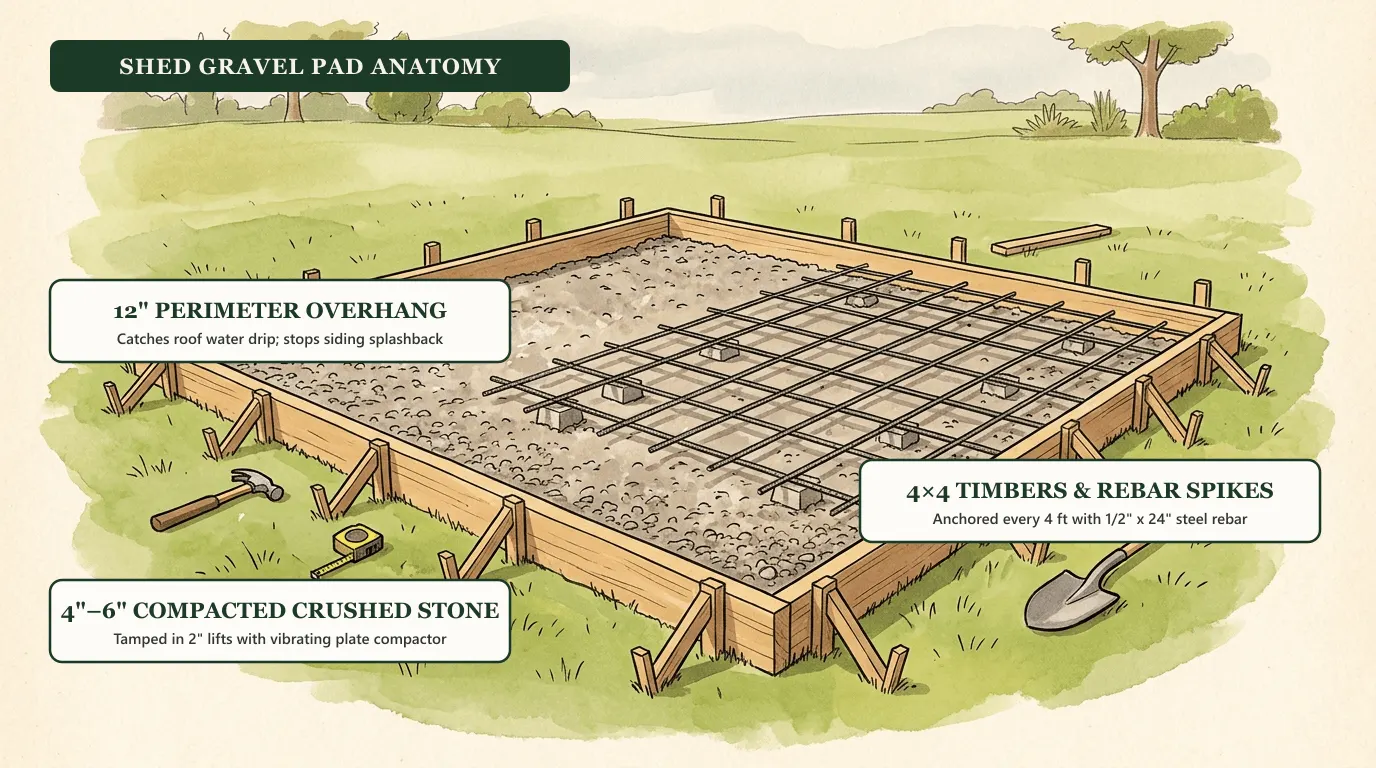
A standard 10×12-foot storage shed needs a 12×14-foot gravel pad—extending 12 inches beyond the walls on all sides—which requires 3.2 tons (2.3 cubic yards) of compacted crushed stone and 7 eight-foot pressure-treated 4×4 timbers for the perimeter box.
Building a crushed gravel pad is the single most cost-effective, rot-resistant foundation for a backyard shed. Unlike bare ground or concrete patio blocks that sink unevenly over winter, a compacted stone pad distributes weight across hundreds of square feet and allows rainwater to drain freely away from wooden floor joists.
Gravel (tons)
3.2 t
Volume (yd³)
2.29 yd³
Pad size
12' × 14'
- 3.2 tons
Crushed stone (#57 or ¾-minus)
≈ 2.29 yd³ (61.6 ft³)
- 7 pieces
4x4 Ground contact timbers (8 ft)
52 linear ft perimeter
- 17 stakes
1/2" × 24" Steel rebar stakes
Anchors timbers into ground every 4 ft
- 193.2 sq ft
Heavy-duty woven geotextile
Subgrade separation fabric (+15% overlap)
Bagged and bulk options are alternatives — the total uses the cheapest one you price.
How much gravel do you need for a shed foundation? (Size Chart)
For a standard 4-inch deep foundation with a 12-inch border overhang, an 8×10 shed needs 1.63 cubic yards (2.28 tons) of gravel, a 10×12 shed needs 2.29 cubic yards (3.20 tons), and a 12×16 shed needs 3.42 cubic yards (4.79 tons) of crushed stone, including a 10% compaction buffer.
All calculations include a 12-inch perimeter overhang on all four sides and a 10% compaction allowance (crushed stone compacts by roughly 10–15% under a vibrating plate compactor):
| Shed Size | Pad Footprint (12" Overhang) | Pad Area | Gravel Volume | Gravel Weight | 4×4 Timbers (8 ft) |
|---|---|---|---|---|---|
| 8×8 ft | 10×10 ft | 100 sq ft | 1.36 yd³ | 1.91 tons | 5 pcs |
| 8×10 ft (Takeoff) | 10×12 ft | 120 sq ft | 1.63 yd³ | 2.28 tons | 6 pcs |
| 10×10 ft (Takeoff) | 12×12 ft | 144 sq ft | 1.96 yd³ | 2.74 tons | 6 pcs |
| 10×12 ft (Takeoff) | 12×14 ft | 168 sq ft | 2.29 yd³ | 3.20 tons | 7 pcs |
| 10×16 ft (Takeoff) | 12×18 ft | 216 sq ft | 2.93 yd³ | 4.11 tons | 8 pcs |
| 12×16 ft (Takeoff) | 14×18 ft | 252 sq ft | 3.42 yd³ | 4.79 tons | 8 pcs |
| 12×20 ft | 14×22 ft | 308 sq ft | 4.18 yd³ | 5.85 tons | 9 pcs |
Note: 1 cubic yard of compacted crushed stone equals approximately 1.4 tons (2,800 lbs).
Why You Need a 1-Foot Border Overhang
The most common DIY mistake when prepping a shed base is digging the pad to the exact dimensions of the shed (e.g., digging a 10×12 ft hole for a 10×12 ft shed).
Adding a 12-inch gravel border around the entire perimeter accomplishes three critical goals:
- Roof Runoff Absorption: Shed roofs rarely have gutters. Rain cascades off the eaves directly onto the ground. An extended gravel apron absorbs cascading water and prevents muddy trench erosion beneath the walls.
- Eliminates Muddy Splashback: Splashing mud against the bottom 6 inches of T1-11 or wood siding causes premature rot, paint peeling, and termite attraction.
- Runner Placement Margin: Factory-built sheds delivered on trailers require room for error when lowering skids onto the pad.
What Type of Gravel Goes Under a Shed?
Not all gravel behaves the same under load:
- ¾-Inch Minus (Crusher Run / Quarry Process): The gold standard for flat shed pads. It contains angular ¾-inch stones mixed with fine rock dust. When vibrated with a mechanical plate compactor, the dust fills the voids between stones, locking the pad into an impenetrable, concrete-like slab.
- Clean #57 Stone (¾" Washed Gravel): Contains uniform stones with zero fines. It does not pack into a solid mass like crusher run, but it provides unmatched vertical drainage. Best for sites with heavy standing water or clay subgrades.
- Never Use Pea Gravel or Round River Rock: Round stones act like ball bearings under pressure. When the heavy skids of a shed bear down, rounded rock shifts sideways, causing the shed to tip out of level.
How to Build a Timber-Framed Shed Pad in 5 Steps
1. Mark and Level the Perimeter
Drive stakes at the four corners of your oversized pad. Run high-visibility nylon mason's line between stakes and check square using the 3-4-5 rule (measure 3 ft along one side, 4 ft along the other; the diagonal between them must equal exactly 5 ft).
2. Excavate to Level Subgrade
Dig out topsoil until you reach firm, unyielding native subsoil (typically 4 to 6 inches deep on the high side of the yard). Remove all roots and sod. Use a 4-foot carpenter's level across straight 2×4 screed rails to verify the excavated floor is level within ¼ inch.
3. Lay Woven Geotextile Fabric
Roll heavy-duty woven geotextile fabric (minimum 4 to 6 oz rating) across the entire excavated floor. Overlap all seams by at least 12 inches and run the fabric up the sides of the trench.
Do not skip the geotextile membrane
Without separation fabric, heavy crushed stone slowly sinks into wet subgrade clay over 2 to 3 winters. Once stone mixes with native soil, the shed loses level and door frames bind.
4. Build and Anchor the 4×4 Timber Box
Construct a perimeter retaining curb using ground-contact rated pressure-treated 4×4 or 6×6 timbers:
- Fasten corner overlapping joints with 6-inch exterior structural timber screws.
- Drill ½-inch holes vertically through the timbers every 4 feet.
- Drive ½-inch × 24-inch steel rebar stakes through the timbers deep into native ground to permanently lock the frame against frost heave.
5. Pour and Compact Gravel in 2-Inch Lifts
Spread your crushed stone in even 2-inch layers. Rent a vibrating plate compactor and make 3 to 4 overlapping passes across each lift, lightly misting the stone with a garden hose to lubricate the stone dust for maximum compaction density. Finish flush with the top of the timber frame.
Sources: Penn State Extension: Agricultural & Backyard Structures, USDA Forest Service: Aggregate Surfacing Guidelines.
FAQ
How much gravel do I need for a 10x12 shed?
A 10×12 ft shed requires a 12×14 ft gravel pad (allowing 12 inches of border overhang on all sides). At 4 inches deep with a 10% compaction factor, you need approximately 2.3 cubic yards or 3.2 tons of crushed stone.
What is the best gravel for a shed foundation?
Crusher run (also called 3/4-minus, dense grade, or quarry process) is best because it contains a blend of sharp crushed stone and stone dust that compacts into a rock-solid, concrete-like surface. For areas with severe water pooling, clean #57 stone provides maximum drainage.
How deep should a gravel shed pad be?
4 inches is standard for small garden and storage sheds up to 10×12 ft. For larger workshops (12×16 ft or larger) or heavy commercial mowers, excavate 6 inches deep.
Why should a shed gravel pad be bigger than the shed?
Extending the pad 12 inches beyond all four walls catches roof rainwater runoff, prevents soil erosion and muddy splashback against siding, and ensures the shed runners rest entirely on stable, compacted stone.