How to Fix and Amend Clay Soil in Raised Beds and Garden Plots

By Efraín Vega · Published November 15, 2026
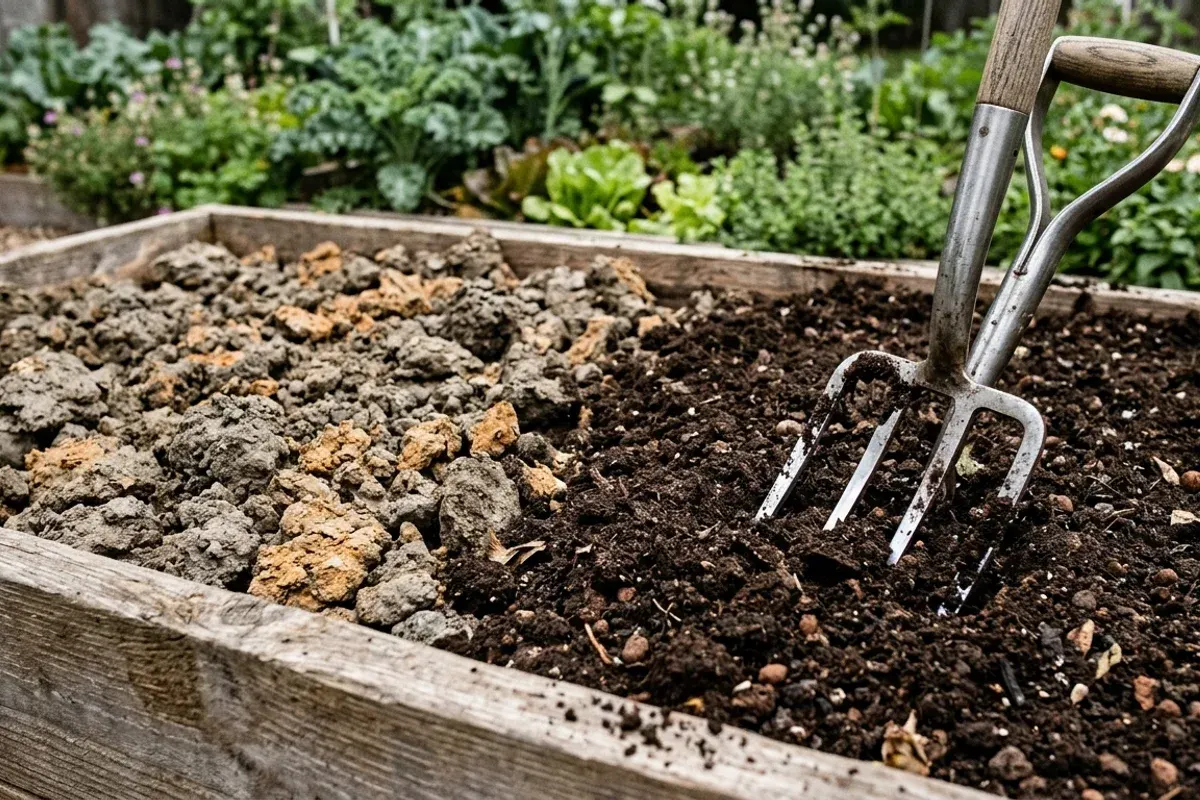
Heavy clay soil is both a blessing and a curse for backyard gardeners. On one hand, clay holds minerals and plant nutrients far better than sandy or silty ground thanks to its tremendous cation exchange capacity (CEC). On the other hand, wet clay acts like pottery slip, waterlogging root systems and causing root rot; when dry, it bakes into rock-hard bricks that snap garden trowels and deflect rainfall.
Many well-meaning gardeners make heavy clay infinitely worse by dumping bags of builder's sand or dousing the soil with gypsum based on outdated folk advice.
This guide breaks down the physical mechanics of clay soil, debunks costly myths, and outlines the proven biological and mineral protocols to transform sticky clay into friable, dark, high-yielding garden loam.
The Great Garden Myth: Why Sand + Clay = Concrete
The most common mistake gardeners make when trying to improve clay soil is buying play sand or coarse builder's sand to "balance" the density.
In concrete manufacturing, the formula for mortar is sand + cement (fine clay/limestone powder) + water.
┌────────────────────────────────────────────────────────┐
│            THE SOIL MECHANICS TRAP                     │
├────────────────────────────────────────────────────────┤
│ Clay Platelet Size : < 0.002 mm (Microscopic sheets)   │
│ Coarse Sand Size   : 0.05 - 2.0 mm (Massive boulders)  │
│                                                        │
│ Adding Sand to Clay:                                   │
│  [Sand]  [Sand]  [Sand]                                │
│   ▒▒▒▒▒▒▒▒▒▒▒▒▒▒▒▒▒▒▒▒▒  <- Clay fills all interstitial │
│  [Sand]  [Sand]  [Sand]     air pockets completely     │
│                                                        │
│ RESULT: Low-grade adobe brick / mortar. Zero air void! │
└────────────────────────────────────────────────────────┘
Because clay platelets are flat and microscopic (less than 0.002 mm in diameter), they slide directly into the interstitial voids between the larger sand grains. Once moistened and dried, this mixture cements into an impenetrable brick with almost zero aeration porosity.
To actually loosen clay with sand, you would need to add over 50% to 70% sand by total soil volume down to a depth of 12 to 18 inches. In a standard 100-square-foot garden plot, that requires hauling over 4 to 6 tons of sand—an exhausting, expensive mistake that ruins soil structure.
How to Test Your Soil Drainage: The Perc Test
Before amending, determine whether your soil suffers from slow internal percolation or an impermeable subsurface hardpan. Conduct a simple percolation (perc) test:
- Excavate a Test Pit: Dig a hole 12 inches deep and 8 to 10 inches in diameter.
- Pre-Saturate the Soil: Fill the hole to the rim with a hose and let it drain completely overnight. This pre-soaks the dry clay platelets to measure true saturated hydraulic conductivity.
- Refill and Measure: Refill the hole with clean water. Place a straight edge (like a 2x4) across the top of the hole and measure the distance from the board to the water surface with a tape measure.
- Record Hourly Drop: Measure the water level drop every 60 minutes for 4 hours.
| Drainage Rate | Classification | Diagnosis & Action Needed |
|---|---|---|
| Less than 0.5" / hr | Severe Stagnation | Standing water hazard. Do not plant directly in-ground. Install raised beds or French drains. |
| 0.5" – 1.0" / hr | Heavy Clay | Slow drainage. Suitable for brassicas, onions, and artichokes; amend heavily with organic compost and cover crops. |
| 1.0" – 3.0" / hr | Ideal Loam | Optimal balance of aeration and moisture retention. Standard annual topdressing required. |
| Over 4.0" / hr | Excessive Leaching | Highly porous sand or gravel. Rapid nutrient loss; add peat or humus for water holding. |
The 4 Proven Amendments That Actually Loosen Clay
To permanently loosen dense clay platelets without causing compaction, you must encourage soil flocculation—the process where individual microscopic clay sheets clump together into crumbly, porous granules (called soil peds).
   DISPERSED CLAY (Tight, Suffocating)         FLOCCULATED CLAY (Granular, Aerated)
      ═════════════════════════                    ░░░░░░░     ▒▒▒▒▒▒▒
      ═════════════════════════          ===>      ░ Peds ░   ▒ Peds  ▒
      ═════════════════════════                    ░░░░░░░     ▒▒▒▒▒▒▒
    No oxygen or water pathways                  Channels allow roots & water flow
1. High-Carbon Coarse Compost and Leaf Mold (The Biological Fix)
Organic matter is the ultimate clay conditioner. When earthworms, beneficial fungi, and aerobic bacteria consume carbon-rich compost, they exude sticky polysaccharides and glomalin (a fungal protein).
These biological glues bind microscopic clay sheets into crumbly aggregates resembling chocolate cake crumbs. Furthermore, organic matter creates permanent macro-pores that hold moisture without waterlogging.
- Application Rate: Topdress with 2 to 3 inches of finished compost across the garden surface twice per year (spring and autumn).
- Best Sources: Mixed manure compost, shredded hardwood leaf mold, and worm castings. Use our Compost Bin Calculator to calculate the pile volume needed for your yard.
2. Expanded Shale (The Permanent Physical Fix)
Expanded shale is mined clay or slate that has been fired in a rotary kiln at 2,000°F until it puffs up like popcorn. Each ceramic pebble is riddled with millions of microscopic air pockets.
- Why It Works: Unlike organic matter, expanded shale never decomposes, never compacts, and never washes away. It permanently opens up the physical pore space of dense clay beds.
- Application Rate: Work a 2-inch layer of 3/8-inch expanded shale into the top 6 to 8 inches of clay soil alongside compost. One application lasts indefinitely.
- Alternative: Coarse horticultural pumice (frequently used in arid Western regions).
3. Agricultural Gypsum (Calcium Sulfate Dihydrate)
Gypsum is frequently marketed as a universal clay-breaker, but it only works in specific soil chemistries:
- When Gypsum Works: In sodic soils (common in arid regions with high sodium tap water or coastal ground). The sodium (
Na+) ions coat clay particles, causing electrostatic repulsion that disperses clay into sludge. The soluble calcium (Ca2+) in gypsum knocks sodium off the clay binding sites, causing the platelets to clump together (flocculate). - When Gypsum Fails: In non-sodic, acidic, or neutral garden soils with balanced calcium and magnesium levels. In these soils, gypsum simply dissolves and leaches through without loosening compaction.
- Protocol: Perform an inexpensive university soil test. If your exchangeable sodium percentage (ESP) is above 5%, broadcast 40 lbs of pelleted agricultural gypsum per 1,000 square feet. If your sodium is low, skip gypsum and invest in compost.
4. Deep Bio-Drilling Cover Crops (The Root Drill Method)
Mechanical rototilling smashes clay soil aggregates into fine dust, leading to worse compaction the moment heavy rains hit. Biological drilling with deep taproot cover crops opens the subsoil without destroying soil fungal networks.
┌────────────────────────────────────────────────────────┐
│             BIO-DRILLING WITH TILLAGE RADISH           │
├────────────────────────────────────────────────────────┤
│   Garden Surface                                       │
│   ══════════════════════════════════════════════════   │
│        \  |  /        Dense Clay Topsoil               │
│         \ | /                                          │
│        (#####)       <-- 2" - 3" Thick Radish Crown    │
│        (#####)                                         │
│         |   |                                          │
│         |   |        Subsoil Hardpan (Compacted)       │
│         |   |        Punches 18" - 24" Deep!           │
│          \ /                                           │
│           V                                            │
│                                                        │
│ Winter Freeze: Radish dies at 20°F and rots inside the │
│ ground, leaving open 2-foot biological drainage shafts.│
└────────────────────────────────────────────────────────┘
- Top Species: Forage Radish (Daikon / Tillage Radish), Daikon, and Deep-Rooted Daikon.
- How to Plant: Broadcast seeds in late summer (60 days before your first autumn frost).
- The Winter Meltdown: When winter temperatures plunge below 20°F (-7°C), the succulent radish roots freeze, burst, and decompose underground. In spring, your clay soil is left honeycombed with deep biological air chimneys and earthworm highways. Learn more about crop selection in our Cover Crops for Raised Beds Guide.
Fixing Clay Underneath Raised Beds
Many gardeners build raised beds specifically to escape native clay, only to find their plants yellowing from soaked, oxygen-starved roots. This is called the bathtub effect.
When you place a box over hardpacked clay and fill it with porous, high-drainage potting mix, gravity pulls water quickly through the light soil. Once that water strikes the flat clay subgrade, downward percolation halts. Water pools at the bottom 4 inches of the bed, suffocating root tips.
       POOR: The Bathtub Trap                 CORRECT: Keyed Subsoil Interface
  ┌───────────────────────────────┐     ┌───────────────────────────────┐
  │ Loose Raised Bed Mix          │     │ Loose Raised Bed Mix          │
  │ (High Permeability)           │     │ (High Permeability)           │
  ├───────────────────────────────┤     ├- - - - - - - - - - - - - - - -┤
  │ Saturated "Bathtub" Water     │     │ Keyed Organic/Clay Transition │
  ├═══════════════════════════════┤     ├ - - - - - - - - - - - - - - - ┤
  │ Native Flat Hardpan Clay      │     │ Broadforked Subsoil (Fractured│
  └───────────────────────────────┘     └───────────────────────────────┘
The 4-Step Raised Bed Clay Preparation Protocol
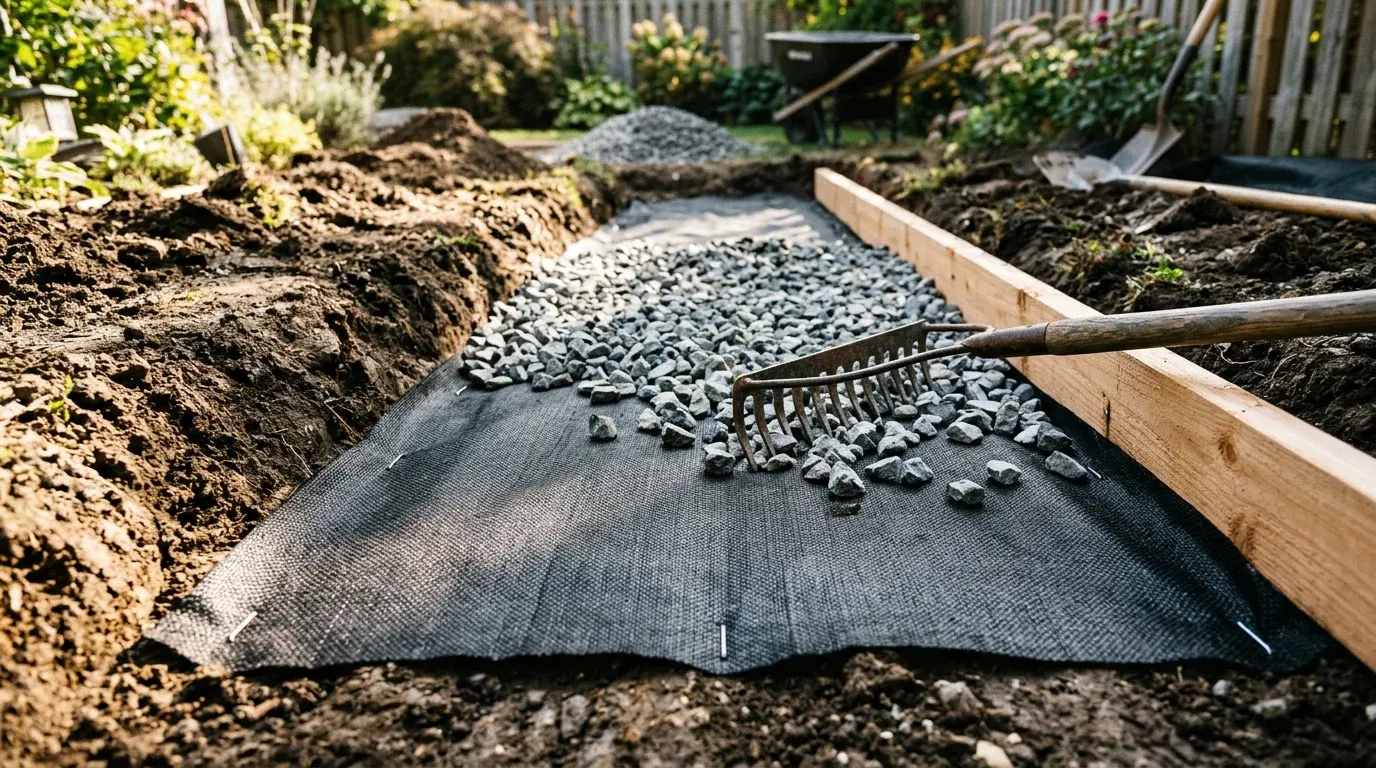
- Never Line with Plastic or Geotextile Fabric: Do not place synthetic weed barrier cloth between your raised bed soil and native clay. Fabric catches silt and clay fines, creating a waterproof barrier within 12 months.
- Fracture with a Broadfork or Spading Fork: Before installing soil, plunge a heavy-duty steel broadfork 10 to 12 inches deep into the clay floor every 6 inches. Rock the tines gently backwards to crack the hardpan without flipping infertile subsoil to the top.
- Incorporate a Keyed Transition Layer: Spread 2 inches of coarse compost and 1 inch of coarse expanded shale directly over the fractured clay. Work it into the top 3 inches of clay with a fork. This creates a gradual texture gradient that eliminates the sharp perched water table.
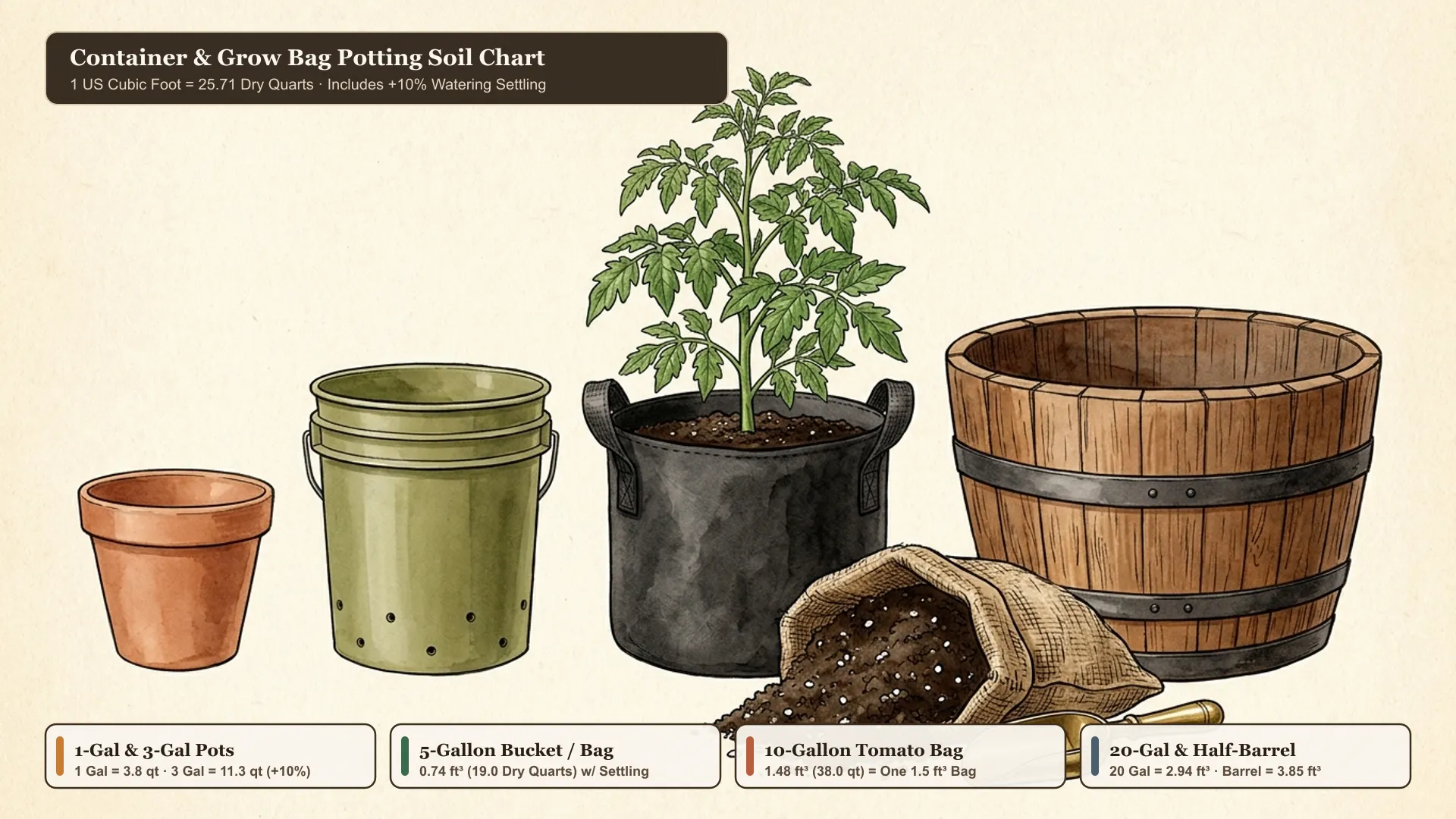
- Fill with High-Aeration Medium: Top off the bed with a balanced potting blend such as Mel's Mix (1/3 compost, 1/3 peat/coir, 1/3 vermiculite). Calculate your exact bulk delivery needs using our Raised Bed Soil Calculator.
Seasonal Maintenance Calendar for Heavy Clay Soils
Reconditioning heavy clay requires consistent seasonal practices:
| Season | Priority Task | Implementation Details |
|---|---|---|
| Early Spring | Never Walk on Wet Clay | Stepping on saturated clay compresses platelets into solid slabs. Place temporary wooden scaffold planks in beds to distribute body weight. |
| Late Spring | Surface Organic Mulch | Apply 2 to 3 inches of shredded wood mulch, straw, or pine bark. Mulch prevents sun-baking and protects clay aggregates from droplet compaction. |
| Late Summer | Sow Bio-Drilling Cover Crops | Seed tillage radish, winter rye, or crimson clover in empty vegetable rows to shatter subsoil hardpan over winter. |
| Late Autumn | Topdress Autumn Leaves & Compost | Spread 3 inches of shredded fall leaves and compost over beds. Rain and snow carry dissolved humic acid deep into clay fissures. |
| Winter | Frost-Heaving Weathering | Let bare subsoil blocks freeze and thaw naturally. Water expansion in clay pores fractures dense clods without mechanical tilling. |
Frequently Asked Questions
Can I plant vegetables in heavy clay while I am amending it?
Yes! Several vegetable varieties thrive in heavier soils while improving structure. Brassicas like cabbage and broccoli handle clay well. However, root vegetables like carrots and parsnips will twist and fork in unamended clay; grow them in deep raised beds or amend heavily with expanded shale.
Should I till my clay garden every spring with a rototiller?
No. Rototilling heavy clay shatters soil crumbs into fine dust. When spring rains fall, this fine powder forms an impenetrable crust on the surface and compacts into a denser hardpan right below the tiller blades (known as a "tiller pan"). Use a broadfork or no-till sheet mulching instead.
How do I calculate how much compost I need to amend my clay plot?
To calculate compost volume, multiply your garden plot length by width in feet, then multiply by your amendment depth (e.g., 2 inches = 0.167 ft), and divide by 27 to find cubic yards. Alternatively, run your garden bed dimensions through our Topsoil Calculator or Raised Bed Soil Calculator for instant bag and bulk estimates.
FAQ
Should I add sand to break up heavy clay soil?
Never add sand to clay soil. Sand particles and microscopic clay platelets pack together like aggregate in cement. Unless you add at least 50% sand by volume throughout the entire root zone, adding small to moderate amounts of sand creates an impervious, concrete-like substance that chokes root respiration and halts drainage.
Does gypsum fix all clay soils?
No. Gypsum (calcium sulfate dihydrate) only works on sodic clay soils where high concentrations of sodium disperse clay platelets. The calcium replaces sodium on soil exchange sites, allowing clay particles to aggregate (flocculate). In standard non-sodic, slightly acidic to neutral clay soils, gypsum has minimal physical effect; coarse organic compost and expanded shale are far more effective.
How long does it take to amend heavy clay into rich garden loam?
Surface sheet mulching and active biological amendment transform the top 4 to 6 inches within 6 to 12 months. Deep root-zone remediation typically takes two to three full growing seasons of continuous organic mulch application, broadforking, and winter tillage cover crops.
Can I just fill a raised bed on top of hard clay ground?
Yes, raised beds are one of the most effective solutions for dense clay sites. However, you must score or broadfork the bottom clay floor before filling. If you simply pour light potting mix over smooth, hardpan clay, the bed acts like a bathtub, collecting perched water at the boundary layer that rots deep taproots.