How Much Mulch for Trees and Flower Beds: Ring Formulas & Depth

By Efraín Vega · Published October 28, 2026
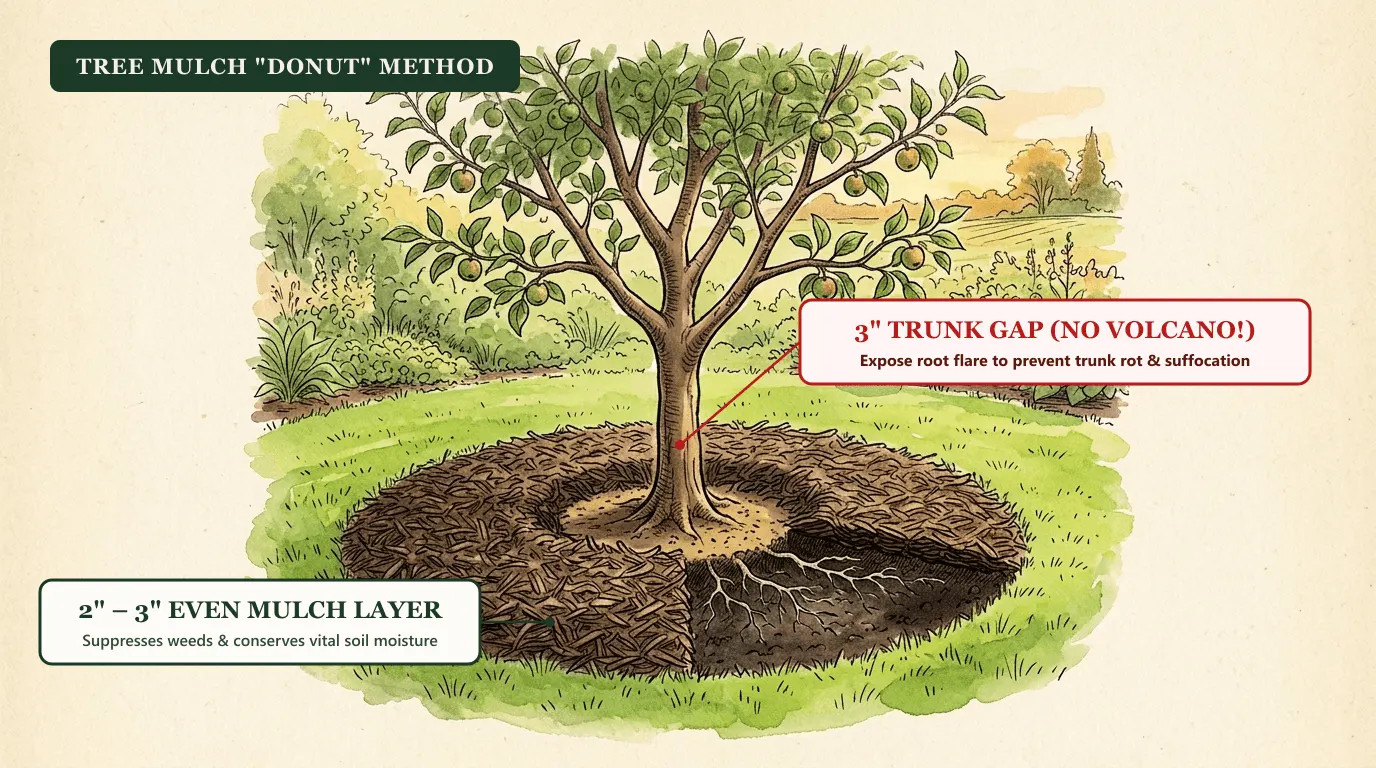
To mulch a standard 6-foot diameter tree ring (3-foot radius) at a healthy 3-inch depth, you need 7 cubic feet of mulch—which equals 3.5 standard bags (2 cu ft each) or about 0.25 cubic yards.
Calculating mulch for circular rings trips up most gardeners because standard volume calculators only accept length and width rectangles.
Quick reference: Mulch bags needed for tree rings
Here is the exact takeoff for common circular tree ring sizes applied at the standard 3-inch depth:
| Ring diameter | Ring radius (trunk to edge) | Surface area | Mulch volume (3" depth) | Standard 2 cu ft bags |
|---|---|---|---|---|
| 3 ft ring | 1.5 ft | 7 sq ft | 1.8 cu ft | 1 bag |
| 4 ft ring (Young sapling) | 2 ft | 12.5 sq ft | 3.1 cu ft | 2 bags |
| 5 ft ring | 2.5 ft | 19.6 sq ft | 4.9 cu ft | 2.5 bags |
| 6 ft ring (Standard shade tree) | 3 ft | 28.3 sq ft | 7.1 cu ft | 3.5 bags |
| 8 ft ring (Mature tree canopy) | 4 ft | 50.2 sq ft | 12.5 cu ft | 6 bags (0.5 yd³) |
| 10 ft ring (Large specimen tree) | 5 ft | 78.5 sq ft | 19.6 cu ft | 10 bags (0.75 yd³) |
For rectangular flower beds, borders, and bulk delivery calculations, use our Mulch Calculator, or view our pre-calculated bag and yard takeoffs for 100 Sq Ft, 200 Sq Ft, 300 Sq Ft, and 1 Cubic Yard of Mulch.
The circle formula for tree rings
To calculate mulch volume for any circle yourself:
- Find radius: Measure from the bark of the trunk out to your landscape edging in feet.
- Calculate area: Multiply Radius × Radius × 3.14. For a 4-foot radius (8-foot wide bed): 4 × 4 × 3.14 = 50.24 sq ft.
- Calculate cubic yards: Multiply square feet by depth in inches, then divide by 324: (50.24 × 3) ÷ 324 = 0.47 cubic yards.
- Convert to bags: Multiply cubic yards by 13.5 (there are 13.5 two-cubic-foot bags in a yard): 0.47 × 13.5 = 6.3 bags (buy 6 or 7 bags).
The "Donut" vs. "Volcano" rule
The single biggest threat to suburban trees is not drought or insects—it is volcano mulching performed by uninformed landscaping crews.
- The Volcano (Fatal mistake): Mounding 6 to 12 inches of mulch directly against the tree bark creates constant moisture against the trunk tissue. Tree bark requires atmospheric air to stay healthy; constant wetness softens the bark, breeds collar rot (Phytophthora), and allows opportunistic burrowing mice and voles to chew girdling rings around the trunk in winter.
- The Donut (Proper method): Spread mulch 2 to 3 inches deep across the root zone, but leave a clean 3-to-4-inch gap around the base of the trunk where the root flare widens into the soil. Mulch should look like a flat donut, with the trunk sitting open in the hole.
Keep mulch inside the drip line
Tree feeder roots that absorb water and nutrients extend far beyond the trunk. Extend your mulch ring out to the "drip line" (the outer circumference of the branches) whenever practical. Mulching replaces lawn grass, preventing aggressive turf roots from competing with the tree for water.
Wood chips vs. shredded hardwood: Which is best?
- Shredded hardwood: Best for sloped flower beds and windy yards. The fibrous, shredded strands knit together into a cohesive blanket that resists washing away during torrential downpours.
- Arborist wood chips: Best for fruit trees, deep shrub beds, and native landscapes. Coarse chips decompose slowly (lasting 2 to 3 years) and foster beneficial mycorrhizal fungi in the soil. Check our Raised Bed Soil Calculator if mixing organic mulch into compost blends.
FAQ
How much mulch do I need for a tree ring?
For a standard 6-foot wide tree ring (3-foot radius from trunk to edge) at 3 inches deep, you need approximately 3.5 bags of mulch (2 cubic feet each), or roughly 7 cubic feet (0.25 cubic yards).
How deep should mulch be around trees and flower beds?
Apply mulch 2 to 3 inches deep. A 3-inch layer is ideal for suppressing weed seeds and conserving soil moisture. Layers thicker than 4 inches suffocate root systems by blocking oxygen exchange.
What is volcano mulching and why is it bad?
Volcano mulching is piling mulch up against the trunk like a cone. Trapping wet organic matter against the bark softens tree tissue, causing rot, fungal infection, and inviting burrowing rodents to chew girdling rings around the wood.
How do you calculate circular area for mulch?
Measure the distance from the tree trunk to the outer edge of your ring (the radius in feet). Multiply: Radius × Radius × 3.14 to get total square footage. Then multiply by depth in inches and divide by 324 to get cubic yards.