How Much Potting Soil Do I Need? Container Gallon & Quarts Chart (2026)

By Efraín Vega · Published November 7, 2026
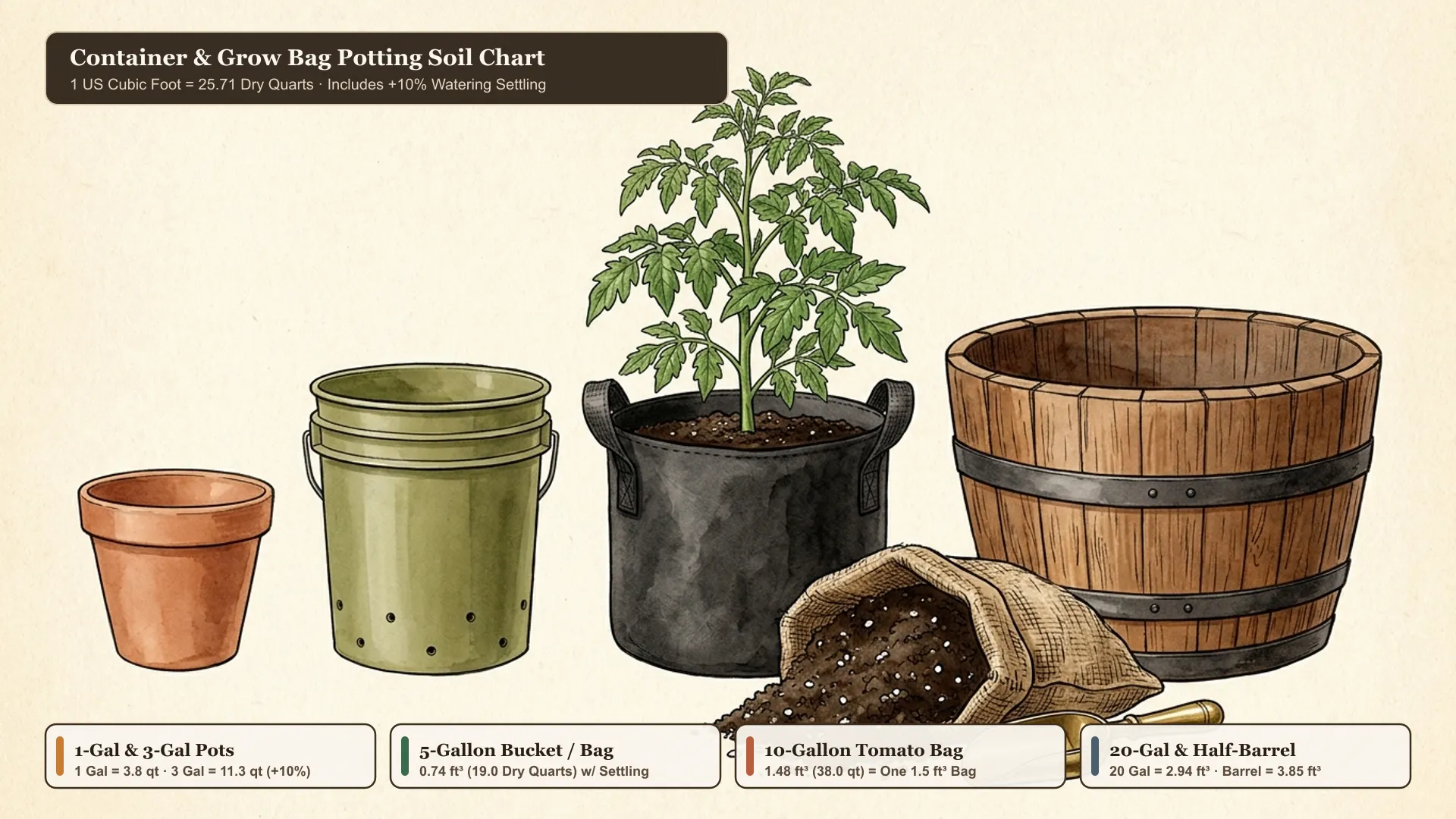
A standard 5-gallon bucket or grow bag takes 0.74 cubic feet (19.0 dry quarts) of potting soil (including a 10% watering compression buffer), a 10-gallon tomato grow bag takes 1.48 cubic feet (38.0 dry quarts — one 1.5 cu ft bag), and a 20-gallon container takes 2.94 cubic feet (75.6 dry quarts — two 1.5 cu ft bags).
Use our interactive Potting Soil & Container Calculator to mix and match container counts, or jump straight to our pre-built takeoffs for 5-Gallon Pots, 10-Gallon Grow Bags, and 20-Gallon Containers.
Potting soil size chart: Gallons to dry quarts, cubic feet & bags
Why do potting soil numbers confuse so many gardeners? Because pots and grow bags are measured in liquid gallons (1 gal = 0.134 cu ft), while bagged potting mix is sold in dry quarts and cubic feet (1 cu ft = 25.71 dry quarts). That means 1 container gallon equals 3.43 dry quarts exact (or 3.79 dry quarts with a 10% watering settling allowance).
| Container Size | Exact Volume (Dry Qt / ft³) | Volume w/ +10% Settling | Pots Filled per 1.5 ft³ Bag | Pots Filled per 2.0 ft³ Bag | Best Crops for This Size |
|---|---|---|---|---|---|
| 1 Gallon Pot | 3.4 qt (0.13 ft³) | 3.8 qt (0.15 ft³) | 10.1 pots | 13.5 pots | Basil, mint, thyme, strawberries |
| 3 Gallon Grow Bag | 10.3 qt (0.40 ft³) | 11.3 qt (0.44 ft³) | 3.4 pots | 4.5 pots | Bush beans, lettuce, determinate peppers |
| 5 Gallon Bucket (Takeoff) | 17.2 qt (0.67 ft³) | 19.0 qt (0.74 ft³) | 2.0 pots | 2.7 pots | Jalapeños, bell peppers, eggplant, patio tomatoes |
| 7 Gallon Grow Bag | 24.2 qt (0.94 ft³) | 26.6 qt (1.03 ft³) | 1.4 pots | 1.9 pots | Determinate tomatoes, cucumbers, zucchini |
| 10 Gallon Grow Bag (Takeoff) | 34.5 qt (1.34 ft³) | 38.0 qt (1.48 ft³) | 1.0 pot (Exact match) | 1.3 pots | Indeterminate tomatoes, seed potatoes, carrots |
| 15 Gallon Container | 51.7 qt (2.01 ft³) | 56.9 qt (2.21 ft³) | 0.68 pots | 0.90 pots | Dwarf citrus, figs, blueberry bushes |
| 20 Gallon Container (Takeoff) | 68.7 qt (2.67 ft³) | 75.6 qt (2.94 ft³) | 0.51 pots (2 bags/pot) | 0.68 pots | Squash hills, watermelon, patio fruit trees |
| 25 Gallon Container | 85.9 qt (3.34 ft³) | 94.5 qt (3.67 ft³) | 0.41 pots | 0.54 pots (2 bags/pot) | Semi-dwarf apple, peach, or olive trees |
| 26″ Whiskey Half-Barrel | 90.0 qt (3.50 ft³) | 99.0 qt (3.85 ft³) | 0.39 pots (3 bags/pot) | 0.52 pots (2 bags/pot) | Mixed herb gardens, dwarf fruit trees |
Retail potting mix bag sizes decoded
When comparing prices at a garden center or big-box store, always check the cubic foot (cu ft) or dry quart (qt) print on the bottom corner of the bag:
| Bag Label Size | Equivalent Dry Quarts | Equivalent Cubic Feet | 5-Gal Pots Filled (+10%) | 10-Gal Bags Filled (+10%) |
|---|---|---|---|---|
| 8 Dry Quart Bag | 8.0 dry qt | 0.31 cu ft | 0.4 pots | 0.2 pots |
| 16 Dry Quart Bag | 16.0 dry qt | 0.62 cu ft | 0.8 pots | 0.4 pots |
| 1.0 Cubic Foot Bag | 25.7 dry qt | 1.00 cu ft | 1.3 pots | 0.7 pots |
| 1.5 Cubic Foot Bag | 38.6 dry qt | 1.50 cu ft | 2.0 pots | 1.0 pot |
| 2.0 Cubic Foot Bag (50–55 qt) | 51.4 dry qt | 2.00 cu ft | 2.7 pots | 1.3 pots |
| 3.8 cu ft Compressed Bale | ~195 dry qt (fluffed) | ~7.60 cu ft (fluffed) | 10.2 pots | 5.1 pots |
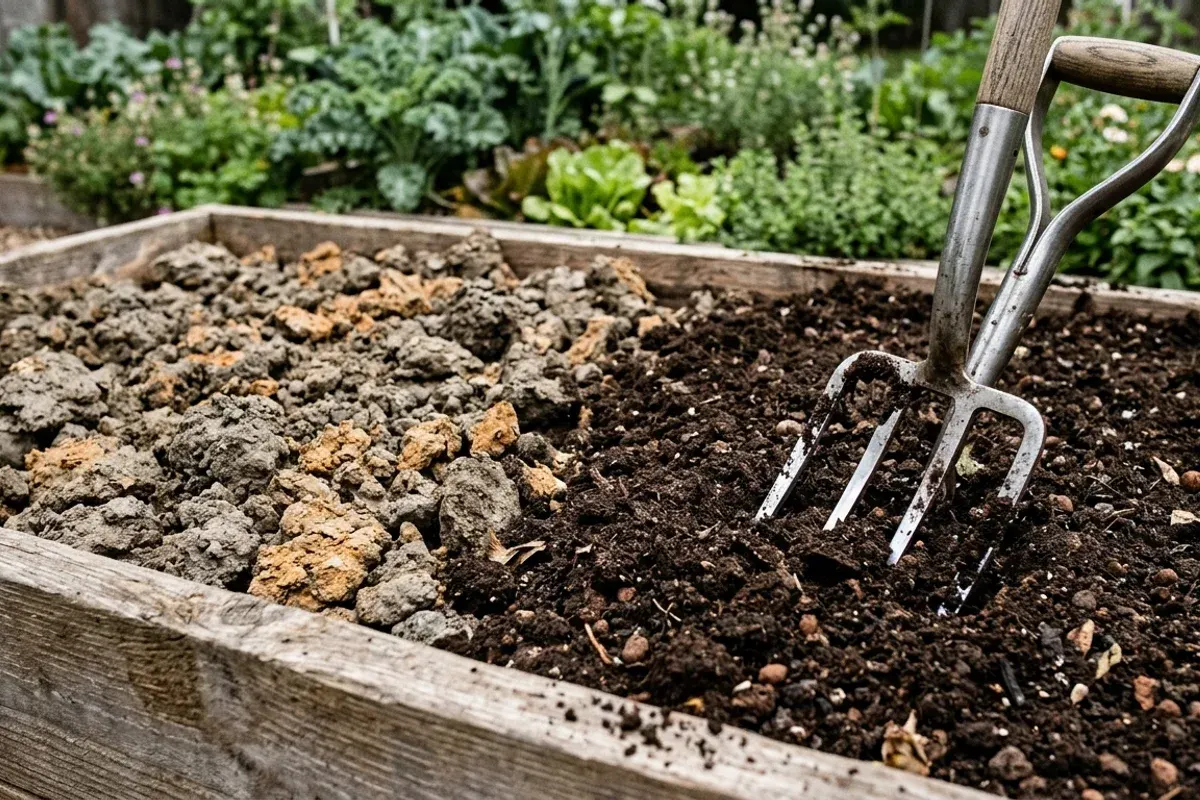
Potting Mix vs. Raised Bed Soil vs. Topsoil: Never put garden dirt in pots
One of the fastest ways to kill container tomatoes or peppers is filling 5-gallon buckets with cheap bagged topsoil or native backyard dirt:
- Potting Mix (Soilless Container Media): Contains zero actual dirt. Formulated from sphagnum peat moss or coconut coir, coarse perlite, pine bark fines, and worm castings. It stays fluffy and aerated inside a confined pot so excess water drains out the bottom within seconds.
- Raised Bed Soil: A heavier 50/50 blend of screened topsoil, compost, and bark fines (see our Raised Bed Soil Calculator). Ideal for open-bottom wooden or cinder block raised beds where earthworms and native ground contact pull water downward, but slightly too dense for small 1-to-5-gallon pots unless amended with 20% extra perlite.
- Bagged Topsoil: Heavy mineral soil that turns into a waterlogged, oxygen-starved brick inside a plastic bucket or grow bag, suffocating roots and causing root rot (Pythium).
DIY 5-gallon & 10-gallon container soil recipe (Bulk savings)
If you are filling 10 or more 5-gallon buckets or 10-gallon grow bags, mixing your own container recipe in a wheelbarrow cuts your cost by 50%:
- 1 part fluffed peat moss or coco coir (moisture retention)
- 1 part screened finished compost (nutrients and microbial life — see our Compost Bin Calculator)
- 1 part coarse perlite or pumice (permanent drainage and root oxygen)
- Add 2 tablespoons of slow-release organic granular fertilizer (plus 1 tablespoon of garden lime if using acidic peat moss) per cubic foot of mix.
FAQ
How much potting soil do I need for a 5-gallon bucket or grow bag?
One 5-gallon bucket or fabric grow bag requires 0.67 cubic feet (17.2 dry quarts) exact, or 0.74 cubic feet (19.0 dry quarts) with a 10% watering settling buffer. One 2-cubic-foot bag of potting soil fills two 5-gallon containers with half a bag left over.
How many bags of soil do I need for a 10-gallon grow bag?
A 10-gallon grow bag holds 1.34 cubic feet (34.5 dry quarts) exact, or 1.48 cubic feet (38.0 dry quarts) after 10% watering settlement—which is almost an exact 1-to-1 match with a standard 1.5-cubic-foot bag of potting mix (38.6 dry quarts).
How many dry quarts are in 1 cubic foot of potting soil?
There are 25.71 dry US quarts in 1 cubic foot of potting mix. That means a 1.0 cu ft bag holds 25.7 dry quarts, a 1.5 cu ft bag holds 38.6 dry quarts, and a 2.0 cu ft bag holds 51.4 dry quarts.
How many 5-gallon buckets will a 2 cubic foot bag of soil fill?
A 2.0-cubic-foot bag (51.4 dry quarts) fills 3 five-gallon buckets mathematically before settling, or 2.7 buckets after accounting for 10% watering compression.