How to Amend Raised Bed Soil: Spring & Fall Soil Refresh Recipes

By Efraín Vega · Published November 20, 2026
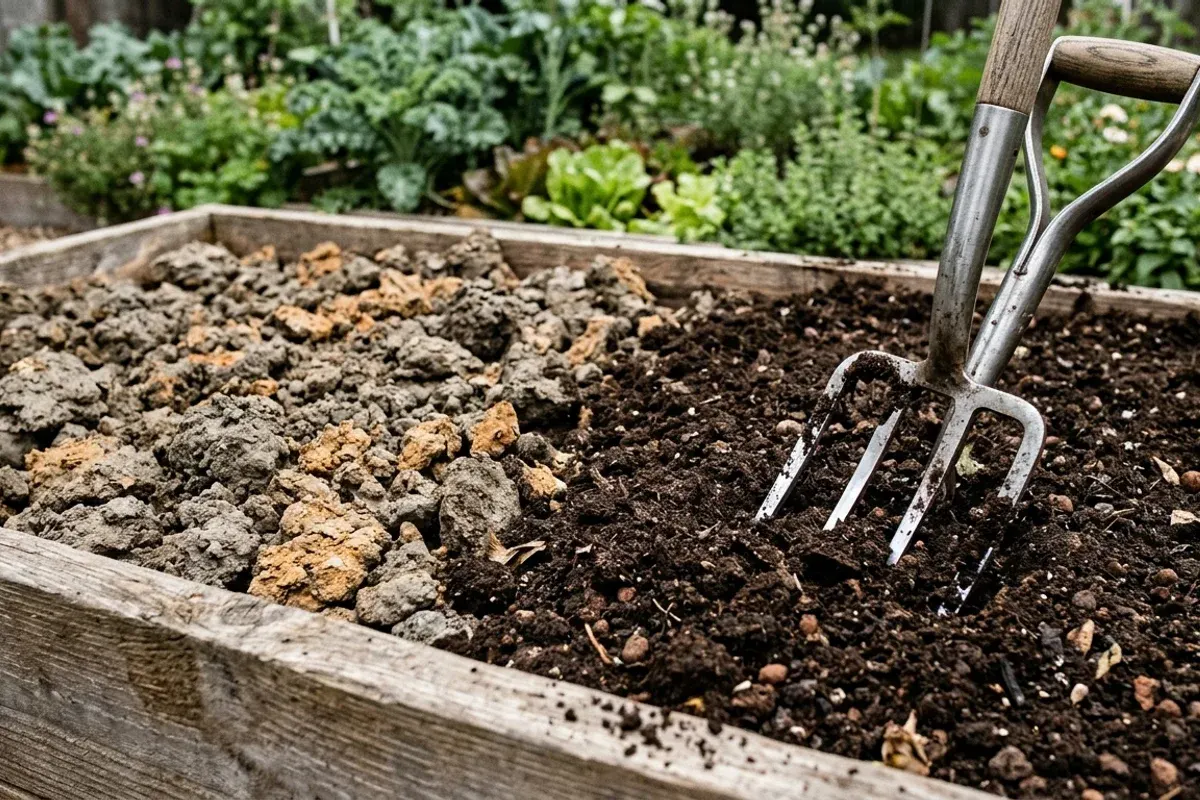
After an abundant growing season of heavy-feeding tomatoes, hungry brassicas, and vigorous squash, your raised garden beds have sacrificed massive reserves of nitrogen, phosphorus, potassium, and trace minerals. Furthermore, microbial activity has digested organic matter, causing the soil level inside your cedar beds to sink by 2 to 5 inches.
Attempting to plant directly into tired, unamended soil the following spring results in stunted seedlings, pale chlorotic leaves, and disappointing harvests. However, you do not need to buy expensive new bulk soil blends every year.
By applying an annual recharge of organic compost, mineral rock dusts, and aeration conditioners, you restore soil fertility, optimize drainage porosity, and nourish beneficial soil biology for pennies on the dollar.
Why Raised Bed Soil Depletes and Sinks
Raised garden bed soils are artificial, hyper-productive ecosystems. Unlike in-ground native soils connected to deep subterranean mineral reserves, raised beds operate as closed containers:
- Nutrient Mining by Crops: A single indeterminate tomato plant extracts over 1/2 pound of pure elemental nitrogen and substantial calcium from the root zone over its lifespan.
- Organic Matter Combustion: Soil microbes consume carbon-based peat moss, compost, and leaf mold, converting solid material into gaseous CO2 and soluble humic acids.
- Gravity Compaction: Watering overhead collapses fluffy aeration pockets, gradually packing soil particles tighter together.
              ANNUAL RAISED BED SUBSIDENCE CYCLE
  ==============================================================
  Year 1 (Fresh Mix):  [ Compost + Peat + Vermiculite (12" Deep) ]
  --------------------------------------------------------------
  Harvest Extraction:  - Heavy vegetable feeding removes N-P-K
  Microbial Digestion: - Microbes consume 25% of organic carbon
  Watering Settle:     - Air pockets collapse
  --------------------------------------------------------------
  Year 2 (Deficit):    [ Depleted Compacted Soil (8" Deep)      ]
                       ^^^^ 4" DROP REQUIRES AMENDMENT RECHARGE
  ==============================================================
Calculate the exact amendment volume needed to refill your sunken beds with our Raised Bed Soil Calculator and check compost bin sizing with our Compost Bin Calculator.
The Master Soil Recharging Matrix (Per 4x8-Foot Bed)
Use this complete organic amendment recipe every spring (4 weeks before planting) or in autumn after clearing summer crop residues:
| Amendment Material | Target Nutrient / Function | Application Rate (32 Sq Ft Bed) |
|---|---|---|
| Finished Screened Compost | Microorganisms, humic acid, bulk volume | 2" to 3" layer (6 to 8 cu. ft.) |
| Earthworm Castings (Vermicompost) | Microbial inoculation & bio-available enzymes | 5 to 10 lbs (1/2 to 1 cu. ft.) |
| Coarse Vermiculite or Perlite | Water retention & aeration porosity | 1 to 2 cu. ft. (if soil feels heavy) |
| Organic Bone Meal (4-12-0) | Root-stimulating slow-release phosphorus | 2 cups |
| Blood Meal or Feather Meal (12-0-0) | Rapid green vegetative nitrogen booster | 1.5 to 2 cups |
| Kelp Meal (1-0-2) or Greensand | 60+ ocean minerals, potash & heat resistance | 1 to 2 cups |
| Azomite Volcanic Rock Dust | Essential trace minerals (calcium, magnesium) | 2 cups |
| Agricultural Lime or Sulfur | pH correction (Lime raises pH; Sulfur lowers) | Test soil first; 1 lb if pH < 6.0 |
Step-by-Step Soil Amending Guide
Step 1: Clean Up Surface Debris & Weeds
- Cut summer crop stalks at ground level with hand pruners rather than yanking roots. Leaving fine root hairs in the soil feeds underground earthworms and preserves root drainage channels.
- Remove and discard any diseased foliage (such as tomato early blight or powdery mildew) into municipal waste, never your home compost pile.
- Hand-pull overwintering weeds while the soil is damp to remove weed roots completely.
Step 2: Aerate Compaction with a Broadfork (No Tilling)
Never use a gas-powered rototiller inside a raised garden bed. Tiller tines slice earthworms, pulverize soil crumb structure into dust, and bring buried weed seeds up into the germination light zone.
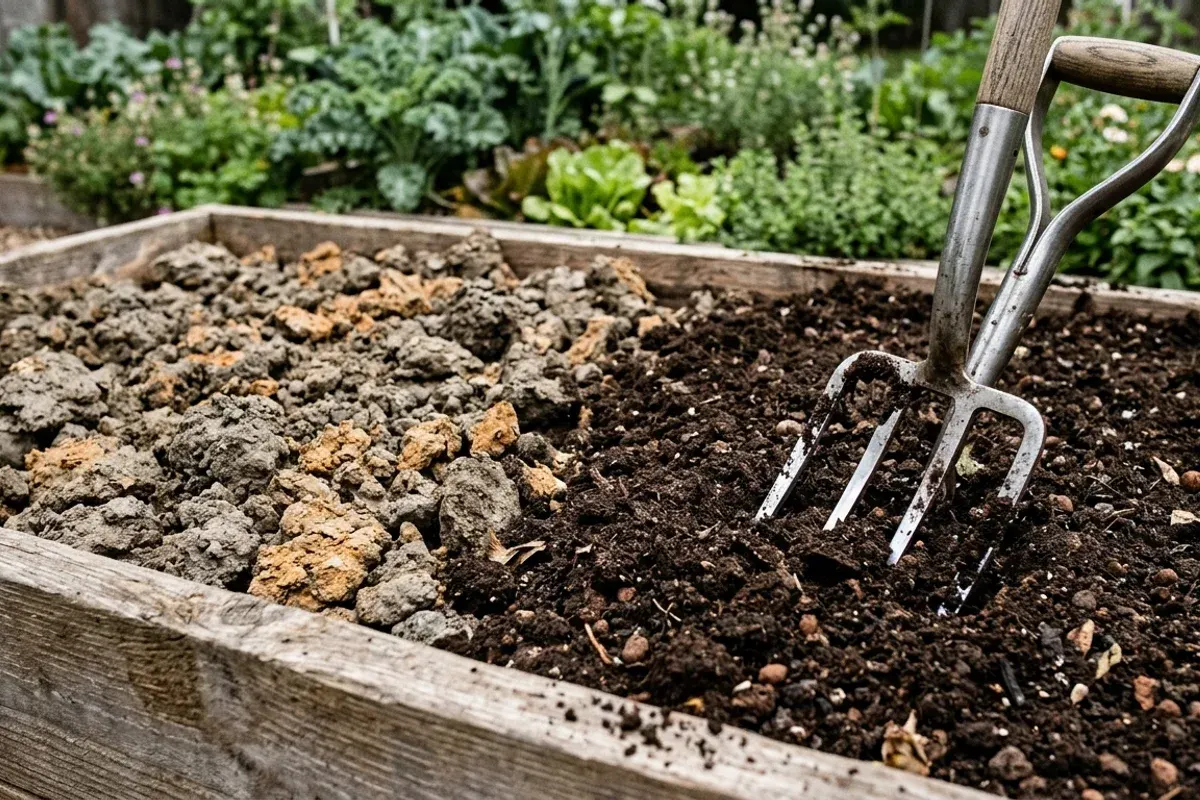
- Push the tines of a garden broadfork or heavy-duty digging fork vertically into the bed at 8- to 10-inch intervals.
- Step onto the crossbar to sink the tines full depth.
- Pull the handles back 30 degrees to gently fracture and lift the compacted soil crust.
- You should see fissures open across the surface. This introduces atmospheric oxygen deep into root zones without inverting soil layers.
       BROADFORKING TECHNIQUE VS. DESTRUCTIVE TILLING
  =============================================================
   [ Broadfork Method ]                  [ Rototiller Method ]
    Tines crack soil from underneath.     Tines blend & pulverize.
    Preserves fungal hyphae.              Destroys worm networks.
    Zero weed seed inversion.             Explodes weed seed bank.
    Fluffs without destroying crumbs.     Creates dense hardpan layer.
  =============================================================
Step 3: Spread Bulk Compost & Worm Castings
- Shovel 2 to 3 inches of screened organic compost across the entire bed surface. (Sift raw compost using a homemade mesh screen; see our Compost Sifter Build Guide).
- Scatter 5 to 10 pounds of pure earthworm castings evenly over the compost. Earthworm castings introduce billions of active beneficial bacteria and growth hormones that stimulate rapid root development.
Step 4: Scatter Slow-Release Minerals and Organic Fertilizers
- Measure your organic bone meal, blood meal, kelp meal, and Azomite according to the bed dimensions.
- Broadcast the dry powders across the damp compost layer.
- Dust with 1 cup of mycorrhizal fungi inoculant powder to ensure new spring seedlings form symbiotic root fungal relationships immediately upon sprouting.
Step 5: Lightly Scratch Amendments into Top 4 Inches
- Using a 3-prong hand cultivator or garden rake, gently mix the top amendments into the upper 3 to 4 inches of the existing bed soil.
- Avoid disturbing deep subsoil layers; rain and earthworms will naturally transport organic nutrients, worm castings, and minerals deep into the bed over the following weeks.
- Level the surface smoothly with the back of an aluminum landscape rake.
Step 6: Water In and Blanket with Protective Mulch
- Water the amended bed deeply with a soft shower spray nozzle to hydrate the amendments and awaken sleeping soil microorganisms.
- Never leave freshly amended soil bare under hot sun or driving rain. Bare soil quickly forms an impermeable baked crust, while UV radiation sterilizes beneficial microbes.
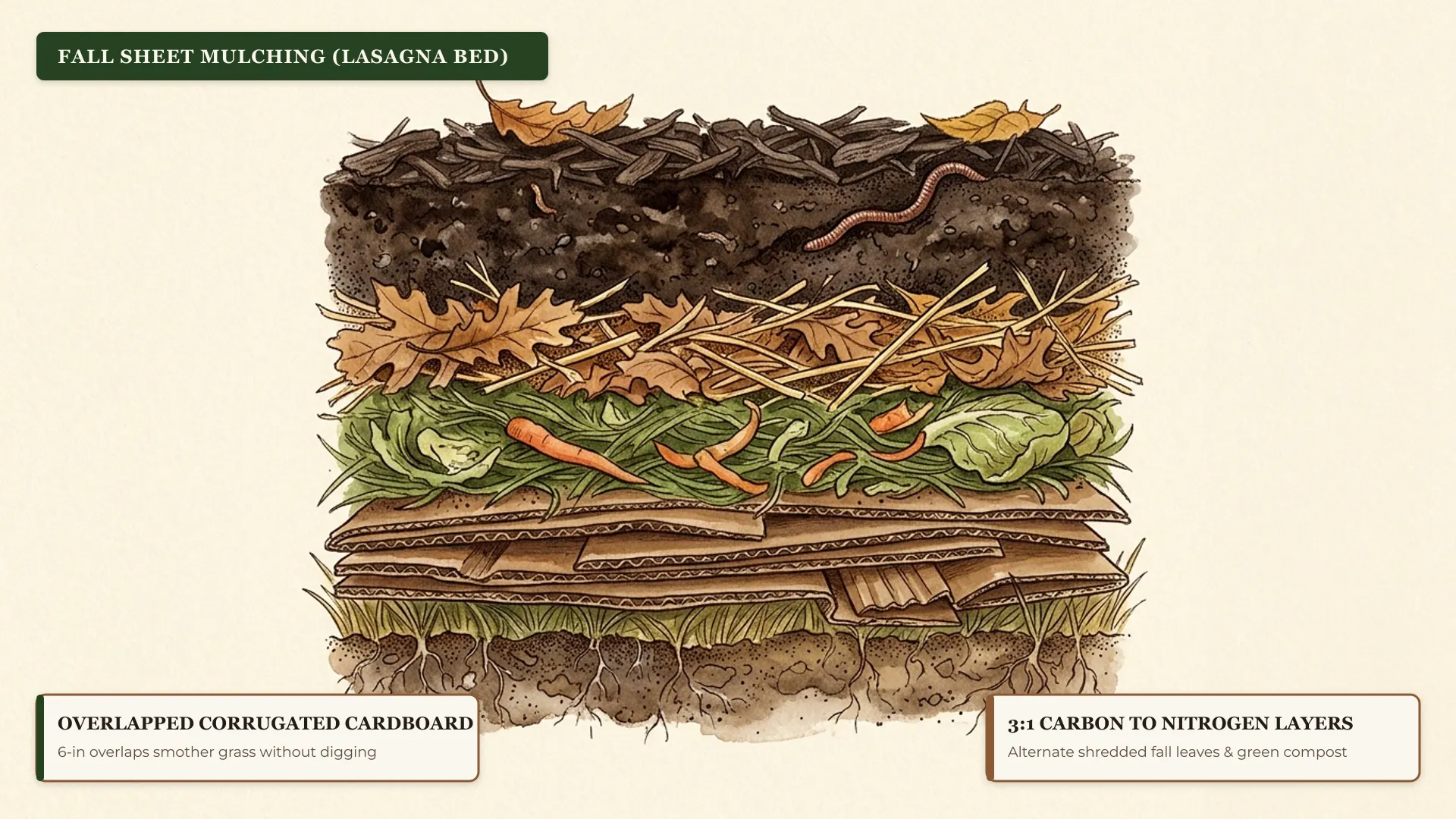
- Cover the amended bed with a 2- to 3-inch protective blanket of clean seed-free straw, shredded fall leaves, or pine straw.
Spring Amending vs. Fall Amending
| Season | Best Strategy | Primary Advantage |
|---|---|---|
| Fall Amending (Recommended) | Apply rough compost, manure, rock dusts, and heavy leaf mulch. | Gives amendments 4 to 5 months to break down, mellow, and integrate via winter snow and freeze-thaw cycles. Ready for early planting. |
| Spring Amending | Apply fully finished screened compost, worm castings, and fast-acting organic meals 3-4 weeks prior to transplanting. | Immediately boosts warmth and available N-P-K right when delicate spring seedlings arrive. |
For complete winter preparation workflows, follow our guide on How to Winterize Raised Garden Beds.
Related Soil Calculators & Guides
Master your raised garden bed fertility with our companion resources:
- Raised Bed Soil Calculator: Determine cubic yards and bags for any bed size.
- Compost Bin Sizing Calculator: Design a home compost pile with proper C:N ratios.
- Mulch Coverage Calculator: Calculate straw, leaf, and bark mulch requirements.
- Mel's Mix Soil Recipe Ratio Guide: The classic 1/3 peat, 1/3 vermiculite, 1/3 compost formula.
- How to Fix Clay Soil in Raised Beds: Break up sticky hardpan and improve sub-drainage.
- How to Grow Blueberries in Raised Beds: Acidic 50/30/20 peat-bark soil recipes and sulfur calculations.
- How to Build a Compost Sifter: Sift coarse compost into fine potting gold.
FAQ
How much compost should I add to a raised garden bed each year?
Top-dress your raised bed with a 2- to 3-inch layer of rich, well-seasoned finished compost every spring or autumn. For a standard 4x8 foot raised bed (32 square feet), this equals roughly 5 to 8 cubic feet (2 to 3 bags) of bulk compost or vermicompost.
Should I dig up and replace old raised bed soil completely?
No. Never throw away or dig out your old raised bed soil unless it has suffered a severe, incurable soil-borne fungal blight (such as Fusarium wilt or clubroot). Over seasons, your soil establishes complex living networks of beneficial bacteria, earthworms, and mycorrhizal fungi. Amending top layers recharges depleted nutrients without destroying soil biology.
Should you till raised bed soil before amending?
Avoid mechanical rototilling. Rotary tiller blades pulverize natural soil aggregates into fine powder that easily compacts into an airless brick when wetted. Instead, insert a garden broadfork or digging fork 8 to 10 inches deep and rock it backward gently to crack compaction fissures without inverting soil microbial layers.
What is the best all-around organic fertilizer for raised beds?
A balanced slow-release organic fertilizer blend containing feather meal or blood meal (nitrogen), steamed bone meal (phosphorus), potassium sulfate or greensand (potassium), and Azomite or kelp meal (trace micronutrients) applied at 2 to 3 cups per 32 square feet.
Why did the soil level in my raised bed drop 4 inches over winter?
Soil subsidence is completely normal. Soil levels sink because organic matter (peat moss, compost, and wood chips) naturally breaks down into microscopic carbon dioxide and humus, while gravity and rain settle loose air pockets.