How to Grow Blueberries in Raised Beds: Acidic Soil Mix, pH & Care Guide

By Efraín Vega · Published November 20, 2026
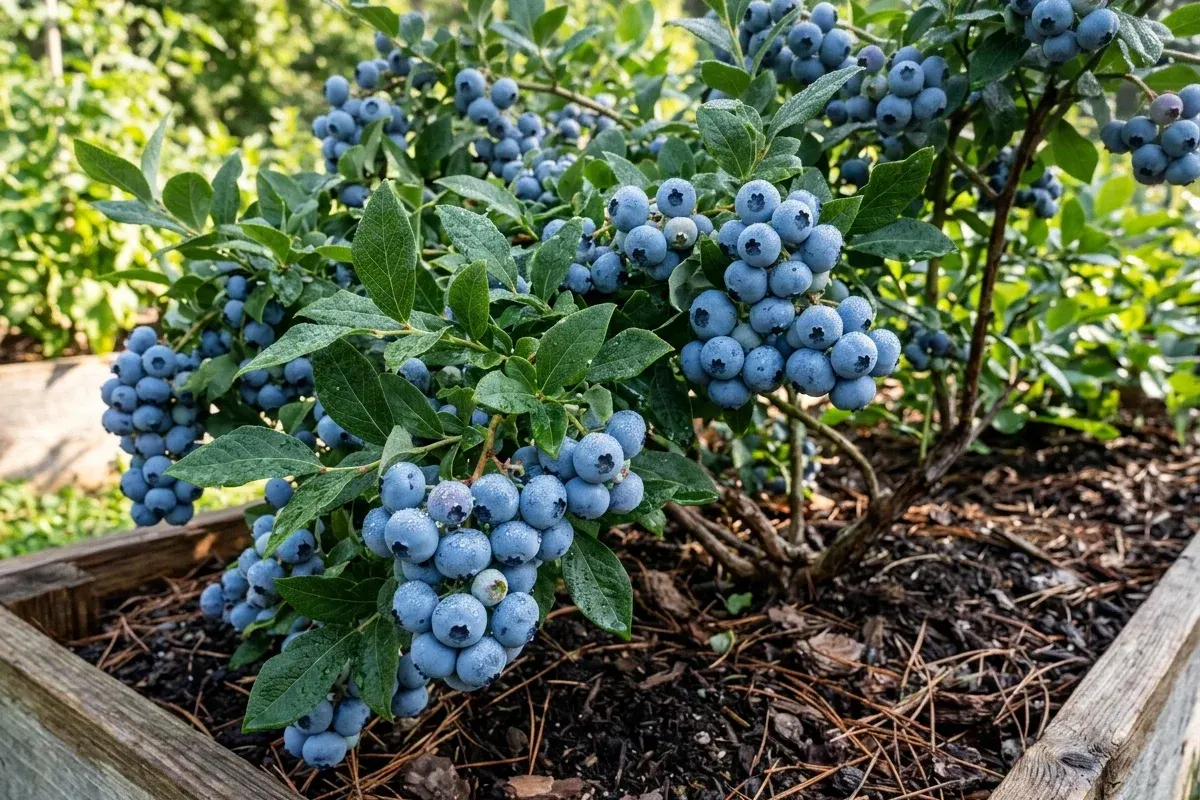
Blueberries (Vaccinium corymbosum) are among the highest-yielding, most delicious perennial fruit shrubs you can grow. A single mature highbush shrub can produce 8 to 12 pounds of crisp, antioxidant-packed berries every summer for 30 to 50 years.
Yet home gardeners regularly fail with blueberries in backyard soil. Within one or two seasons, deep green leaves turn sickly pale yellow with bright green veins (interveinal iron chlorosis), growth halts, and the bush slowly dies back.
The problem is almost never sunlight, water, or climate: it is native soil chemistry.
Garden vegetables thrive in neutral soil (pH 6.2 to 6.8). Blueberries, however, evolved in acidic, sandy peat bogs. They possess specialized fibrous root systems devoid of root hairs that can only absorb iron, nitrogen, and phosphorus at an ultra-acidic pH of 4.5 to 5.2.
Building a dedicated acidic raised bed completely isolates your berry shrubs from surrounding alkaline native soil and gives you 100% control over root zone chemistry.
The Acidic Raised Bed Soil Recipe
Do not fill a blueberry bed with commercial 3-way topsoil, standard compost, or bagged potting mixes containing limestone. Use this specialized 50/30/20 bog-mimic formula:
                 BLUEBERRY RAISED BED CROSS-SECTION
  ===================================================================
   [ 3" Aged Pine Bark or Shredded Needle Mulch (Retains Acid & Moisture) ]
  -------------------------------------------------------------------
   [ 50% Canadian Sphagnum Peat Moss (Natural pH 3.8–4.4)           ]
   [ 30% Aged Pine Bark Fines / Fir Mulch (Acidic Organic Fiber)    ]  16"–18"
   [ 20% Coarse Horticultural Perlite or Washed Sand (Drainage)     ]  Depth
  -------------------------------------------------------------------
   [ 1/2" Galvanized Hardware Cloth (Gopher & Rodent Barrier)        ]
  ~~~~~~~~~~~~~~~~~~~~~~~~ [ Native Garden Soil ] ~~~~~~~~~~~~~~~~~~~
Ingredients for a 4 × 8 ft Bed (18" Deep = 48 Cu. Ft. / 1.77 Cubic Yards)
Calculate your bed's exact volume with our Raised Bed Soil Calculator:
- Canadian Sphagnum Peat Moss (50%): Approx. 24 cu. ft. (about six to seven 3.8 cu. ft. compressed bales). Soak and pre-moisten peat moss thoroughly in a wheelbarrow before shoveling into the bed; dry peat moss repels water.
- Aged Pine Bark Fines (30%): Approx. 14.5 cu. ft. (seven 2 cu. ft. bags). Pine bark breaks down slowly, provides fungal mycorrhizal habitat, and releases organic humic acids.
- Coarse Perlite or Coarse Sand (20%): Approx. 9.5 cu. ft. Prevents soil compaction and ensures rapid drainage during torrential spring storms.
- Pelleted Elemental Sulfur: 1.5 cups mixed throughout the soil to lock the blend firmly between pH 4.8 and 5.0.
Bed Construction & Sizing Standards
When planning your blueberry bed, adhere to these structural benchmarks:
- Depth: 16 to 18 inches minimum. Blueberry roots spread wide (3 to 4 feet in diameter) but stay shallow. An 18-inch bed allows uninhibited horizontal root run.
- Width: 3 to 4 feet maximum. You must be able to harvest berries and prune canes from both sides without ever stepping onto the acidic soil, which compacts fragile fibrous roots.
- Lumber Selection: Use naturally rot-resistant Western Red Cedar, Redwood, or thick untreated Douglas fir timbers. Avoid pressure-treated lumber formulated with copper azole if you maintain an organic garden. See our guide on the Best Wood for Raised Beds for comparative lifespans.
- Rodent Barrier: Line the bottom of the raised bed with 1/2-inch galvanized hardware cloth before adding soil to prevent burrowing voles from chewing through the tender roots in winter.
Cultivar Selection: High-Yield Cross-Pollination Pairs
Always plant at least two distinct cultivars that bloom during the same window. Cross-pollination dramatically improves berry size and doubles total yield:
| USDA Zones | Primary Cultivar | Cross-Pollination Partner | Harvest Window | Berry Profile |
|---|---|---|---|---|
| Zones 4–7 (Northern) | 'Duke' (Early) | 'Patriot' (Early-Mid) | June – Early July | Large, firm, sweet-tart |
| Zones 5–8 (Northern) | 'Bluecrop' (Mid) | 'Chandler' (Mid-Late) | July – August | Huge berries (size of quarters) |
| Zones 7–10 (Southern) | 'Misty' (Very Early) | 'O'Neal' (Early) | May – June | Rich, sweet, low chill (200 hrs) |
| Zones 7–9 (Rabbiteye) | 'Tifblue' (Late) | 'Powderblue' (Late) | Late July – August | Heat-tolerant, robust shrubs |
Planting Step-by-Step
- Pre-Soak the Root Ball: 2-year bare-root or potted nursery bushes can be root-bound. Soak the pot in a bucket of rainwater for 30 minutes.
- Unwind the Roots: Gently massage and slice the bottom 1 inch of the root ball with clean shears. Tease the outer fibrous roots outward so they immediately venture into the new peat-bark medium.
- Plant at Grade: Dig a hole twice as wide as the root container. Set the bush so the top of the root collar is level or 1/2 inch higher than the surrounding bed. Never bury the crown deeper than it grew in the pot.
- Spacing: Space highbush shrubs 4 feet apart on center. In a standard 4x8-foot bed, two mature bushes thrive comfortably.
- Initial Acidifying Drench: Water each shrub with 5 gallons of rainwater mixed with 1 tablespoon of organic liquid kelp.
Watering & Drip Irrigation Strategy
Blueberries lack deep taproots; 80% of active root volume sits in the upper 8 to 10 inches of soil. If that top layer dries out for 48 hours during fruit swelling, berries shrivel and drop:
- Consistent Moisture: Blueberries require 1 to 2 inches of water per week.
- Install Drip Emitter Lines: Overhead sprinkler watering causes powdery mildew and fruit mold. Lay two parallel lines of 1/2-inch drip tubing with 0.5 GPH in-line pressure-compensating emitters spaced every 12 inches along both sides of the shrubs. See our Drip Irrigation Calculator to balance water flow.
- Water Source Warning (Hard Water): Municipal tap water and well water often have a high pH (7.5 to 8.5) loaded with dissolved calcium bicarbonate. Watering your beds with hard tap water will steadily neutralize your acidic peat within a single summer. Whenever possible, irrigate blueberries from rain barrels or add 1 tablespoon of white vinegar per gallon of tap water during midsummer dry spells.
3-Year Pruning and Training Timeline
               BLUEBERRY PRUNING STRATEGY (MATURE BUSH)
  ===================================================================
     [ Vigorous 2–4 Year Old Red/Brown Canes: KEEP & FRUIT ]
     [ Thin Whippy Twigs (< Pencil Thickness): STRIP CLEAN ]
     [ Low Sprawling Canes Touching Mulch: PRUNE TO BASE   ]
     [ 6+ Year Old Thick Gray Shaggy Canes: CUT TO CROWN   ]
- Year 1 (Establishment): Strip off 100% of all flower blossoms as soon as they appear in spring. While painful to sacrifice your first crop, this forces the plant to divert all photosynthetic sugars into deep root and cane establishment rather than fruit production.
- Year 2 (Structure): Allow 10 to 15 berry clusters to form for a small taste, but prune out weak, spindly twigs thinner than a pencil.
- Year 3 & Beyond (Renewal Pruning): Prune in late winter while shrubs are dormant (February–March):
- Remove all dead, damaged, or winter-killed branch tips.
- Cut away canes that grow horizontally toward the ground.
- Thin the center of the shrub to maintain open airflow and let sun reach the inner fruiting spurs.
- Cut 1 to 2 of the oldest, thickest, gray-barked canes completely down to ground level every year. This triggers a continuous annual renewal of vigorous, red-barked fruiting canes.
Organic Fertilizer & Soil Maintenance Schedule
| Season / Month | Nutrient / Amendment | Rate | Purpose |
|---|---|---|---|
| Early Spring (Bud Break) | Organic Cottonseed Meal or Ammonium Sulfate | 1/2 cup per bush | Delivers acid-forming nitrogen |
| Late Spring (Petal Fall) | Organic Berry Fertilizer (4-3-4 with Mycorrhizae) | 1/3 cup per bush | Sustains berry cell division |
| Early Summer (Post Harvest) | Pelleted Elemental Sulfur | 2 tablespoons per bush | Maintains pH between 4.5–5.0 |
| Late Autumn (Dormancy) | 3" Fresh Pine Needle / Pine Bark Mulch | 1 bale per 4x8 bed | Insulates roots & suppresses weeds |
[!CAUTION] Never Use Nitrate Nitrogen, Lime, or Wood Ash: Fertilizers containing calcium nitrate, sodium nitrate, bone meal, or wood ashes will rapidly raise the soil pH above 6.0 and induce catastrophic root chlorosis. Always select nitrogen sources formulated with ammonium sulfate, urea, or organic cottonseed meal.
Bird Netting & Pest Protection
Robins, starlings, and mockingbirds will strip an entire blueberry bush of ripe berries in 30 minutes at dawn.
- Build a PVC Hoop Frame: Insert 1/2-inch flexible PVC electrical conduit into 3/4-inch PVC sleeve pipes screwed to the interior corners of your raised bed, creating arches 5 feet tall.
- Drape 1/4" Knitted Bird Netting: Pull heavy UV-treated polypropylene bird mesh over the arches and clip tightly to the bottom of the wooden raised bed boards with furring strips. Never drape netting directly onto the foliage, or birds will peck fruit through the mesh and become entangled.
Related Guides & Growing Calculators
- Blueberry Plant Profile & Growing Guide: Botanical specs, chill hours, and disease care.
- Raised Bed Soil Calculator: Exact cubic yards and bag estimates for custom beds.
- Raised Bed Lumber Calculator: Design cedar bed dimensions and corner bracket hardware.
- Mulch Material Calculator: Calculate pine bark fines and wood chips for beds.
- Drip Irrigation Calculator: Plan main lines, emitter tubing, and timers.
- How to Trellis Blackberries and Raspberries: High-tensile T-bar wire plans for upright brambles.
- How to Amend Raised Bed Soil: Organic recipes for mineral refreshing.
FAQ
Why are raised beds best for growing blueberries?
Blueberries require an extremely acidic soil pH (4.5 to 5.2) and flawless drainage. Most suburban garden soil is slightly acidic to alkaline (pH 6.5 to 7.8) with heavy clay. Trying to acidify in-ground clay takes 1 to 2 years and frequently fails as surrounding minerals buffer the pH back up. A dedicated wooden raised bed lets you engineer 100% acidic, fast-draining potting medium from day one.
What is the exact soil mix recipe for blueberry raised beds?
Mix 50% Canadian sphagnum peat moss (naturally acidic at pH 3.8 to 4.4), 30% aged pine bark fines or fir sawdust, and 20% coarse horticultural perlite or washed river sand. Avoid standard topsoil, garden compost containing kitchen scraps, manure, or mushroom compost, which introduce calcium and raise pH.
How much elemental sulfur do you add to lower soil pH for blueberries?
In a raised bed containing a peat-bark blend, incorporate 0.5 to 1.0 lb of pelleted elemental sulfur (90% sulfur) per 100 square feet (approx. 1/4 cup per 4x8 bed) once a year in spring if pH creeps above 5.2. Soil microbes convert sulfur into sulfuric acid over 8 to 12 weeks during warm weather.
Do you need two different blueberry bushes to produce fruit?
Yes. While many modern cultivars are labeled self-fertile, cross-pollination between two different cultivars within the same blueberry class (such as pairing 'Duke' with 'Bluecrop') increases berry size by 30% to 50%, enhances fruit firmness, and doubles overall harvest yields.
How deep must a blueberry raised bed be?
Build your raised bed at least 16 to 18 inches deep. While blueberry roots are fibrous and concentrate in the top 10 to 12 inches, extra depth ensures pristine root drainage, keeps summer soil temperatures cooler, and accommodates deep root expansion.