How to Build a Square Foot Garden: 4x4 Box, Wood Grid & Soil Plans

By Efraín Vega · Published November 20, 2026
Traditional single-row gardening is extraordinarily inefficient: gardeners spend 80% of their time weeding, walking on, and watering empty pathway dirt between thin rows of crops. In 1981, civil engineer Mel Bartholomew revolutionized backyard agriculture by inventing Square Foot Gardening (SFG).
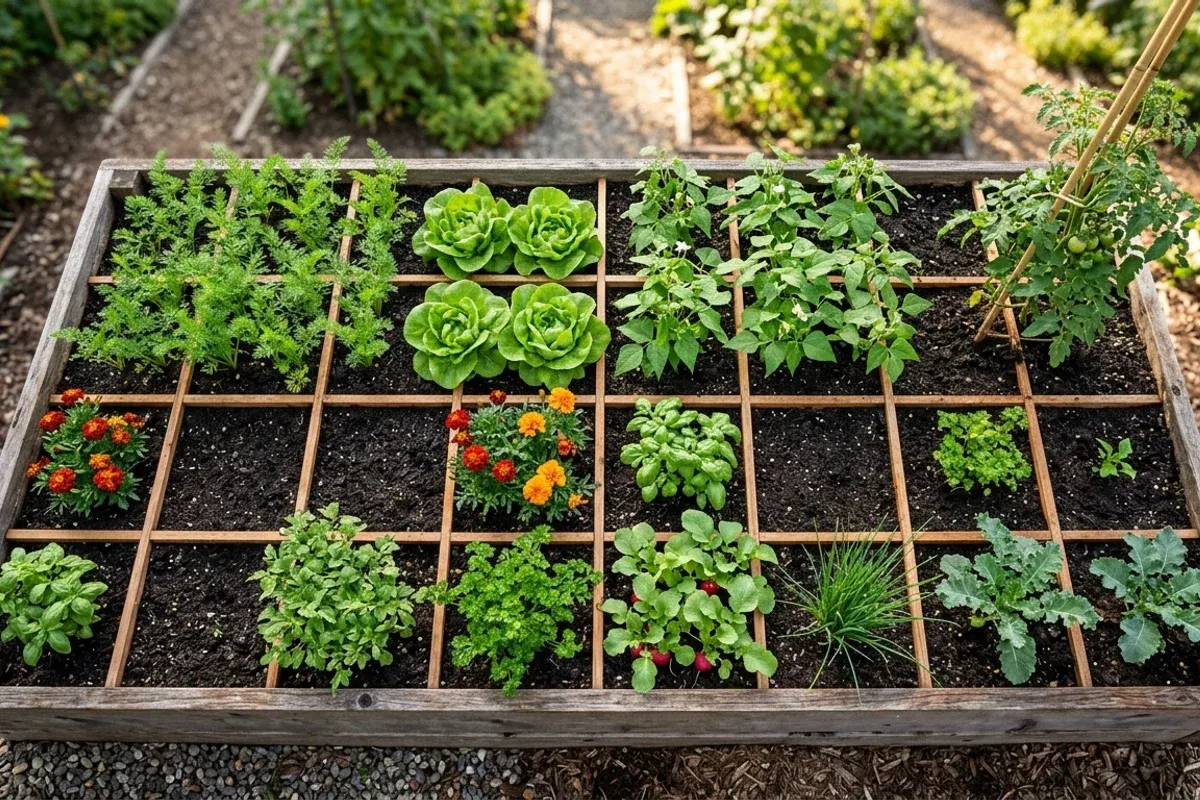
By dividing a compact 4x4-foot raised garden bed into sixteen individual 12x12-inch squares and filling it with an ultra-rich, weed-free growing medium (Mel's Mix), you produce 100% of the vegetable harvest of a conventional single-row garden in just 20% of the space, using 90% less water and zero power tilling.
Building your own 4x4 Square Foot Garden is one of the easiest, most rewarding weekend woodworking projects: a complete cedar bed, permanent wooden grid, and premium organic soil blend costs between $85 and $140 in materials.
The 4x4 Grid Layout & Ergonomic Principles
The genius of Square Foot Gardening relies on strict human physical ergonomics and intensive spatial mathematics:
                  4x4 SQUARE FOOT GARDEN GRID (16 SQUARES)
  ======================================================================
  [ North Side: Tall Crops / Trellises (Tomatoes, Cucumbers, Pole Beans) ]
  +------------------+------------------+------------------+-----------+
  | 1 Tomato (Trellis| 1 Tomato (Trellis| 4 Pole Beans     | 4 Beans   |
  +------------------+------------------+------------------+-----------+
  | 1 Bell Pepper    | 1 Eggplant       | 4 Romaine Lettuce| 4 Spinach |
  +------------------+------------------+------------------+-----------+
  | 9 Bush Beans     | 9 Beets          | 9 Spinach        | 9 Chard   |
  +------------------+------------------+------------------+-----------+
  | 16 Carrots       | 16 Radishes      | 16 Onions        | 16 Carrots|
  +------------------+------------------+------------------+-----------+
  [ South Side: Short Crops & Root Vegetables (Maximum Solar Exposure) ]
Why the 4x4 Dimension Works Perfectly
- The 24-Inch Reach Rule: An average human arm reaches 24 inches comfortably from a kneeling or standing position. A 4x4 bed accessed from both sides eliminates stretching, back strain, and stepping on the soil.
- Never Tamping the Soil: Because human feet never touch the growing bed, the soil never compacts. You never need to rent a rototiller or dig up the bed ever again.
- Pest Isolation: Rotating different plant families across the 16 squares disrupts pest life cycles. If cabbage loopers attack one square, neighboring squares of carrots and onions act as natural aromatic shields.
Calculate your exact lumber dimensions with our Raised Bed Lumber Calculator and soil bags with our Raised Bed Soil Calculator.
Bill of Materials & Cut List (4x4 Cedar Bed with Grid)
1. Cedar Box Frame
- Box Sides: 2 pieces of 2x8 Western Red Cedar (8-ft length), cut into four 48-inch lengths.
- Corner Cleats: 1 piece of 2x2 or 4x4 Cedar (6-ft length), cut into four 7.5-inch corner corner posts.
- Structural Screws: 24 exterior-rated 3-inch ceramic-coated deck screws (or GRK R4 screws).
2. Permanent Wooden Divider Grid
- Grid Slats: 6 pieces of 1/4" x 1-1/2" Cedar Lattice Slats or Screen Molding (48-inch lengths).
- Hardware: 9 brass eyelet screws or 1/2-inch stainless steel pan-head wood screws to fasten slat intersections.
3. Mel's Mix Growing Soil (8 Cubic Feet Total)
- 1/3 Blended Compost: 2.7 cubic feet (from 3 to 5 different compost sources: manure, leaf mold, mushroom, worm castings).
- 1/3 Coarse Horticultural Vermiculite: 2.7 cubic feet (large grade, never fine dust).
- 1/3 Sphagnum Peat Moss or Washed Coconut Coir: 2.7 cubic feet (one 3.0 cu. ft. compressed bale expands to roughly 5 cu. ft.).
Step-by-Step Construction Guide
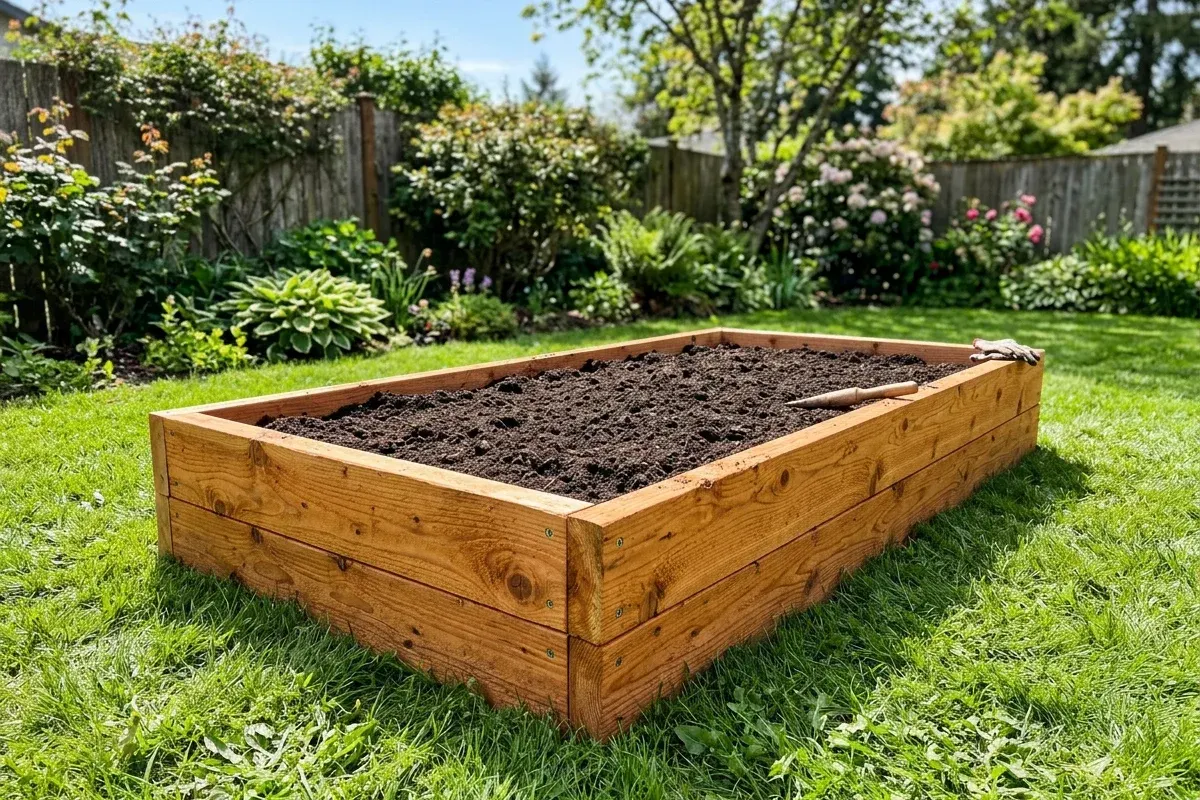
Step 1: Cutting and Assembling the 4x4 Cedar Frame
- Cut both 8-foot 2x8 cedar boards in half to yield four identical 48-inch planks.
- Cut four 7.5-inch corner cleats from your 2x2 or 4x4 cedar post.
- Stand two 48-inch planks at a 90-degree angle on a flat garage floor or workbench.
- Place a corner cleat in the inner angle.
- Pre-drill three pilot holes through the face of each plank into the corner cleat.
- Drive 3-inch ceramic-coated deck screws tightly into the cleat. Repeat for all four corners until you have a rigid, square 48x48-inch box.
- Measure diagonals corner-to-corner with a tape measure; adjust until both diagonal measurements match within 1/8 inch for a true square.
Step 2: Site Preparation & Weed Smothering
- Choose a garden location that receives at least 6 to 8 hours of unobstructed direct sunlight daily.
- Mow existing turf or weeds down as short as possible.
- Lay down 2 to 3 overlapping layers of thick, non-printed corrugated cardboard over the lawn, extending 2 inches beyond the bed perimeter.
- If burrowing gophers, moles, or voles inhabit your region, staple a sheet of 1/2-inch galvanized steel hardware cloth to the bottom edges of the wooden box frame before setting it down.
- Set the 4x4 wooden box directly on top of the cardboard base.
Step 3: Mixing and Loading Mel's Mix
Never fill a Square Foot Garden with native backyard dirt. In an enclosed box, native topsoil quickly settles into a hard, compact block.
- Lay a large 10x10-foot poly tarp on the grass next to the bed.
- Dump 1 bucket of peat moss, 1 bucket of coarse vermiculite, and 1 bucket of blended compost onto the tarp.
- Have a helper grab two corners of the tarp while you grab the opposing corners. Roll the ingredients back and forth in a rolling burrito motion until thoroughly blended.
- Moisten the dry peat moss with a gentle hose spray as you mix to eliminate dust.
- Shovel the fluffy blend into the 4x4 box until filled flush with the top rim (allowing 1/2 inch of space for settling).
For full recipe variations and budget ingredient substitutions, see our Mel's Mix Soil Recipe Ratio Guide.
Step 4: Building the Permanent Physical Grid
The physical grid is what enforces the discipline of Square Foot Gardening. Do not use string lines or twine; strings sag, break in wind, and tangle around weed cultivators.
                  WOODEN GRID OVERLAPPING JOINTS
  ==============================================================
  Mark bed sides at:  [ 12 Inches ]  [ 24 Inches ]  [ 36 Inches ]
  --------------------------------------------------------------
  Lay 3 horizontal slats across bed.
  Lay 3 vertical slats over top.
  Fasten intersections with 1/2" brass screws or half-lap notches.
  Fasten slat ends to top edges of cedar frame with 1" screws.
  ==============================================================
- Using a tape measure, make pencil marks along the top edge of the cedar frame at 12 inches, 24 inches, and 36 inches on all four sides.
- Lay three 48-inch cedar lattice slats horizontally across the bed connecting opposing marks.
- Lay three 48-inch cedar slats vertically across, creating sixteen individual 12x12-inch square compartments.
- Fasten the slat intersections with small 1/2-inch stainless steel screws or brass rivets so the grid remains rigid.
- Fasten the ends of the slats to the top rim of the cedar bed frame with 1-inch exterior screws.
Step 5: The Intensive 1-4-9-16 Planting Spacing Rules
Each 12x12-inch square is planted with a specific number of vegetables based on their mature adult size. You never plant seeds in continuous rows; you plant in finger-pressed grids:
| Spacing Density | Plants Per Square Foot | Vegetable Varieties |
|---|---|---|
| Extra Large (1 per Sq Ft) | 1 plant (Center of square) | Tomatoes, Bell Peppers, Eggplant, Cabbage, Broccoli, Cauliflower |
| Large (4 per Sq Ft) | 4 plants (2x2 grid, 6" apart) | Romaine Lettuce, Swiss Chard, Bush Green Beans, Strawberries |
| Medium (9 per Sq Ft) | 9 plants (3x3 grid, 4" apart) | Spinach, Beets, Large Onions, Bush Peas, Turnips |
| Small (16 per Sq Ft) | 16 plants (4x4 grid, 3" apart) | Carrots, Radishes, Green Onions (Scallions), Parsnips |
Consult our complete printable reference chart in the Square Foot Gardening Plant Spacing Guide.
Step 6: Watering & Succession Harvesting
- Hand Watering: Water each square individually using a gentle watering wand or install a dedicated 1/4-inch drip irrigation grid with 1/2-GPH emitters inside each square.
- Succession Sowing: When you harvest a square of fast-growing radishes (25 days) or spinach (45 days), simply add one trowelful of fresh compost to that specific square, scratch it in, and immediately plant your next crop. The bed stays in continuous, non-stop food production from spring through late autumn.
Cost Breakdown: DIY Build vs Commercial SFG Kits
| Component | DIY Build (4x4 Cedar + Soil) | Commercial Raised Bed Kit |
|---|---|---|
| Cedar Framing Lumber (2x8) | $38 | $90 - $140 (Flimsy composite) |
| Cedar Grid Slats & Fasteners | $14 | $35 (Plastic grid optional) |
| Soil Mix Ingredients (8 cu ft) | $45 (Bulk components) | $90 (Bagged pre-mix) |
| Hardware & Cardboard Base | $6 | $25 |
| Total Investment | $103 | $240 - $290 |
Estimated DIY savings: $140 to $190 (60% savings).
Related Guides & Calculators
Plan your high-yield garden setup with precision calculators:
- Raised Bed Soil Calculator for 4x4 Beds: Accurate cubic yards and bag estimates.
- Raised Bed Lumber Calculator for 4x4 Beds: Complete cut lists and board-foot takeoffs.
- Square Foot Gardening Plant Spacing Chart: Printable grid spacing for 50+ vegetables.
- Mel's Mix Soil Recipe Ratio Guide: Ingredients and mixing instructions.
- How to Amend Raised Bed Soil: Keep your squares fertile season after season.
- How to Build a Raised Bed: Traditional deep timber beds for in-ground gardens.
FAQ
Why is a 4x4-foot box the standard size for Square Foot Gardening?
A 4-foot width allows an average adult to comfortably reach 2 feet from either outer edge to the exact center of the bed without ever stepping on the soil. This prevents soil compaction, keeps the root zone loose and fluffy forever, and divides perfectly into sixteen 12x12-inch planting squares.
How deep does a Square Foot Garden box need to be?
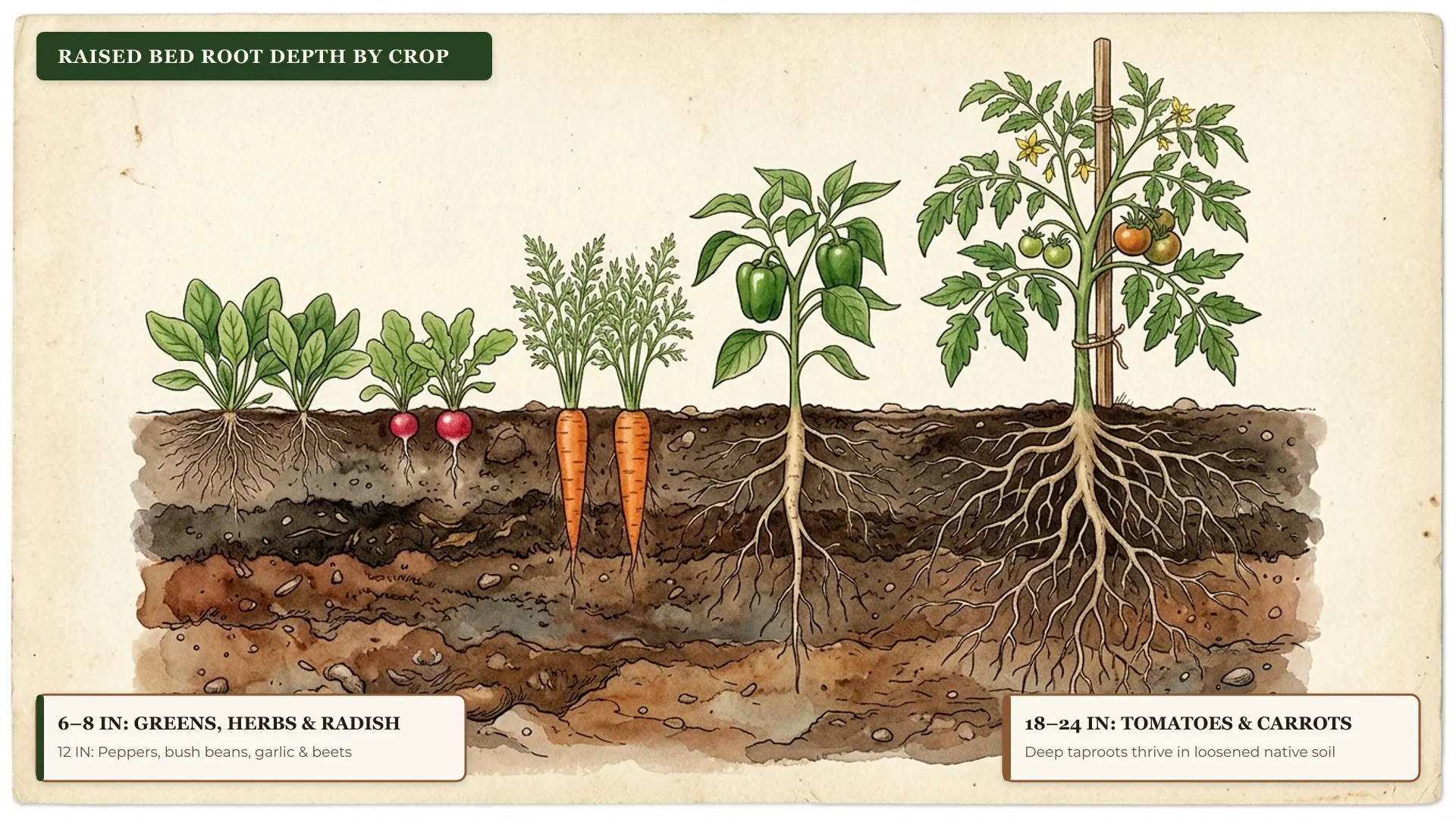
The standard depth is 6 to 8 inches. Because Mel's Mix is 100% loose, nutrient-rich organic matter with zero stones or dense clay, virtually all standard vegetables (tomatoes, peppers, greens, bush beans, and carrots) develop healthy, prolific root systems in just 6 inches of soil.
Do you really need a physical wood grid on top of the bed?
Yes. Mel Bartholomew emphasized that a physical, permanent grid made from wood slats, vinyl lattice, or cedar lath is the soul of Square Foot Gardening. Without a physical grid, gardeners subconsciously revert to planting in straight single rows, wasting up to 80% of the bed's growing capacity.
How much soil mix does a 4x4 raised bed require?
A 4x4 bed with a 6-inch depth requires 8 cubic feet of soil mix (0.30 cubic yards). An 8-inch deep 4x4 bed requires 10.7 cubic feet (0.40 cubic yards). Following the classic 1/3 Mel's Mix ratio, an 8-inch bed needs 3.5 cu ft of blended compost, 3.5 cu ft of coarse vermiculite, and 3.5 cu ft of peat moss.
Can you build a Square Foot Garden directly on top of grass?
Yes. You do not need to dig out sod. Mow the lawn turf down to the ground, lay 2 to 3 overlapping layers of thick, non-printed corrugated cardboard over the grass, place your 4x4 cedar box directly on top, and fill with soil mix. The cardboard smothers weeds and grass within 6 weeks, then earthworms digest it into rich subterranean humus.