Retaining Wall Drainage: Gravel Backfill, Pipe & Fabric

By Efraín Vega · Published November 9, 2026
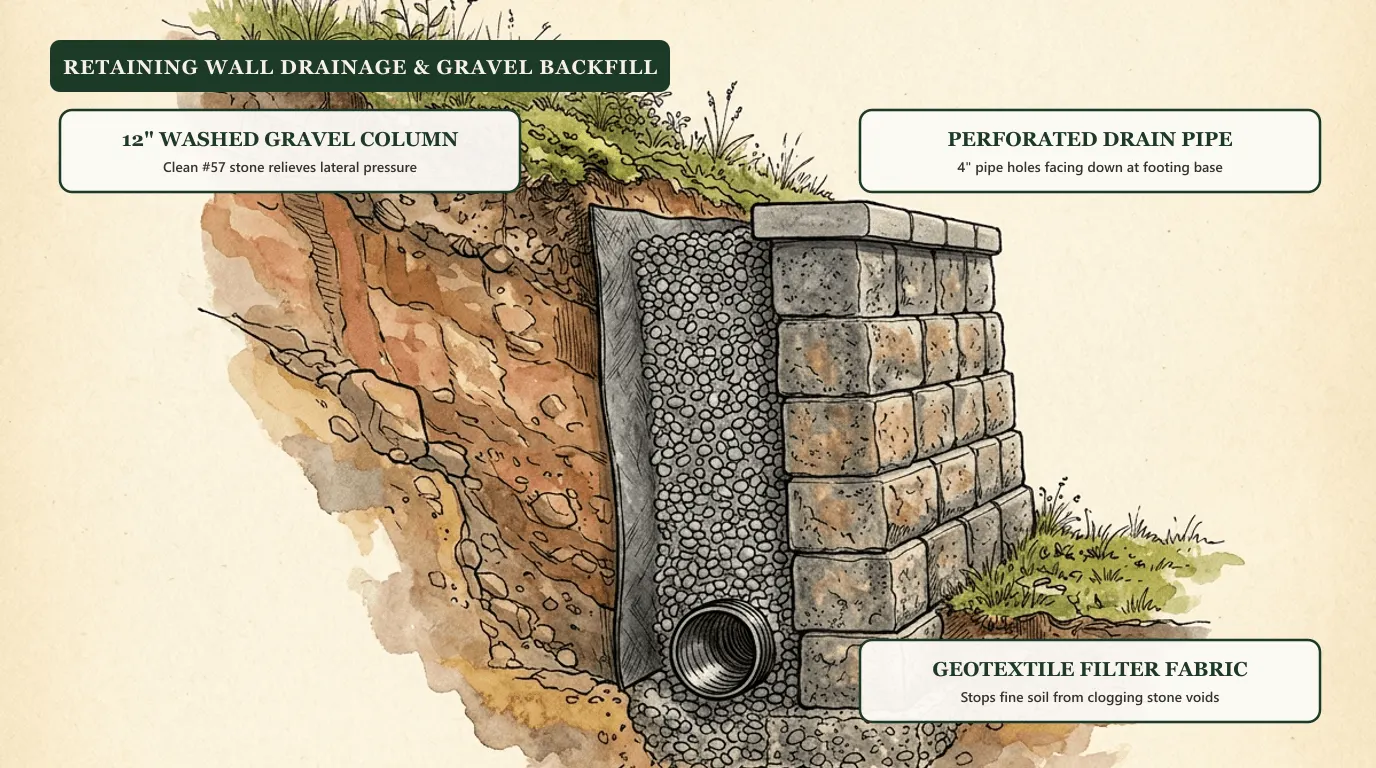
Water is responsible for more than 90% of retaining wall failures. Saturated backfill soil weighs up to 120 pounds per cubic foot, and trapped water creates hydrostatic lateral pressure that bulges, cracks, or completely topples concrete block walls.
To prevent failure, every retaining wall requires three drainage elements: a 12-inch vertical column of clean #57 crushed stone behind the blocks, a 4-inch perforated drain pipe sloped to daylight, and non-woven filter fabric separating the stone from native soil.
How much gravel backfill do you need behind a wall?
Industry standards from the National Concrete Masonry Association (NCMA) require a minimum 12-inch wide continuous drainage column extending from the buried leveling pad to within 4 to 6 inches of the top cap.
Volume Formula: Wall Length (ft) × Wall Height (ft) × 1 ft (depth) ÷ 27 = Cubic Yards of #57 Stone. Multiply by 1.4 tons/yd³ to convert to weight.
| Wall Height | Wall Length | Drainage Gravel Volume | Crushed Stone Weight (#57) |
|---|---|---|---|
| 2 feet | 20 ft | 1.48 yd³ (40 cu ft) | 2.07 tons |
| 2 feet | 40 ft | 2.96 yd³ (80 cu ft) | 4.14 tons |
| 3 feet | 20 ft | 2.22 yd³ (60 cu ft) | 3.11 tons |
| 3 feet | 30 ft | 3.33 yd³ (90 cu ft) | 4.66 tons |
| 3 feet | 50 ft | 5.56 yd³ (150 cu ft) | 7.78 tons |
| 4 feet | 30 ft | 4.44 yd³ (120 cu ft) | 6.22 tons |
| 4 feet | 50 ft | 7.41 yd³ (200 cu ft) | 10.37 tons |
To calculate both your facing blocks and the exact gravel tonnage for your layout, use our Retaining Wall Calculator and Gravel Calculator.
Which aggregate is safe for wall drainage?
Only clean, washed, angular crushed stone maintains the 30% to 40% open void space required for water to percolate downward rapidly.
- AASHTO #57 crushed stone (Recommended): Washed 1/2 to 1-inch angular granite or limestone with zero rock dust fines.
- Washed round river rock: Permissible for drainage, but angular stone locks together better against segmental blocks.
- NEVER use crusher run / 3/4-minus / road base: Dense-graded bases contain stone dust designed to compact hard. If placed behind the wall, they pack into a watertight dam.
- NEVER use native excavated soil: Backfilling with excavated yard dirt or clay holds water directly against the block face, causing frost heaving in winter.
Always place drain pipe holes facing down
It seems counterintuitive, but perforated drain pipes must sit with their holes pointing down at the 4 o'clock and 8 o'clock positions. Water accumulates at the bottom of the trench first; downward holes collect water at the lowest grade level before it can rise behind the bottom block course.
Anatomy of a long-lasting retaining wall drainage system
A proper drainage detail is built in distinct vertical layers from the trench up:
- Compacted Gravel Leveling Pad: A 6-inch base of compacted road base aggregate (#57 stone or 3/4-minus) set below grade.
- Filter Fabric "Chimney": Lay a roll of non-woven needle-punched geotextile fabric (4 oz weight) against the excavated dirt bank. Fold the top over the gravel once backfilled, preventing topsoil from migrating into the stone voids.
- 4-inch Perforated Collector Pipe: Place a perforated rigid PVC (SDR 35) or heavy-duty corrugated slotted pipe at the rear base of the first buried block course, pitched at 1/8 inch per foot (1% slope) toward a discharge point.
- Clean Stone Column: Fill the 12-inch space behind each course of blocks with washed #57 stone. Trowel or hand-tamp lightly as each block row is laid; heavy plate compactors must stay at least 3 feet back from the wall face to avoid pushing blocks out of alignment.
- Soil Cap & Swale: Finish the top 4 to 6 inches above the fabric with low-permeability topsoil or sod, shaped into a gentle swale directing surface runoff away from the top cap.
How to daylight the drain pipe
Water collected in the drainage gravel must have a clear exit path. Depending on your yard layout, choose one of these discharge methods:
- Through-Wall Core Drain: In longer walls, install a tee fitting every 30 to 50 feet and run an unperforated pipe through a cut block opening at ground level, covered with a rodent grate.
- Gravity Daylight to Slope: Run the pipe out past the end of the retaining wall wing and daylight onto the lawn or a gravel splash pad downslope.
- Discharge to French Drain or Catch Basin: Connect the wall pipe into a primary yard French drain system. See how deep a French drain should be for trench elevation guidance.
Sources: National Concrete Masonry Association (NCMA), Design Manual for Segmental Retaining Walls; International Residential Code (IRC) Section R405 (Foundation Drainage).
FAQ
What kind of gravel goes behind a retaining wall?
Use clean, angular, washed crushed stone measuring 1/2 to 3/4 inch, such as AASHTO #57 crushed granite or limestone. Never use pea gravel, crusher run, or base gravel with rock dust (fines), which compact and trap water behind the blocks.
How much gravel do you need behind a retaining wall?
Install a vertical column of clean drainage stone at least 12 inches thick directly behind the entire height of the wall. For a wall 3 feet tall and 30 feet long, that requires about 3.3 cubic yards (approx 4.6 tons) of #57 stone.
Do retaining walls under 4 feet need a drain pipe?
Yes. Even short 2-to-3-foot retaining walls experience massive hydrostatic pressure when heavy clay soil becomes saturated. A 4-inch perforated PVC or corrugated pipe placed holes-down at the bottom of the gravel column carries groundwater safely away.
Which way do the holes go on a retaining wall drain pipe?
Face the perforations downward toward the leveling pad. As rising groundwater enters the gravel zone, it fills the trench from below; holes facing down allow water to enter the pipe immediately and flow out before rising into the backfill.
Do you need filter fabric between the gravel and soil?
Yes. Line the native soil bank with non-woven needle-punched geotextile landscape fabric before placing the gravel. This prevents clay and silt particles from washing into and clogging the voids between the drainage stones.