How Deep Should a French Drain Be? Slope, Trench Width & Gravel

By Efraín Vega · Published October 28, 2026
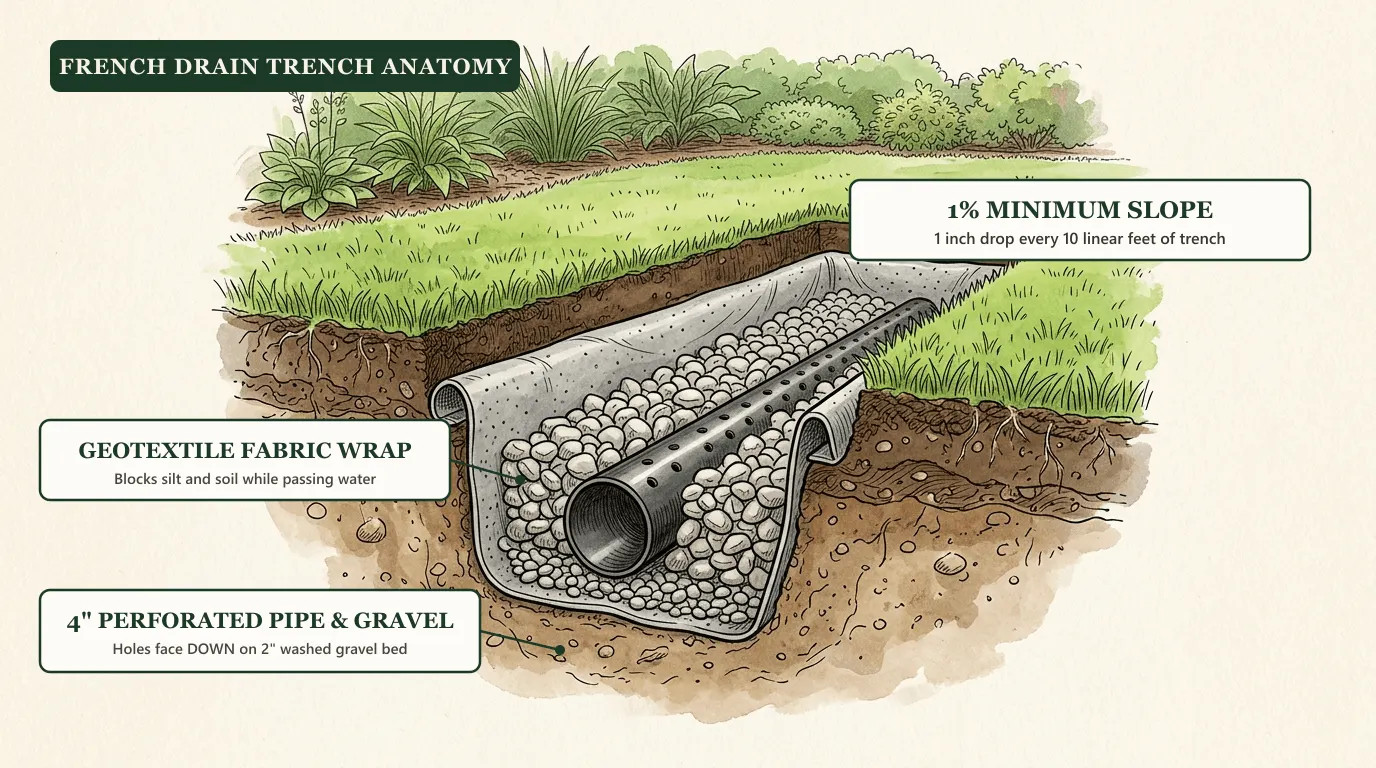
A residential yard French drain should be dug 18 to 24 inches deep and 8 to 12 inches wide, with a continuous downhill slope of at least 1% (1/8 to 1/4 inch of drop per linear foot) toward its exit point.
Deeper trenches (24 to 36 inches) are only required when protecting basement foundations or footing drains against hydrostatic pressure. For yard standing water, soggy turf, and downspout runoff, 18 to 24 inches provides the optimal balance of water interception and manageable digging.
How deep should a French drain be?
A residential yard French drain must be dug 18 to 24 inches deep and 8 to 12 inches wide, with a continuous downward slope of at least 1% (1 to 2 inches of drop every 10 linear feet). Foundation and footing drains require a deeper trench of 24 to 36 inches to intercept subsurface water tables.
| Dimension / Element | Standard yard drain | Foundation / Footing drain | Critical installation rule |
|---|---|---|---|
| Trench Depth | 18–24 inches | 24–36 inches (to footing) | Maintain continuous downward grade |
| Trench Width | 8–12 inches | 10–12 inches | Wide enough for 4" pipe + gravel on sides |
| Minimum Slope | 1% (1/8" per ft) | 1% to 2% (1/4" per ft) | Drop 1–2.5 inches every 10 linear feet |
| Pipe Size & Type | 4-inch perforated pipe | 4-inch rigid perforated PVC | Holes oriented facing downward |
| Bedding Gravel | 3–4 inches under pipe | 4–6 inches under pipe | Washed #57 crushed angular stone |
| Fabric Envelope | Non-woven geotextile (4 oz) | Non-woven geotextile (4–6 oz) | Wrap stone & pipe; never wrap pipe alone |
To calculate the exact tons of crushed gravel, fabric yardage, and pipe length for your trench, use our French Drain Calculator.
Why the slope matters (And how to measure it)
French drains operate strictly on gravity. If a trench is dug level or has low belly pockets, water will pool inside the pipe, collect fine silt over time, and stagnate.
- 1% slope formula: 1 foot of vertical drop for every 100 feet of run.
- Per 10 feet: 1.2 inches of vertical drop.
- Per 50 feet: 6 inches of vertical drop.
How to verify slope during excavation:
- Drive wooden stakes at the trench start (highest point) and end (discharge point).
- Stretch tight mason's line between them and attach a line level. Adjust the string until the bubble is centered level.
- Measure down from the level string with a tape measure every 10 feet. If your start depth is 18 inches below the string, your depth at 10 feet must be 19.25 inches, at 20 feet must be 20.5 inches, and at 50 feet must be 24 inches.
The right gravel (and the two types that fail)
Gravel is the primary filtration and conveyance medium in a French drain. Water flows through the voids between gravel stones roughly 100 times faster than through surrounding clay soil.
- The only gravel to buy: Washed #57 Crushed Stone (3/4-inch to 1-inch angular limestone or granite). The angular shapes lock together to prevent trench collapse while leaving massive 40% void ratios for rapid water movement.
- Mistake 1: Pea gravel: Small rounded river pebbles (1/4-inch to 3/8-inch) settle tightly together under compaction, drastically reducing water flow rates.
- Mistake 2: Unwashed quarry run / road base: Any gravel labeled "crusher run", "dense grade", or "with fines" contains stone dust. The moment water touches it, the dust turns into cement-like paste that bonds to the geotextile fabric and permanently blinds the drain.
You can calculate cubic yards and total tonnage needed with our Gravel Calculator.
Never wrap just the pipe with fabric sock
Thin fabric "sleeves" pulled directly over perforated corrugated pipes clog quickly because silt contacts the pipe holes directly. Instead, create a geotextile burrito wrap: line the entire dirt trench with non-woven geotextile fabric, lay gravel and pipe inside, and fold the fabric over the top before backfilling.
Why pipe holes must face down
One of the most common DIY mistakes is installing perforated pipe with the drain holes pointed toward the sky.
- How water moves: Ground moisture does not drop from the sky into the pipe like a gutter. Rain saturates the soil and raises the subterranean water table from the bottom up.
- When holes face up: Water must fill the entire 18-inch trench with water and submerge the pipe completely before spilling over into top holes. Your yard remains soaked until the trench is 80% full.
- When holes face down: Resting on a 4-inch gravel bed with holes angled at 4 o'clock and 8 o'clock, rising water enters the pipe as soon as it reaches 4 inches off the trench floor. The pipe siphons the water away before it ever nears your lawn surface.
Where to daylight the discharge
A French drain must terminate somewhere water can exit safely without flooding neighboring properties:
- Pop-up emitter in lawn: Terminates in an emitter cap that stays flush with turf until water pressure lifts the lid to discharge onto a downhill lawn section.
- Dry well: A buried 50-gallon perforated plastic basin surrounded by gravel where water slowly percolates back into deep subsoils.
- Gravity daylight exit: Cutting through a sloped hillside or retaining wall with a rodent-screened grate above grade.
FAQ
How deep should a French drain be for a yard?
For standard surface water and soggy lawn drainage, dig the trench 18 to 24 inches deep. If intercepting subsurface water near a foundation footing or basement wall, dig 24 to 36 inches deep (at least as deep as the footing).
What is the minimum slope for a French drain?
A French drain must slope downward at least 1% toward the discharge outlet—which equals 1/8 inch to 1/4 inch of fall per linear foot, or 1 to 2.5 inches of drop every 10 feet.
Do the holes in a French drain pipe face up or down?
The holes must face downward (toward 4 o'clock and 8 o'clock). Water fills the gravel trench from the bottom up. Facing the holes down allows water to enter the pipe at the lowest possible water table level and flow away by gravity before rising to flood your lawn.
What kind of gravel should I use in a French drain?
Use 3/4-inch to 1-inch washed, angular crushed stone (commonly sold as #57 stone). Never use rounded pea gravel (which packs too tightly) or unwashed crushed run containing stone dust, which turns into slurry and clogs the drainage fabric.