How to Build an A-Frame Cucumber Trellis: Dimensions, Lumber & Plans

By Efraín Vega · Published November 12, 2026
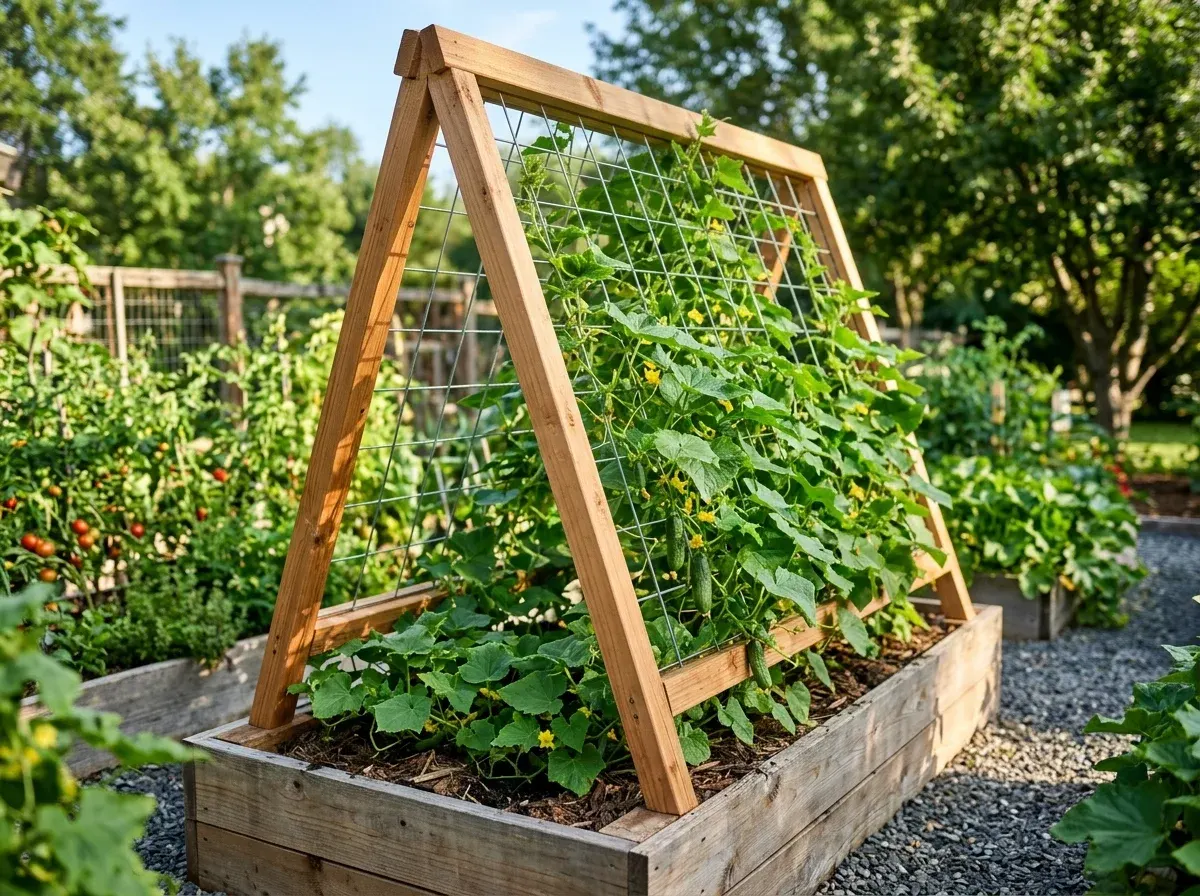
An A-frame trellis is one of the most space-efficient, high-yielding structures you can add to a raised bed garden. By training vigorous vining cucumbers up angled lattice frames, you can grow twice as many plants in the same footprint while keeping fruit clean, straight, and completely off the damp soil.
Even better, the hollow "tent" space beneath the A-frame stays 5° to 10° cooler during summer peaks, providing prime filtered shade to grow tender greens like lettuce and spinach.
Why an A-Frame Trellis Outperforms Flat Trellises
Flat vertical trellises catch strong summer winds like a sail and require heavy, deep posts driven into subsoil. An A-frame trellis, by contrast:
- Self-supporting triangular stability: The two opposing angled frames brace against each other, eliminating the need for concrete footings or permanent post holes.
- Under-canopy fruit hang: Cucumbers naturally hang straight down inside the tent tunnel. They stay completely shaded from sunburn, clean from soil splash, and easy to spot without parting dense leaves.
- Winter storage: By connecting the top apex with exterior utility hinges, the entire trellis folds completely flat for easy off-season storage against a garden shed wall.
Recommended Dimensions & Materials Cut List
This build fits a standard 4-foot wide raised bed (or a 4×8 ft bed footprint):
| Component | Quantity | Material | Finished Dimensions |
|---|---|---|---|
| Side Legs | 4 | 2×2 Cedar or Redwood | 6 ft (72 in) long |
| Top Crossbars | 2 | 2×2 Cedar | 48 in long |
| Bottom Crossbars | 2 | 2×2 Cedar | 48 in long |
| Middle Stretchers | 2 | 2×2 Cedar | 48 in long |
| Apex Hinges | 2 | Galvanized T-hinges or strap hinges | 3 in or 4 in with exterior screws |
| Support Infill | 2 panels | Welded wire fence (2×4 in grid) or heavy trellis netting | 4 ft wide × 5.5 ft long |
| Fasteners | 1 box | 2½ in exterior deck screws | Coated ceramic or stainless steel |
For calculating wood quantities, board-foot estimates, and cutting layouts across multiple beds, use our Raised Bed Lumber Calculator and Arbor & Trellis Calculator.
Step-by-Step Construction Guide
Step 1: Assemble the Two Identical Ladder Frames
- Lay out two 72-inch legs parallel on a flat work surface, spaced 48 inches apart on the outside edges.
- Place the top 48-inch crossbar flush with the top ends of both legs. Pre-drill pilot holes to avoid splitting the cedar, and fasten with two 2½-inch deck screws at each corner.
- Fasten the bottom crossbar 6 inches up from the bottom leg tips (leaving 6-inch feet that push down into the garden soil).
- Secure the middle stretcher 36 inches from the top to ensure lateral stiffness under heavy fruit loads.
- Repeat for the second identical ladder frame.
Step 2: Attach the Wire Mesh or Trellis Netting
- Unroll heavy-duty 14-gauge welded wire fencing (or rigid welded cattle panel wire) across each wood frame.
- Secure the wire to the 2×2 lumber using 1-inch galvanized fencing staples or heavy cable ties spaced every 6 inches along all rails.
- Trim any protruding wire ends flush with wire cutters to prevent scratching leaves or hands during harvest.
Step 3: Install Apex Hinges & Spread Limiter
- Lay both completed frames top-to-top on the ground with wire sides facing outward.
- Position two exterior strap hinges across the top joint, spaced 6 to 8 inches in from each outer corner, and drive exterior screws.
- Attach an 18-inch length of lightweight brass or stainless steel chain on each side, roughly 2 feet up from the base. This acts as a positive spread limiter, preventing the A-frame legs from sliding outward under wet cucumber weight.
Bed Placement & Planting Layout
- Orientation: Position the A-frame with the open ends aligned North-to-South. This allows both angled faces to receive equal morning and afternoon sun without one face permanently casting shade on the other.
- Planting Cucumbers: Sow seeds or set out transplants along the outside bottom base, spaced 6 to 8 inches apart. Guide young tendrils toward the lowest wire rungs; within 10 days, the vines will climb autonomously.
- Companion Cropping: Underneath the trellis arch, plant quick-maturing, shade-tolerant companions such as arugula, radishes, or dwarf carrots.
Learn more about companion layout strategies in our Cucumber Companion Guide and interactive Companion Planting Checker.
FAQ
What is the best angle for an A-frame cucumber trellis?
A 60° to 70° interior angle is ideal. It provides a steep enough incline for cucumber tendrils to grip easily while keeping ripening fruit hanging down into the shaded interior tunnel for effortless, clean harvesting.
What lumber is best for an outdoor garden trellis?
Untreated western red cedar or redwood is best due to natural rot- and insect-resistant tannins. If using standard pine or fir, coat with a non-toxic food-safe exterior wood seal or tung oil.
Can I use an A-frame trellis inside a 4x8 raised bed?
Yes. An A-frame with a 4-foot base span straddles a standard 4-foot wide raised bed perfectly, creating a shaded under-canopy ideal for cool-season companion crops like lettuce, spinach, and radishes.
Why do cucumbers grow better on an A-frame trellis?
Vertical airflow drastically cuts down powdery mildew and fungal blights, keeps fruit away from soil slugs and moisture rot, and results in perfectly straight, uniform, dark green cucumbers.