#57 Stone for Shed Base: Size, Depth & Pad Framing

By Efraín Vega · Published November 12, 2026
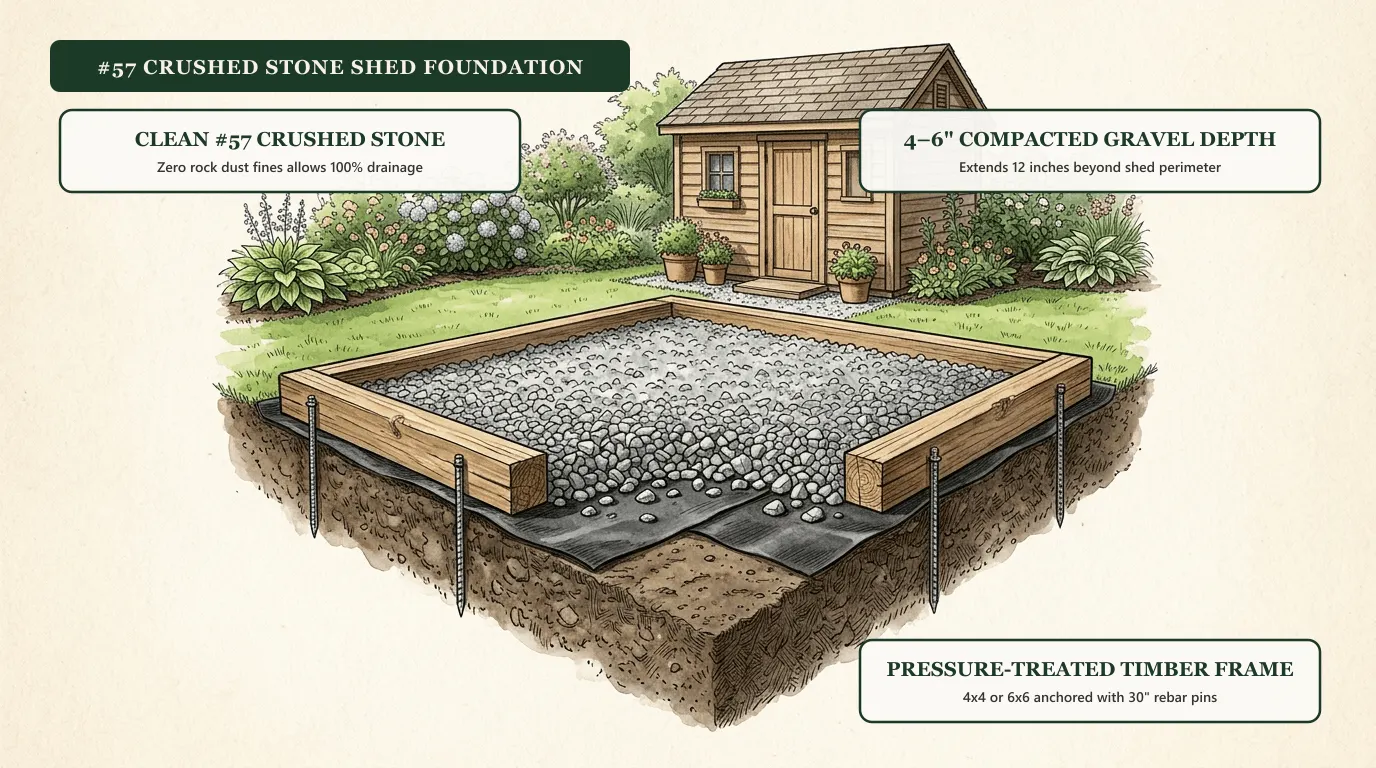
A crushed stone gravel pad is the most cost-effective, long-lasting foundation for a prefabricated backyard shed. It costs 60% less than a concrete slab, provides 100% permeable drainage, and prevents wooden floor joists from rotting.
The gold standard aggregate for this build is AASHTO #57 crushed stone—clean, angular 1/2 to 1-inch rock with zero dust fines.
Why #57 clean stone beats crusher run for sheds
Homeowners often confuse #57 clean crushed stone with crusher run (3/4-minus):
- #57 Clean Stone (Best for Sheds): Washed angular rock with all dust removed. When dumped and leveled, it leaves roughly 35% open void space. Rainwater draining off the shed roof passes straight through into the soil, keeping the wooden skids bone-dry.
- Crusher Run / Road Base (Best for Pavers, Poor for Sheds): Contains angular stone blended with fine stone dust. It compacts into a dense, semi-impermeable layer. Water sitting on top of crusher run cannot drain freely and pools directly against wooden floor framing.
- Pea Gravel (Avoid): Smooth, rounded stones act like ball bearings and shift under shed skids, causing the structure to lean out of level.
How to size and calculate gravel for your shed pad
Always build the foundation 2 feet wider and 2 feet longer than your shed footprint (a 12-inch gravel border around the perimeter).
Weight Formula: Pad Length (ft) × Pad Width (ft) × Depth (ft) ÷ 27 × 1.4 tons/yd³ = Tons of #57 Stone.
| Shed Size | Foundation Pad Size (12" border) | 4-Inch Depth (Tons) | 6-Inch Depth (Tons) |
|---|---|---|---|
| 8 × 8 ft | 10 × 10 ft (100 sq ft) | 1.73 tons (1.23 yd³) | 2.60 tons (1.85 yd³) |
| 8 × 10 ft | 10 × 12 ft (120 sq ft) | 2.07 tons (1.48 yd³) | 3.11 tons (2.22 yd³) |
| 10 × 12 ft | 12 × 14 ft (168 sq ft) | 2.90 tons (2.07 yd³) | 4.36 tons (3.11 yd³) |
| 10 × 16 ft | 12 × 18 ft (216 sq ft) | 3.73 tons (2.67 yd³) | 5.60 tons (4.00 yd³) |
| 12 × 20 ft | 14 × 22 ft (308 sq ft) | 5.32 tons (3.80 yd³) | 7.99 tons (5.70 yd³) |
Calculate gravel tonnage and perimeter timber boards for your exact dimensions with our Gravel Calculator and Shed Foundation Calculator.
How to build a timber-framed shed gravel pad
- Mark and Square the Perimeter: Drive stakes at the four corners of the pad (remember to add 2 feet to shed dimensions). Check diagonals with a tape measure to ensure the layout is a true rectangle.
- Excavate Sod and Loam: Dig out turf and organic topsoil down to firm mineral dirt (typically 4 to 6 inches deep).
- Build the Timber Retaining Box: Build a box using ground-contact pressure-treated 4×4 or 6×6 timbers. Join corners with 1/2-lap joints or 8-inch structural timber screws. Level the box on all four sides using a 4-foot level.
- Anchor Timbers with Rebar: Drill 1/2-inch holes through the timbers every 4 to 6 feet and drive 24 to 30-inch steel rebar pins (#4 rebar) through into the ground to lock the frame in place.
- Install Non-Woven Geotextile Fabric: Line the bottom of the excavation with heavy-duty non-woven landscape fabric, running it up the inside walls of the timber frame and stapling it in place.
- Fill with #57 Crushed Stone: Shovel or dump the clean stone into the framed box. Screed the gravel level with the top edge of the timbers using a straight 2×4 board, then run a gas plate compactor over the surface to interlock the angular stones.
Handling sloped ground
If your yard slopes more than 6 inches across the pad area, never dig into the hill without retaining walls. Instead, build a stepped two-tier timber box on the downhill side to retain the deeper gravel layer, and install a perforated drain pipe along the uphill timber to catch runoff.
Sources: International Residential Code (IRC) Section R403 (Footings and Foundations); American Wood Protection Association (AWPA) Standard UC4A (Ground Contact Lumber).
FAQ
What is the best gravel for a shed base?
Clean, washed #57 crushed stone (also called 3/4-inch clean crushed granite or limestone). Unlike road base or crusher run, #57 stone contains zero stone dust fines, allowing rainwater to drain instantly away from the shed's floor joists and skids.
How deep should #57 stone be for a shed foundation?
Install 4 to 6 inches of compacted #57 stone for standard prefabricated garden sheds on level ground. If your site slopes more than 8 inches across the pad, build a tiered timber cribbing frame and increase depth up to 8 to 12 inches on the downhill side.
Should a shed gravel pad be bigger than the shed?
Yes. Extend the gravel pad 12 inches (1 foot) beyond the shed walls on all four sides. An 8×10 ft shed needs a 10×12 ft gravel foundation. The extra border catches roof drip water, prevents soil splashing onto siding, and provides structural perimeter support.
Do you need landscape fabric under #57 stone?
Yes. Lay a heavy-duty, non-woven geotextile fabric (at least 4 to 6 oz weight) over the bare excavated soil before shoveling in the #57 stone. Without fabric, the crushed rock will slowly sink into muddy subsoil under the weight of the shed.
How much #57 stone do I need for a 10x12 shed pad?
A 10×12 ft pad (for an 8×10 shed) at a 4-inch depth requires 1.48 cubic yards, which equals approximately 2.07 tons of #57 stone. At a 6-inch depth, it requires 2.22 cubic yards or 3.11 tons.