How Much Soil for a Raised Bed? (Formula + Size Chart)

By Rowan Plank · Published September 24, 2026
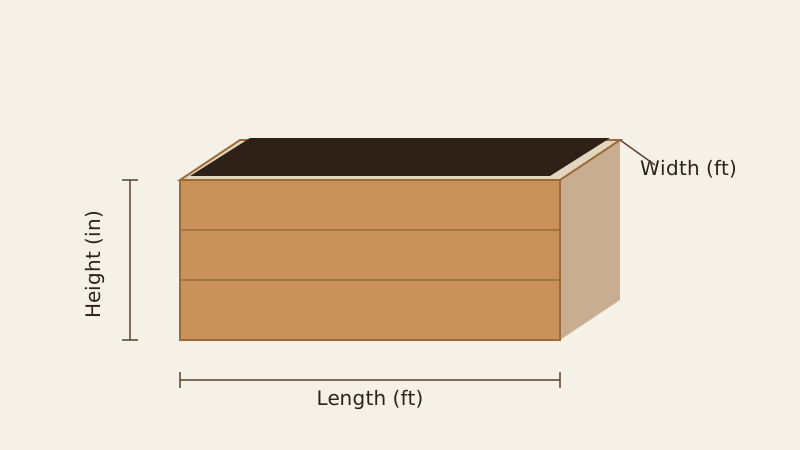
A 4×8 ft bed that's 12 in deep needs 32 cu ft of soil, about 1.2 cubic yards. Every other bed size uses the same formula — you're just swapping in your own numbers.
The formula
Volume (cu ft) = length (ft) × width (ft) × (height in inches ÷ 12)
Divide that by 27 to get cubic yards, since a cubic yard is 27 cubic feet. Bulk soil is usually sold by the yard; bagged soil is usually sold by the cubic foot — which is why both units matter.
Soil needed by bed size
These are exact numbers from the formula above, no rounding for waste yet — add 10% on top of any of these for settling.
| Bed size (L × W) | Depth | Volume |
|---|---|---|
| 2×4 ft | 12 in | 8 cu ft (0.30 yd³) |
| 4×4 ft | 12 in | 16 cu ft (0.59 yd³) |
| 3×6 ft | 12 in | 18 cu ft (0.67 yd³) |
| 4×8 ft | 12 in | 32 cu ft (1.19 yd³) |
| 4×8 ft | 18 in | 48 cu ft (1.78 yd³) |
| 4×12 ft | 12 in | 48 cu ft (1.78 yd³) |
Add a waste margin
Soil settles over the first few weeks, so add about 10% on top of the raw number before you buy. For a 4×8 ft bed at 12 in, that's roughly 35 cu ft instead of 32.
Bagged soil vs. bulk soil
Bagged soil usually comes in 1, 1.5, or 2 cu ft bags. For anything under about 1 cubic yard (27 cu ft), bags are often more convenient than arranging a bulk delivery — for a single 4×8 ft bed at 12 in deep, that's roughly 18–35 bags depending on size, which fits in a couple of car trips.
Once you're filling several beds or anything over a cubic yard, bulk soil delivered by the yard is almost always cheaper per cubic foot, even after the delivery fee.
What to fill it with
A common raised bed mix is:
- 60% topsoil — the bulk of the volume and mineral content
- 30% compost — organic matter and nutrients
- 10% perlite or vermiculite — keeps the mix from compacting and holds some moisture
This lines up with Utah State University Extension, which recommends amending topsoil with 30–50% compost by volume. Plain topsoil on its own compacts hard in a contained bed and drains poorly. The compost and aerator are what make it behave like a proper raised-bed mix instead of dirt from the yard.
Use the Raised Bed Soil Calculator to plug in your own bed dimensions and get bag counts and a mix breakdown instead of doing the math by hand.
Still planning the bed itself? See how deep a raised bed should be, what size to make it, and how to build a 4×8 raised bed.
Sources: Raised Bed Gardening — USU Extension, Growing Vegetables in Raised Beds — UMD Extension.
FAQ
Do I need to fill a raised bed all the way to the top?
No — leave about 1 in of space below the rim so water doesn't spill over when you irrigate, and soil settles a bit after the first season anyway.
Can I fill the bottom of a deep bed with something other than soil?
Some gardeners fill the bottom third of a very deep bed (12 in+) with untreated logs or coarse woody debris (hügelkultur-style) to cut down on soil volume and cost. It's optional, not required.
Is topsoil the same as garden soil or raised bed mix?
No. Plain topsoil is too dense and compacts in a contained bed. Raised beds need a blended mix — topsoil plus compost plus an aerator like perlite or vermiculite — so roots get both nutrients and drainage.