What Size Should a Raised Bed Be? Width, Length & Paths

By Rowan Plank · Published September 28, 2026
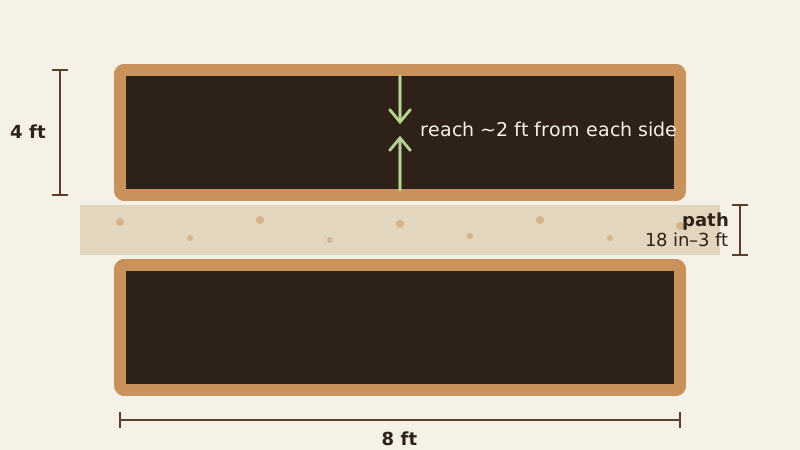
The standard raised bed is 4 ft wide by 8 ft long, and there's a good reason: 4 feet is about as wide as you can reach across from both sides, and 8 feet matches the most common lumber length. Leave 18 to 24 inches between beds for walking, or about 3 feet if you need a wheelbarrow to fit.
How wide should a raised bed be?
3 to 4 feet if you can reach it from both sides. Oregon State Extension calls 4 feet "a good choice for adult gardeners," and Clemson and Utah State Extension both recommend 3 to 4 feet so you can reach the center without stepping into the bed.
That last part matters. The main advantage of a raised bed is loose soil that's never walked on. Once you're stepping in to reach the middle, you compact it.
| Situation | Recommended width |
|---|---|
| Open on both sides | 3–4 ft |
| Against a wall or fence | 2–3 ft |
| For kids, or gardening from a seat | 2–3 ft |
How long should a raised bed be?
Length is up to you — Clemson Extension says beds "can be as long as desired." In practice, the best lengths line up with lumber, which is sold in 8, 10, 12 and 16 ft lengths:
| Bed size | Growing area | Boards per row of height |
|---|---|---|
| 4×4 ft | 16 sq ft | 2 (8 ft boards) |
| 4×8 ft | 32 sq ft | 3 (8 ft boards) |
| 4×12 ft | 48 sq ft | 3 (12 ft boards), or 5 spliced 8 ft boards |
| 3×6 ft | 18 sq ft | 3 (8 ft boards) |
A 4×8 bed uses two full 8 ft boards for the sides and one 8 ft board cut in half for the ends, with zero waste. That's why it's the default.
Long sides need support. Oregon State Extension recommends reinforcing beds longer than about 6 feet — a stake or brace at the middle of each long side keeps the boards from bowing once the bed is full of wet soil.
How much space between beds?
Enough to work comfortably. Recommendations vary:
- 14–16 in is common for tight vegetable plots (Oregon State Extension) — enough to walk, but not to kneel comfortably.
- 2 ft is a practical minimum for kneeling and carrying tools (University of Maryland Extension).
- 3–4 ft is "comfortable for most pathways" (Clemson Extension), and it's what you'll need for a wheelbarrow, a mower, or a wheelchair.
Measure your wheelbarrow and mower before you commit. Paths are much harder to widen after the beds are filled.
Mulch the paths
Wood chips or mulch on paths keep weeds down and mud off your shoes. Use the Mulch Calculator to figure out how much you need for the path area.
How many beds do you need?
Start smaller than you think. One or two 4×8 beds (32–64 sq ft) is plenty for a first season: room for a few tomato plants, a row of peppers, greens, and herbs. It's easier to add a bed next year than to keep up with more than you can water and weed.
How tall should it be?
Most beds are 8 to 12 inches tall, which is enough when the bed sits on soil roots can grow into. Beds on concrete, or for crops like tomatoes and squash, need more depth. See how deep a raised bed should be for depth by crop.
Once you've settled on a size, the Raised Bed Lumber Calculator gives you the exact board count, and the Raised Bed Soil Calculator tells you how much soil to fill it.
Sources: Raised Bed Gardening — OSU Extension, Raised Beds — Clemson HGIC, Raised Bed Gardening — USU Extension, Growing Vegetables in Raised Beds — UMD Extension.
FAQ
Why are raised beds usually 4 feet wide?
Because most adults can reach about 2 feet in from each side. A 4-foot bed lets you reach the center from either side without stepping in and compacting the soil.
How wide should a raised bed be against a wall or fence?
About 2 to 3 feet. When you can only reach from one side, keep the bed narrow enough to reach the back edge without stepping in.
How long can a raised bed be?
As long as you like, but long beds are tiring to walk around, and Oregon State Extension recommends reinforcing sides longer than about 6 feet so they don't bow outward. Eight feet is the most common length because it matches standard lumber.
How much space should be between raised beds?
At least 18 to 24 inches to walk and kneel, and closer to 3 feet if you need to push a wheelbarrow or mower through, or use a wheelchair.