How Many Bags of Concrete for a 10x10 Slab (4, 5 & 6 Inches Deep)

By Efraín Vega · Published October 28, 2026
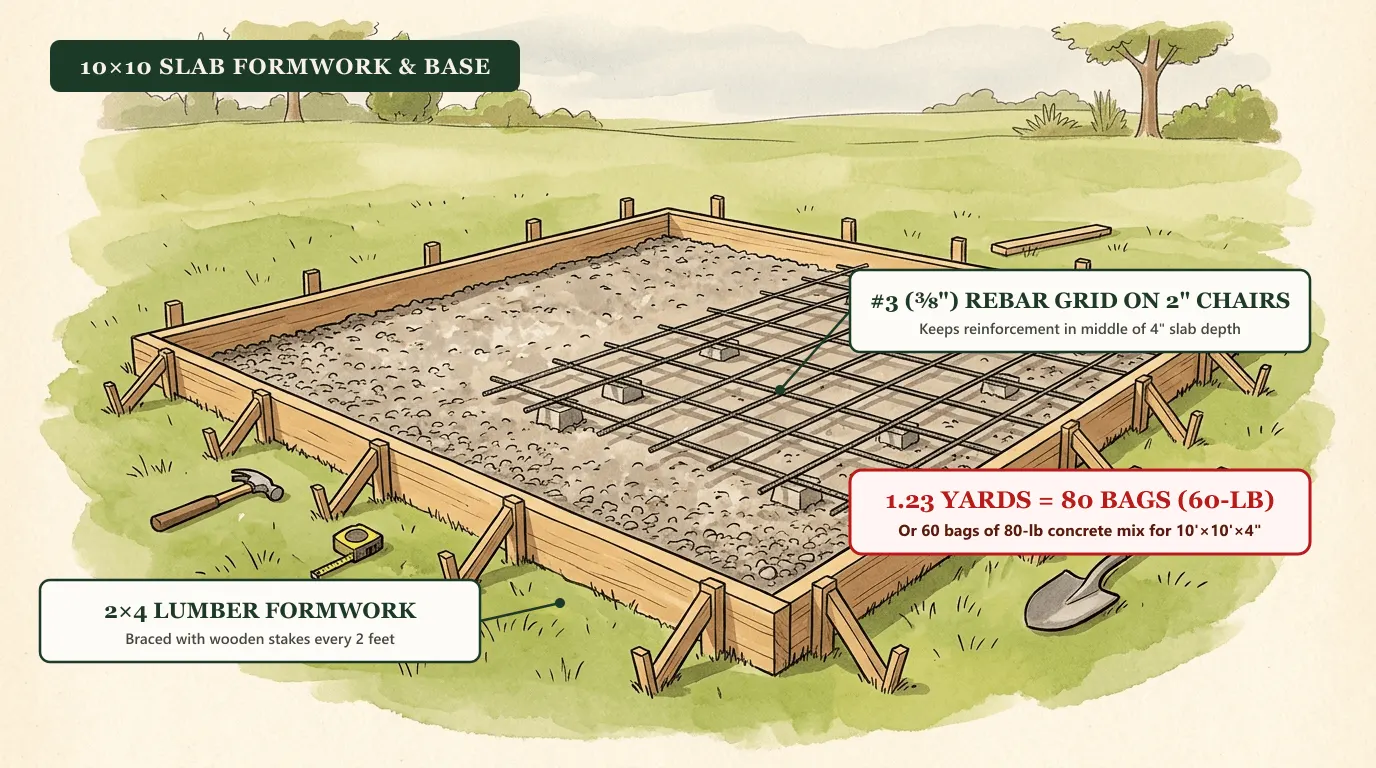
Pouring a standard 10×10 foot slab at 4 inches thick requires 1.23 cubic yards of concrete, which equals 56 bags of 80-lb concrete or 74 bags of 60-lb concrete.
Because dirt excavation and gravel subgrades are never laser-flat, always add a 10% waste buffer: buy 62 bags (80-lb) or 82 bags (60-lb) so you don't run short while screeding.
How many bags of concrete do you need for a 10×10 slab?
To pour a standard 10×10 foot slab at 4 inches thick, you need 56 bags of 80-lb concrete or 74 bags of 60-lb concrete (exact volume of 1.23 cubic yards). With a recommended 10% safety margin for subgrade unevenness and spillage, purchase 62 bags (80-lb) or 82 bags (60-lb).
| Slab thickness | Best used for | Exact volume | 80-lb bags (+10% waste) | 60-lb bags (+10% waste) | Ready-mix truck order |
|---|---|---|---|---|---|
| 4 inches (0.33 ft) | Patio, light shed, trash pad | 1.23 cu yds | 62 bags (56 exact) | 82 bags (74 exact) | 1.5 cu yds |
| 5 inches (0.42 ft) | Hot tub pad, heavy tool shed | 1.54 cu yds | 77 bags (69 exact) | 103 bags (92 exact) | 1.75 cu yds |
| 6 inches (0.50 ft) | Driveway apron, vehicle parking | 1.85 cu yds | 92 bags (83 exact) | 123 bags (109 exact) | 2.0 cu yds |
To calculate custom slab lengths, widths, or mixed bag sizes, calculate your takeoff with our Concrete Slab Calculator.
The math behind concrete bag yields
Ready-mixed dry concrete bags do not yield their dry weight in volume. Concrete density produces standardized volumetric yields:
- 80-lb bag yield: 0.60 cubic feet (takes 45 bags to make 1 cubic yard).
- 60-lb bag yield: 0.45 cubic feet (takes 60 bags to make 1 cubic yard).
- 40-lb bag yield: 0.30 cubic feet (takes 90 bags to make 1 cubic yard).
Formula to calculate your slab volume:
- Multiply Length (ft) × Width (ft) × Depth (in). For a 10×10 slab at 4 in: 10 × 10 × 4 = 400.
- Divide by 324 to get Cubic Yards: 400 ÷ 324 = 1.234 cu yds.
- Convert to Cubic Feet (multiply by 27): 1.234 × 27 = 33.3 cu ft.
- Divide cubic feet by the bag yield: 33.3 ÷ 0.60 cu ft = 55.5 bags (round up to 56 bags).
- Multiply by 1.10 for the 10% safety cushion: 56 × 1.10 = 61.6 (round up to 62 bags).
Bags vs. Ready-Mix truck: The tipping point
A 10×10 slab at 4 inches sits right on the borderline where DIYers debate between hand-mixing bags or calling a local ready-mix concrete supplier:
When to buy bags:
- Tight backyard access: If a 30-ton mixer truck cannot drive within 15–20 feet of your forms, wheelbarrowing wet concrete from the street across grass is exhausting and risks getting stuck.
- Phased weekend timeline: Bags let you set forms and mix at your own pace without the 15-minute countdown clock of an arriving transit-mixer.
- Equipment required: Renting a portable electric barrel mixer ($50–$75/day) is mandatory. Mixing 62 bags in a wheelbarrow with a hoe takes 5 to 6 hours and will give you cold joints (seams where old batches harden before new batches meet them).
When to order a truck (Short-load / Ready-mix):
- Physical weight: 62 bags of 80-lb concrete weigh 4,960 pounds (nearly 2.5 tons). Loading them onto a cart at the store, unloading into your vehicle, carrying them to the backyard, and lifting them into the mixer is grueling physical labor.
- Short-load fee vs. mixer rental: Most suppliers charge a $100 to $150 "short-load fee" for deliveries under 4 cubic yards. However, once you factor in bag retail prices ($5.50–$6.50/bag = ~$380), renting a mixer ($60), and buying plastic/curing sealer, a truck delivery ($175/yd + fees = ~$420) is comparable in total cost.
- Pour time: A concrete truck chute discharges 1.5 cubic yards in under 10 minutes, giving you a monolithic, perfectly blended slab with zero cold joints.
Watch out for 'hot batches' and cold joints
If mixing 60+ bags with a rented barrel mixer, keep your cycle time under 5 minutes per batch. If earlier sections begin setting (initial set occurs in 45–90 minutes depending on temperature), newly poured concrete will not bond chemically with the adjacent section, creating a permanent structural fracture line known as a cold joint.
Don't skip the 4-inch gravel subbase
A concrete slab is only as sound as the ground directly below it. Never pour wet concrete onto bare organic soil or poorly draining clay:
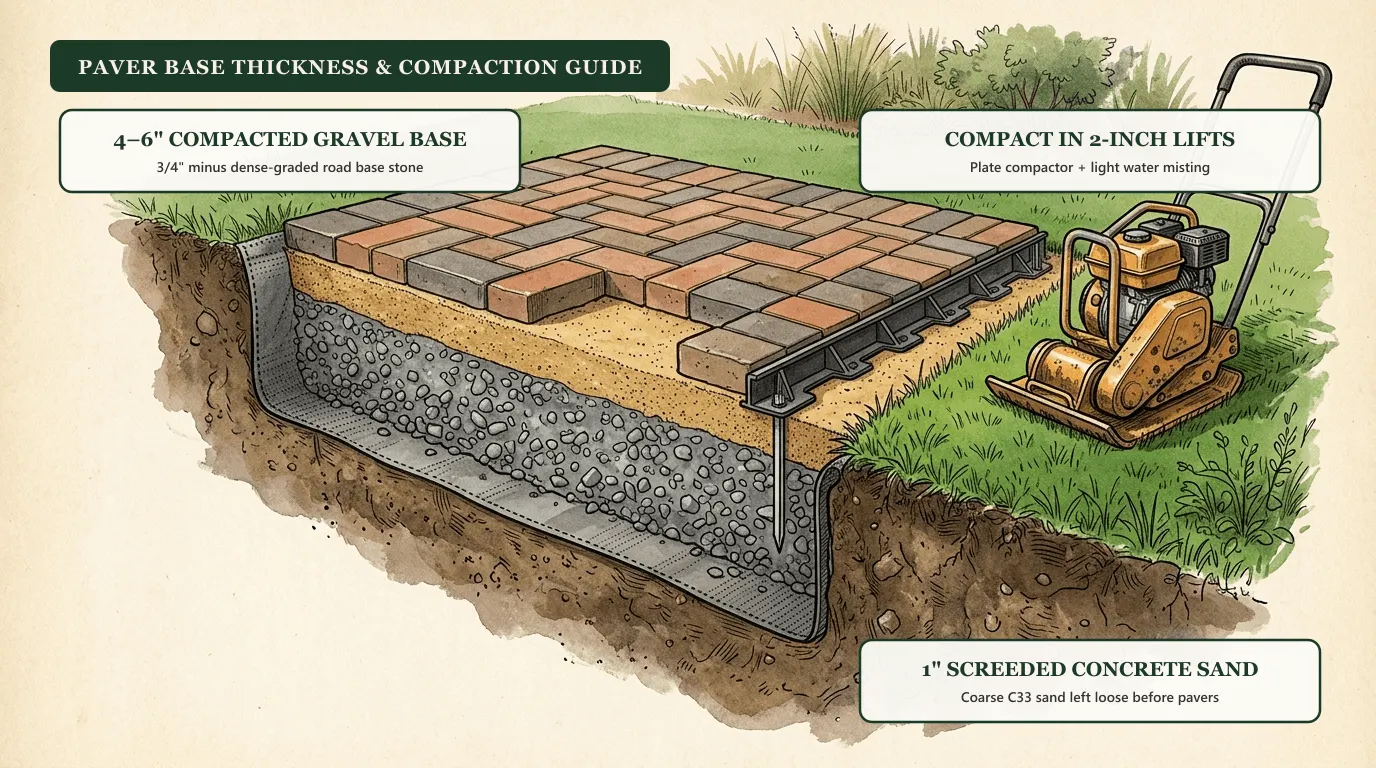
- Excavate 8 inches total depth: 4 inches for the crushed gravel subbase, and 4 inches for the concrete slab itself.
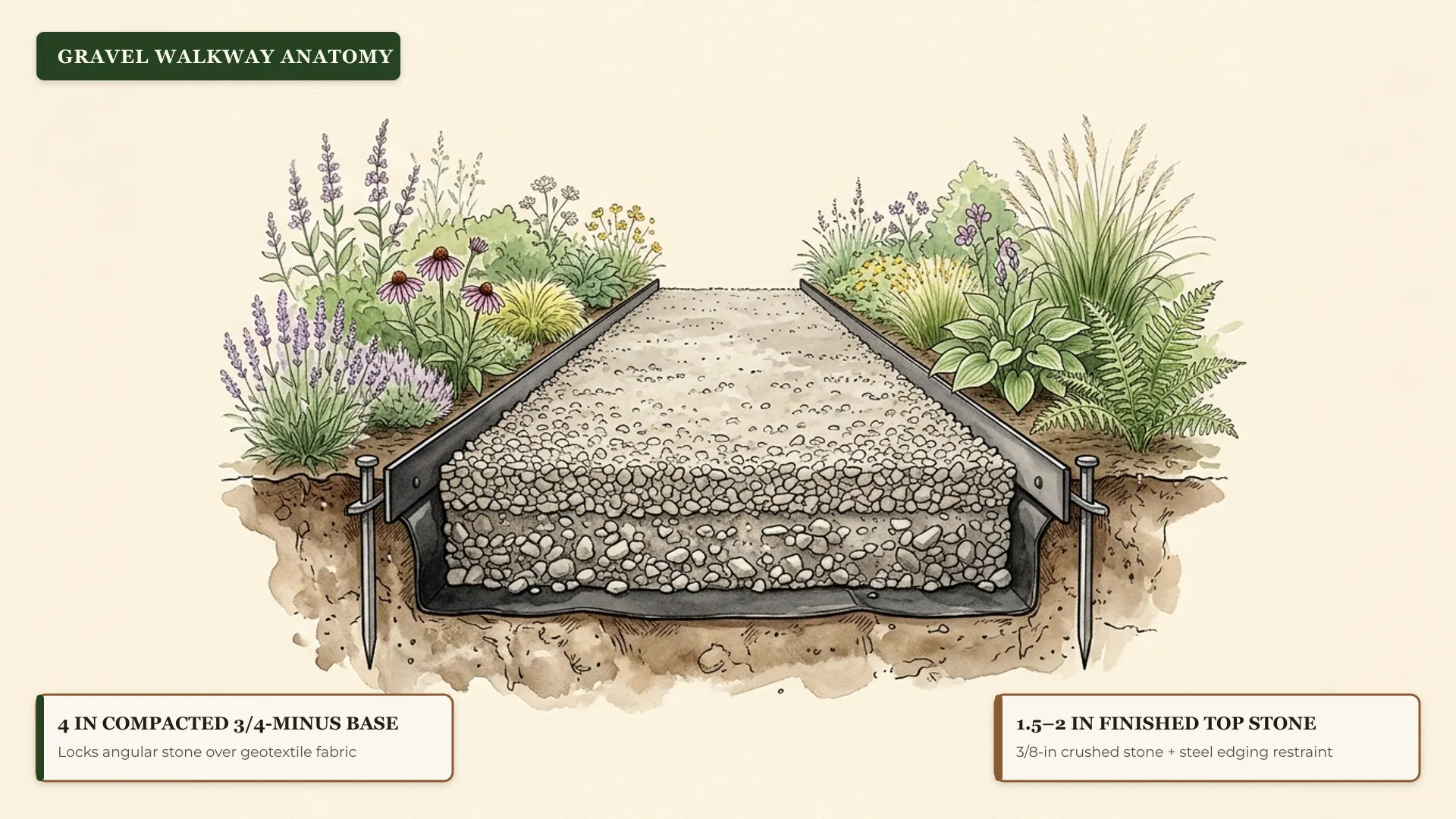
- Compact 4 inches of crushed gravel: Use angular stone with stone dust (such as #57 crushed limestone or crusher run / ABC stone). Rake it level and rent a vibrating plate compactor to tamp it down until firm. (You can check volume with our Gravel Calculator).
- Install control joints: In a 10×10 slab, cut or groove one control joint down the center in each direction (forming four 5×5 ft squares) to a depth of 1 inch (1/4 the slab thickness) within 24 hours of pouring. Concrete shrinks as it hydrates; control joints dictate exactly where hairline relief cracks occur.
FAQ
How many 80 lb bags of concrete do I need for a 10x10 slab at 4 inches?
You need 56 bags of 80-lb concrete (1.23 cubic yards) for the exact dimensions. With a standard 10% safety margin for ground unevenness and form deflection, buy 62 bags.
How many 60 lb bags of concrete for a 10x10 slab?
A 4-inch deep 10x10 slab requires 74 bags of 60-lb concrete without waste, or 82 bags with a 10% waste buffer.
Is it cheaper to buy bags or order a concrete truck for a 10x10 slab?
Bagged concrete usually costs $350 to $450 for 62 bags (80-lb), while a ready-mix truck delivery charges $150 to $200 per yard plus a small-load fee ($100 to $200), totaling roughly $350 to $450. The dollar cost is often neck-and-neck, but a truck eliminates mixing 5,000 pounds of concrete by hand.
How thick should a 10x10 concrete slab be?
4 inches is the standard residential thickness for walkways, garden shed floors, and patio seating. Increase thickness to 5 or 6 inches if installing a hot tub, parking a heavy riding mower, or storing heavy workshop machinery.