How to Care for Carrots: Deep Soil Preparation, Thinning & Moisture Guide

By Efraín Vega · Published November 24, 2026
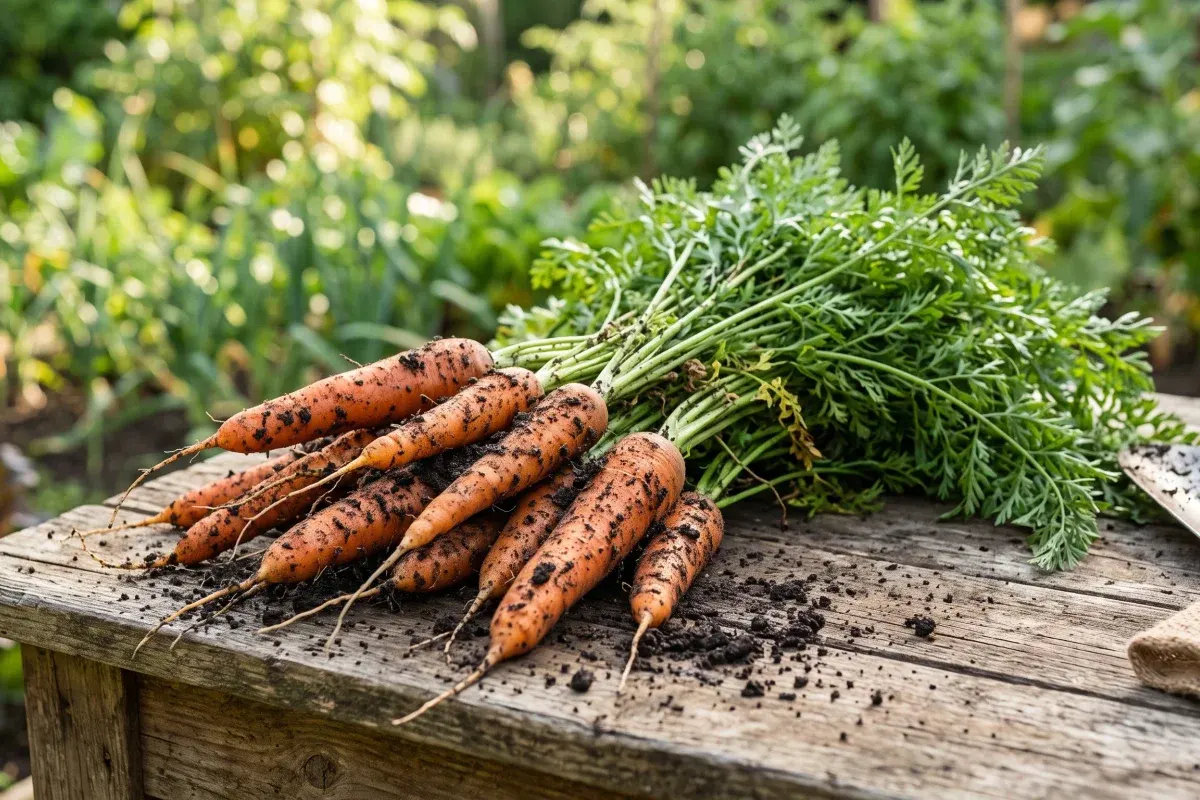
Carrots (Daucus carota subsp. sativus) are one of the most beloved crops in the home garden, but they are also responsible for more gardener disappointment than almost any other vegetable. Too often, pulling a carrot tops out in a twisted, forked monstrosity, a tiny 2-inch stub, or a split root covered in tangled hair.
Yet when grown with proper technique, homegrown carrots are extraordinarily sweet, juicy, and crisp—vastly superior to the rubbery, chlorinated "baby carrots" sold in supermarkets.
The secrets to growing straight, prize-winning carrots come down to deep, stone-free soil preparation, the wooden board germination method, ruthless seedling thinning, and consistent, deep watering.
The Best Soil for Carrots: Deep, Loose & Low-Nitrogen
Because a carrot is a taproot, the physical structure of your soil dictates its final shape:
                      CARROT SOIL BENCHMARKS
   =====================================================================
   [ Target Soil pH ]         6.0 to 6.8 (Neutral to slightly acidic)
   [ Soil Depth ]             10 to 14 inches of stone-free, uncompacted loam
   [ Soil Texture ]           Sandy loam with 20%–30% coarse river sand
   [ Nitrogen Warning ]       LOW nitrogen (excess N causes hairy forked roots)
   =====================================================================
1. Eliminating Rocks & Clay Clods
The growing tip of a baby carrot root is as delicate as a hair. If it hits a tiny pebble or a hard clay ball 2 inches under the surface, the taproot splits in two, creating a "forked" carrot.
- In native ground, double-dig and sift the soil through a 1/4-inch mesh screen.
- Alternatively, build a 12- to 16-inch deep raised bed. Raised beds eliminate native rock problems entirely. Check soil requirements with our Raised Bed Soil Calculator.
2. Avoid Fresh Manure or Excess Nitrogen
Never apply fresh chicken manure or high-nitrogen fertilizers to carrot beds. Excess nitrogen causes the plant to produce a massive, bushy canopy of green foliage while the underground root becomes hairy, branched, and split. Focus instead on phosphorus and potassium (bone meal and greensand), which fuel root elongation and sugar synthesis.
Cultivar Selection: Match Variety to Your Bed Depth
Do not buy seeds based on the picture on the packet; choose varieties that match your soil depth:
| Carrot Class | Average Length | Root Shape | Best Soil Environment | Top Cultivars |
|---|---|---|---|---|
| Nantes | 6 to 7 inches | Cylindrical, blunt-tipped | Raised beds, light loam (Sweetest eating) | 'Nelson', 'Bolero', 'Scarlet Nantes' |
| Danvers | 6 to 8 inches | Tapered, broad shoulder | Heavy soils, raised beds (Top storage) | 'Danvers 126', 'Yellowstone' |
| Chantenay | 4 to 5 inches | Short, broad, conical | Heavy clay or shallow beds | 'Red Cored Chantenay', 'Royal Chantenay' |
| Parisian / Round | 1 to 2 inches | Small round globe | Containers, shallow 6" beds, clay | 'Paris Market', 'Tonda di Parigi' |
| Imperator | 8 to 10 inches | Long, slender, pointed | Deep, sifted sandy beds only | 'Sugarsnax', 'Imperator 58' |
The Board Technique for 100% Seed Germination
Carrot seeds are microscopic and notoriously slow to germinate (14 to 21 days). If the surface 1/4 inch of soil dries out under the sun for even 6 hours during this window, the germinating seed dies:
                   THE WOODEN BOARD GERMINATION TRICK
  ======================================================================
   [ 2x6 or 2x8 Untreated Wooden Board (Placed Flat Over Seeded Row)    ]
  ----------------------------------------------------------------------
   [ 1/4" Screened Compost / Sand Layer (Keeps Seeds Moist)             ]
   [ Carrot Seeds (Sown 1/4" Deep)                                      ]
  ~~~~~~~~~~~~~~~~~~~~~~~~ [ Moist Seedbed Soil ] ~~~~~~~~~~~~~~~~~~~~~~
- Sow Shallow: Form a shallow 1/4-inch furrow. Sprinkle seeds at roughly 2 to 3 seeds per inch. Cover lightly with finely screened compost or sand; sand never crusts over.
- Moisten the Bed: Water gently with a fine mist sprayer until saturated.
- Lay the Board: Lay an untreated 2x6 wooden board or a double layer of wet burlap directly over the seeded row.
- The Benefits: The board locks in 100% relative humidity, prevents heavy spring rains from washing tiny seeds away, and keeps soil cool.
- The Critical Reveal: Check beneath the board daily starting on day 7. The exact morning you see the first pale green sprouts emerge, remove the board immediately. If left covered, seedlings will turn spindly and yellow within 24 hours.
Ruthless Thinning: The Secret to Fat Taproots
You cannot grow straight, thick carrots without thinning. When crowded together, carrots twist around each other like braids:
- Stage 1 (At 2 Inches Tall): When seedlings reach 2 inches in height, thin to 1 inch apart.
- Stage 2 (At 4 Inches Tall): Three weeks later, thin to a final spacing of 2 to 3 inches apart (or 3 to 4 inches for large Danvers).
- Golden Rule: Never Pull! Pulling unwanted seedlings out of the ground dislodges and kinks the delicate taproots of the neighboring carrots you intended to keep. Use small embroidery scissors or micro-pruning shears to snip unwanted seedlings flush at the soil line.
Moisture & Green Shoulder Prevention
- Water Consistency: Carrots require 1 inch of water per week. Deep soaking once or twice a week encourages the taproot to drive downward in search of moisture. Frequent shallow sprinkling creates short, stubby roots with excess hairy rootlets.
- Preventing Green Shoulders: As carrots expand, the top "shoulder" of the root often pushes up above the soil surface. When exposed to sunlight, the shoulder turns green and bitter due to chlorophyll production. Shovel 1/2 inch of compost or straw mulch over exposed orange shoulders in midsummer to keep them sweet and orange.
Winter Sweetening & Overwintering
Carrots handle autumn frost with ease. Freezing temperatures force the carrot root to convert its starches into natural sucrose:
- The Straw Blanket: In November, cover your carrot bed with 8 to 12 inches of clean wheat straw.
- Harvest Through Winter: Pull back the straw blanket and dig crisp, ice-cold, candy-sweet carrots in December, January, and February. Follow our full guide on How to Store Root Vegetables for Winter.
Related Guides & Calculators
- Carrot Plant Profile & Spacing: In-depth companion planting and botanical specs.
- How to Store Root Vegetables for Winter: In-ground and cellar storage plans.
- How to Care for Leeks: Dibber planting and blanching.
- Best Soil Depth for Raised Bed Vegetables: Understand root zone requirements.
- Raised Bed Soil Calculator: Accurately calculate loose, stone-free bed soil.
FAQ
Why do carrots fork, split, or grow hairy?
Forking occurs when the delicate downward-growing tip of the young taproot encounters a physical obstacle (rocks, gravel, or compacted clay clumps) or fresh, un-decomposed animal manure. Excess nitrogen stimulates hairy lateral roots rather than a smooth central taproot. Loose, stone-free sandy loam and aged compost ensure razor-straight roots.
How do you germinate carrot seeds quickly and evenly?
Carrot seeds are tiny and take 14 to 21 days to sprout, drying out easily in the top 1/4 inch of soil. The secret commercial trick is the 'board technique': sow seeds 1/4 inch deep, water thoroughly, and place a 2x6 wooden board or piece of wet burlap flat on top of the row. The board traps 100% humidity and keeps soil cool. Check daily and remove the board the exact morning the first green sprouts emerge.
How far apart should carrots be thinned?
Thin seedlings in two stages: first, when greens are 1 to 2 inches tall, snip seedlings with small scissors to 1 inch apart. Three weeks later, thin to a final spacing of 2 to 3 inches apart (or 3 to 4 inches for large storage varieties like Danvers). Use small scissors rather than pulling, which disturbs and bends neighboring taproots.
What is the best soil for growing carrots?
Carrots require deep, loose, stone-free sandy loam with a pH of 6.0 to 6.8. A raised bed filled with 12 to 14 inches of screened compost, peat moss, and washed river sand is the premier medium, allowing taproots to plunge downward without resistance.
Can carrots stay in the ground all winter?
Yes! In fact, cold-weather storage in the ground produces the sweetest carrots possible. In late autumn before the soil freezes solid, cover the carrot bed with 8 to 12 inches of clean wheat straw. The straw insulates the soil from hard frost, allowing you to dig crisp, candy-sweet carrots throughout midwinter.