How to Build a Vegetable Trellis (Height, Posts & Wire)

By Efraín Vega · Published October 20, 2026
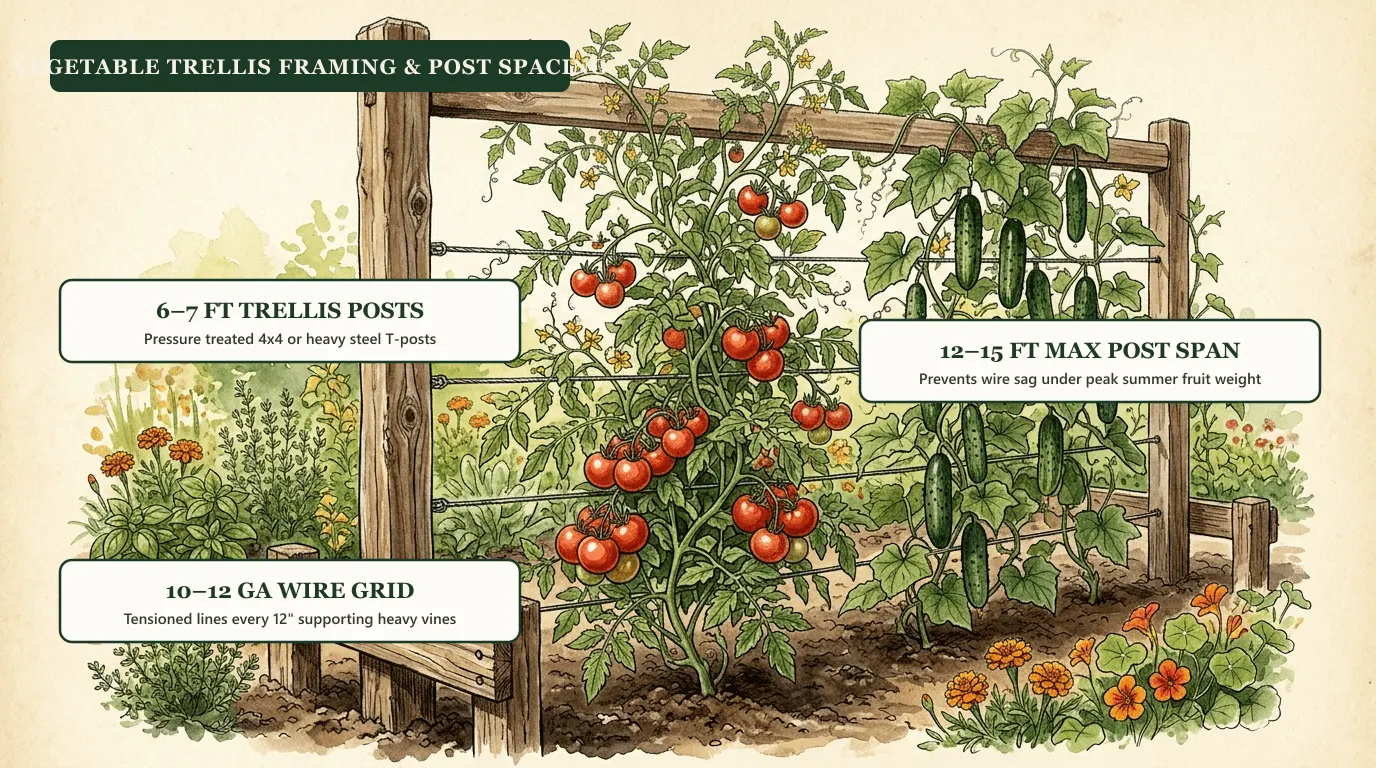
A good vegetable trellis is about 6 feet tall, with posts no more than 15 feet apart, a taut top wire, a bottom wire, and twine or netting running between them for each plant. That design, from University of Maryland Extension, works for cucumbers, pole beans, peas and other vining crops.
Growing up instead of out turns a crop that sprawls over a whole bed into one that fits along one edge.
Why trellis vegetables at all?
For cucumbers, University of Maryland Extension reports that trellising can double or triple average yields compared with vines on the ground, and lists these benefits:
- Better fruit color and shape, with no yellow "ground spot"
- More effective control of many diseases and insects
- Less damage to vines, so a longer harvest season
- More thorough, easier harvesting — fewer oversized fruit you missed
Air moves through a trellised plant and leaves dry faster, which is a big part of why disease pressure drops.
What do you need to build one?
For a straight trellis along the back of a raised bed:
| Part | What to use |
|---|---|
| Posts | Wood posts or metal T-posts, set so about 6 ft stands above the soil |
| Top wire | Heavy-gauge wire, pulled very taut (Maryland uses No. 8) |
| Bottom wire | Lighter wire near the soil (Maryland uses No. 12) |
| Plant supports | Plastic twine or trellis netting between the two wires |
| Extra support | A mid-span brace or post for long runs and heavy crops |
A welded-wire livestock panel ("cattle panel") zip-tied to two posts is a sturdy, no-wire alternative for a short trellis.
How do you build a trellis, step by step?
- Place it on the north side of the bed (or the side that won't shade other crops).
- Set the posts no more than 15 feet apart, deep enough that the trellis can't lean or tip in wind once it's loaded with vines.
- Run the top wire between post tops and pull it very taut. A sagging top wire is the most common failure.
- Run the bottom wire a few inches above the soil.
- Tie twine from the bottom wire to the top wire at each plant, or hang netting across the whole frame.
- Add a brace between posts if the fruit load gets heavy — Maryland Extension notes it may be needed mid-season.
Build it before you plant
Put the trellis up at planting time. Driving posts next to established plants damages roots, and vines that have already sprawled are hard to train upward.
How do you train vines up a trellis?
Guide each main stem to its twine and wrap it loosely as it grows; cucumbers and peas grab on with tendrils, and pole beans twine on their own. Maryland Extension trains the main cucumber stem until it reaches the top wire. For spacing, Clemson Extension thins trellised cucumbers to 9–12 inches apart.
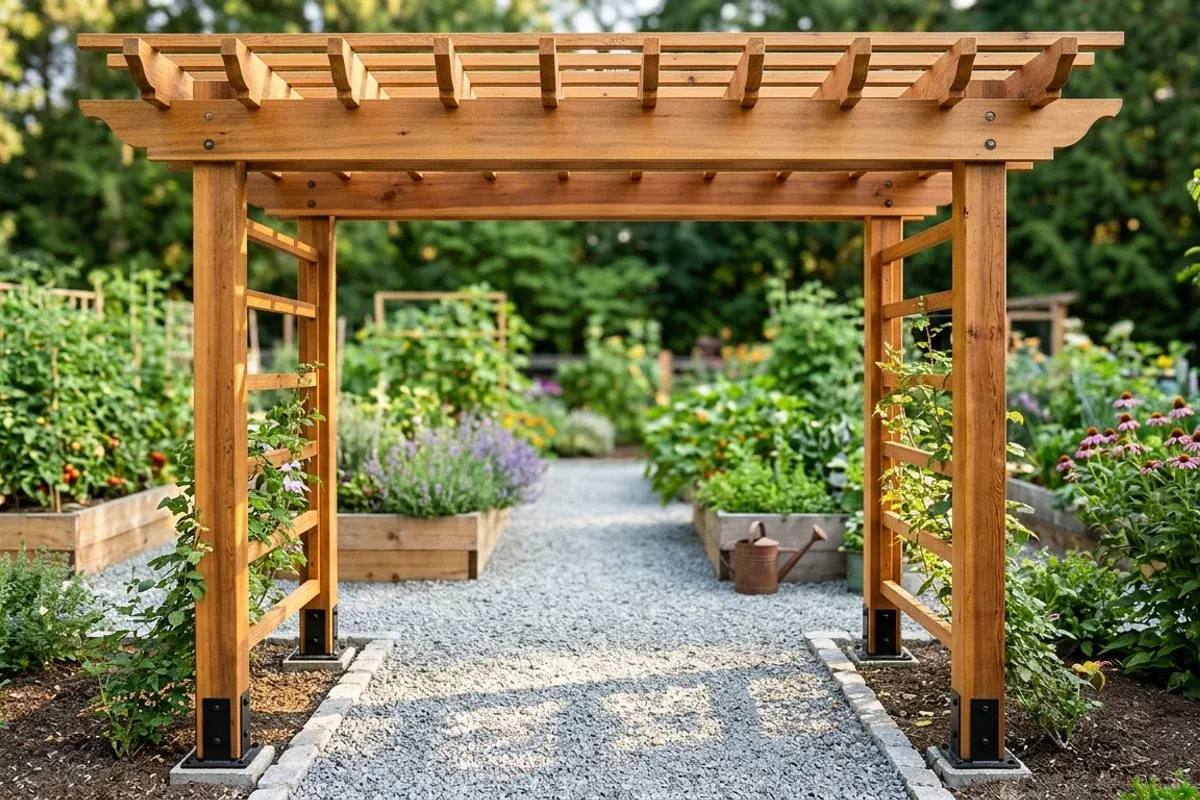
Want a wooden arbor or a freestanding frame instead? The Arbor & Trellis Calculator gives post lengths and slat counts, and the Raised Bed Lumber Calculator covers the bed below it.
Sources: Cucumbers — UMD Extension (Commercial Vegetable Production Recommendations), Cucumber — Clemson HGIC.
FAQ
How tall should a cucumber trellis be?
About 6 feet. University of Maryland Extension recommends a 6 ft trellis with a top and bottom wire and twine or netting between them at each plant. It's tall enough for the vines and still easy to harvest from.
Which vegetables grow well on a trellis?
Vining crops: cucumbers, pole beans, peas, and small melons or squash. Bush varieties of the same crops don't climb and don't need one.
When should I put up a trellis?
At planting time, before the vines start to run. Driving posts later can damage roots, and sprawling vines are hard to train upward.
Why use a trellis instead of letting vines sprawl?
Better fruit and easier care. Maryland Extension lists straighter, better-colored fruit with no yellow ground spot, better disease and insect control, less vine damage and easier harvesting. Trellised vines also take far less bed space.