How to Build an A-Frame Chicken Tractor: Mobile DIY Plans

By Efraín Vega · Published November 19, 2026
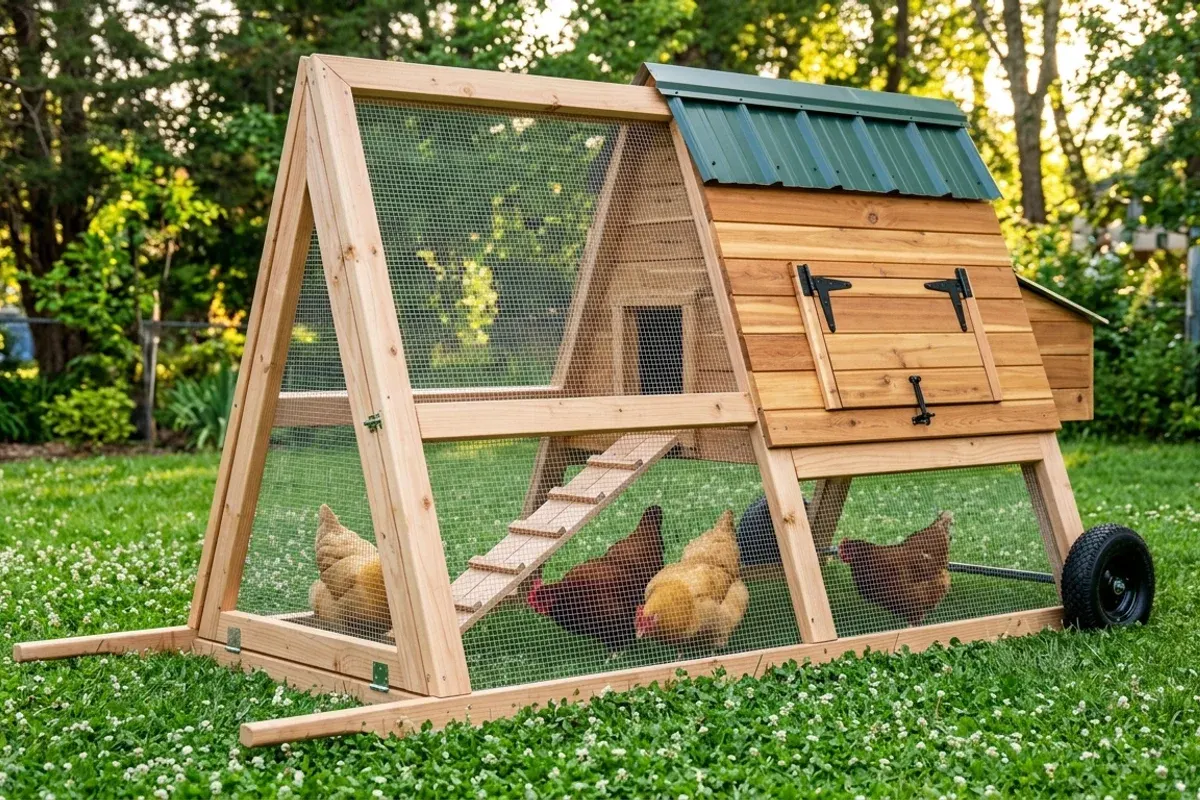
A stationary chicken coop requires constant shoveling, develops muddy, foul-smelling runs, and strips the ground down to bare dirt within weeks. A mobile chicken tractor, by contrast, leverages the natural foraging instincts of your flock while transforming lawn care and garden maintenance into an automated closed-loop ecosystem.
Built as an equilateral triangular A-frame, this design maximizes vertical structural strength with minimal lumber weight. By rotating the tractor across your lawn every morning, your hens enjoy a constant buffet of fresh pasture grass, clover, and pest insects (such as ticks, slugs, and grasshoppers) while spreading rich organic fertilizer evenly across your yard.
This complete DIY guide provides architectural plans to construct an 6-foot wide by 10-foot long mobile A-frame chicken tractor equipped with an elevated predator-proof roosting loft, exterior egg collection door, 1/2-inch hardware cloth run, and pneumatic wheel system.
1. Permaculture Geometry & The A-Frame Advantage
The triangular A-frame is the most structurally efficient shape in carpentry. It sheds torrential rain, resists severe crosswinds, and eliminates heavy vertical corner posts:
          6x10 MOBILE A-FRAME CHICKEN TRACTOR CROSS-SECTION

                                60° Ridge Peak
                                ┌────────────┐
                               /              \   ◄── Corrugated Metal Roof
                              /   [ROOSTING]   \      (Upper 4' Loft Shelter)
                             /      [LOFT]      \
                            /   ┌────────────┐   \  ◄── Plywood Droppings Floor
          Hinged Nesting ──►│   │ [Nest Box] │   │
          Box Door          └───┴────────────┴───┘
                           /                      \  ◄── 1/2" Galvanized Hardware Cloth
                          /                        \     (Enclosed Lower Run)
                         /    [Chicken Ladder]      \
                        /            ▼               \
                 ──────┴──────────────────────────────┴──────
                 ▲                                          ▲
                 └──────── 6' 0" Pasture Base Width ────────┘
                    (2x4 Skids with Anti-Dig Wire Apron)
Key Dimensional Zones:
- Footprint: 6 feet wide × 10 feet long = 60 square feet of fresh daily pasture run.
- Peak Height: 5 feet 2 inches at the center ridge, providing an ergonomic reach for feeding and watering.
- Lower Pasture Run (6' × 10'): Open to the grass, protected on all sloped sides with 1/2-inch 19-gauge welded hardware cloth.
- Elevated Sleeping Loft (4' × 6'): Enclosed upper chamber sitting 24 inches above the ground. Features an 18-inch natural branch roosting bar, two private nesting boxes, and a non-stick pull-out droppings tray.
- Pasture Ramp: A 1x6 wooden ramp with cross cleats leads hens between the ground run and the upper loft.
2. Materials Takeoff & Hardware Schedule (6x10 Footprint)
Built with standard Douglas fir and exterior treated dimensional lumber:
Timber Framing:
- Bottom Ground Skids: 2 pieces — 2x4 pressure-treated lumber @ 10 ft (skids with beveled sled tips).
- Cross Runners: 3 pieces — 2x4 pressure-treated lumber @ 6 ft (bottom base ties).
- A-Frame Rafter Ribs: 8 pieces — 2x4 lumber @ 8 ft (cut to 70" length with 60° peak miters to form 4 triangular ribs).
- Ridge Beam & Purlins: 3 pieces — 2x4 lumber @ 10 ft (one top ridge spine, two loft support rails).
- Loft Floor & Nesting Boxes: 1 sheet — 1/2-inch exterior CDX plywood (4 ft × 8 ft).
Wire Mesh & Weatherproof Sheathing:
- Predator-Proof Hardware Cloth: 1 roll — 36 in wide × 50 ft long 1/2-inch galvanized welded wire (19-gauge).
- Roof Panels: 2 panels — 26 in wide × 8 ft long corrugated metal or polycarbonate roofing (cut to cover the upper 4-foot loft on both sides).
- Foam Ridge Cap: 1 piece @ 8 ft (seals the top peak against rain).
Mobility & Hardware:
- Pneumatic Wheels: 2 pieces — 10-inch pneumatic all-terrain tires with 5/8-inch bore.
- Wheel Axle: 1 piece — 5/8-inch cold-rolled steel axle rod @ 7 ft, with cotter pins and flat washers (or bolt-on axle brackets).
- Fasteners:
- 1 box (5 lb) — 3-inch exterior ceramic-coated screws.
- 1 pack (250 count) — 3/4-inch galvanized wire fence staples or 1-inch pan-head screws with fender washers (to attach wire mesh).
- 4 heavy-duty 3-inch utility hinges and 2 spring-loaded barrel bolt latches.
3. Step-by-Step Construction Guide
Step 1: Build the Sled Base Skids
- Cut a 45-degree bevel on the front ends of both 10-foot pressure-treated 2x4 skids. These upward-angled sled noses allow the tractor to glide over uneven grass and garden bed lips without digging in.
- Join the two skids with three 6-foot cross runners (one at the front, one at 6 feet, one at the rear) using 3-inch exterior structural screws.
- Check diagonal measurements to ensure the 6x10 rectangular base is perfectly square.
Step 2: Assemble the Triangular A-Frame Ribs
- Cut 8 rafter rafters from 2x4 lumber at 70 inches.
- Miter the top ends at 30 degrees (so when two boards meet at the peak, they form a 60-degree equilateral triangle).
- Miter the bottom ends at 30 degrees to sit flush against the outer edges of the 2x4 base skids.
- Assemble 4 triangular A-frame trusses on the ground. Fasten the apex joints using triangular 1/2-inch plywood gussets and 2-1/2-inch screws.
- Erect the 4 trusses onto the base frame (spaced at 0 ft, 3.3 ft, 6.6 ft, and 10 ft). Tie all 4 truss peaks together with the continuous 10-foot 2x4 top ridge beam.
Step 3: Frame the Upper Roosting Loft & Nesting Boxes
Hens instinctively seek the highest elevation point at dusk to sleep safe from ground predators.
- Install two horizontal 2x4 loft support stringers across the rear 4 feet of the tractor, 24 inches above the ground skids.
- Cut a 4x6-foot piece of 1/2-inch exterior plywood to form the loft floor. Cut a 10x12-inch trapdoor opening in the forward corner for the chicken ladder ramp.
- Build two 12x12-inch wooden nesting boxes along the side wall.
- Mount an 18-inch natural tree branch or 2x4 (with edges rounded over) 8 inches above the loft floor to serve as the nighttime roosting bar.
Easy Egg Collection Access
Never crawl inside the chicken run to collect eggs. Frame a 14x24-inch hinged access hatch on the exterior side wall of the upper loft directly adjacent to the nesting boxes. Secure it with a carabiner lock or two-step barrel latch that raccoons cannot manipulate.
Step 4: Install 1/2-Inch Hardware Cloth
Raccoons have dexterous paws and can reach through large wire openings to kill chickens.
- Wrap the lower 6 feet of the A-frame run with 1/2-inch galvanized welded wire hardware cloth.
- Secure the mesh every 4 to 6 inches along all wooden studs using 1-inch exterior screws with 1/4-inch fender washers or heavy galvanized fencing staples.
- Attach a 12-inch wide strip of hardware cloth along the outer bottom edge of the wood skids, flaring outward onto the lawn as a perimeter anti-dig apron.
Step 5: Roof Sheathing & Weatherproofing
- Fasten the corrugated metal roof panels over the rear 4 feet of the upper A-frame, directly protecting the roosting loft and nesting boxes from rain and cold winds.
- Fasten a corrugated metal ridge cap along the peak using roofing screws with rubber EPDM washers.
- Leave the front 6 feet of the A-frame open with wire mesh to maximize sunlight exposure and pasture views for the foraging hens.
Step 6: Wheels & Mobility System
- Fasten heavy-duty steel axle mounting brackets to the rear exterior ends of both 2x4 skids.
- Slide the 5/8-inch steel axle rod through the brackets and install the two 10-inch pneumatic wheels, securing them with washers and cotter pins.
- Position the axle height so the rear of the coop sits 1 inch above the grass when the front is resting on the ground.
- Fasten two sturdy 2x4 wheelbarrow pull handles to the front nose of the tractor.
- Lifting the front handles tilts the coop onto its rear pneumatic tires, allowing you to walk the tractor to fresh pasture in under 30 seconds.
4. Garden Rotation: The Ultimate Soil Preparation Machine
A mobile chicken tractor is the single most effective tool for regenerative kitchen gardening:
- Post-Harvest Bed Cleanout: After harvesting winter brassicas or squash in late autumn, park the chicken tractor over your beds. Four hens will strip weeds, devour fallen seeds, and scratch up root-knot nematodes in 48 hours.
- Bed Manure Injection: Chicken manure contains three times more nitrogen and phosphorus than steer manure. Moving the tractor across dormant garden plots deposits fresh organic fertility without burning plant roots.
- Compost Fuel: Shovel soiled pine shavings from the upper loft droppings tray directly into your DIY Compost Bin to supercharge decomposition temperatures.
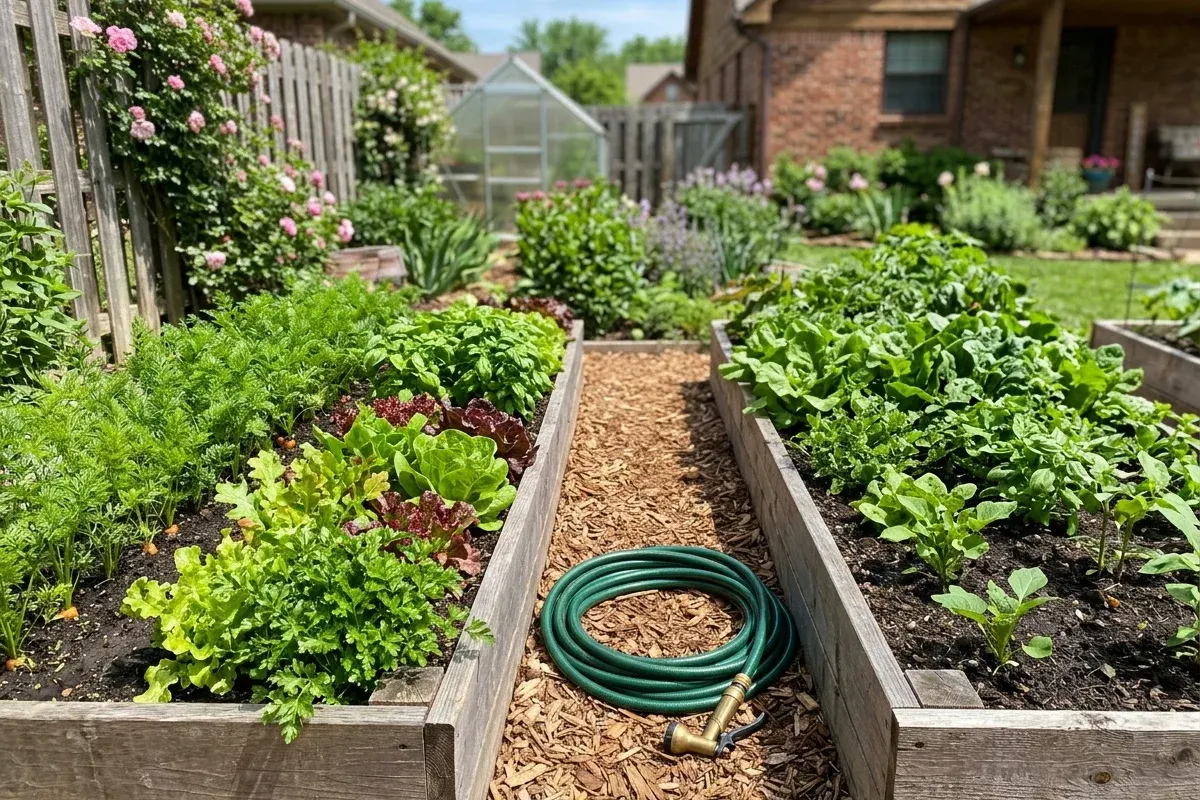
- Winter Bed Integration: Need raised bed sizing for pasture rotation? Check our Raised Bed Size Guide and Raised Bed Lumber Calculator.
Chicken Tractor Specification Matrix
| Feature | Standard Specification | Reason for Design |
|---|---|---|
| Footprint | 6 ft wide × 10 ft long | 60 sq ft pastured run; ideal for 4–6 laying hens |
| A-Frame Pitch | 60° Equilateral Triangle | Maximum structural rigidity; sheds rain and wind |
| Mesh Rating | 1/2" Galvanized 19-Ga Hardware Cloth | 100% raccoon, fox, and rodent-proof |
| Roost Elevation | 24" above pasture grade | Keeps bedding dry; natural instinctual roosting |
| Mobility | 10" pneumatic wheels + front handles | Single-person relocation across turf |
| Egg Access | Exterior drop-down hatch with safety latch | Collect clean eggs without stepping in the run |
Planning a permanent, full-height walk-in setup instead of a mobile tractor? Build our craftsman DIY Chicken Coop with Predator-Proof Walk-In Run. Planning perimeter backyard predator barriers? Review our Garden Fence Height Guide and estimate wire fencing with our Garden Fence Calculator.
Sources: University of Kentucky Cooperative Extension — Pastured Poultry Housing, Virginia Tech Extension — Small-Scale Poultry Housing, Cornell Small Farms Program — Managing Mobile Coops.
FAQ
How many chickens fit in an A-frame chicken tractor?
An A-frame tractor with a 6-foot wide by 10-foot long footprint (60 square feet of pasture run) comfortably accommodates 4 to 6 standard-breed laying hens (such as Rhode Island Reds, Orpingtons, or Plymouth Rocks). Hens require a minimum of 4 square feet of outdoor run space and 2 square feet of enclosed roosting space when rotated to fresh grass daily.
Why is traditional chicken wire dangerous for chicken coops?
Never use thin hexagonal 'poultry netting' (chicken wire) to secure a coop. Chicken wire is designed only to keep chickens in—it does not keep predators out. Raccoons can easily reach through 1-inch hexagonal holes to grab birds, while foxes, coyotes, and neighborhood dogs can rip right through thin 22-gauge wire. Always use 1/2-inch galvanized welded wire hardware cloth (19-gauge).
How do you predator-proof the open bottom of a mobile tractor?
Attach a 12-inch wide anti-dig predator apron made of 1/2-inch hardware cloth around the bottom perimeter of the wooden skids. When the tractor rests on the lawn, the wire apron lies flat against the grass. If a fox, dog, or raccoon attempts to dig under the wood skid, it hits the wire mesh and gives up.
How do you move an A-frame chicken tractor without straining your back?
Install two 10-inch pneumatic rubber wheels on a rear pivot axle or flip-down lever arms, and fasten two folding wheelbarrow handles to the front nose. Lifting the front handles shifts 70% of the coop's weight onto the rear tires, allowing a single person to glide the 120-pound structure smoothly across pasture or lawn grass.
Can you park a chicken tractor over raised garden beds?
Yes. In the late autumn and early spring, dimensioning your chicken tractor to match your raised bed footprint (such as 4x8 ft) allows you to park the tractor directly over dormant beds. The hens voraciously devour overwintering weed seeds, beetle grubs, and cutworms while depositing high-nitrogen manure directly into the soil.