How to Install a DIY French Drain (Trench Slope, Pipe & Gravel Guide)

By Efraín Vega · Published November 15, 2026
A chronically soggy lawn, standing water puddling against your home's foundation, or waterlogged raised beds that turn into muddy bogs after every rainstorm are clear symptoms of poor surface drainage and subsoil compaction.
Invented in Massachusetts by Henry French in 1859, the French drain remains the gold standard of gravitational subsurface water management. Yet more than half of all DIY French drains fail within three to five years because homeowners make three fatal errors: using thin corrugated flex pipe that crushes, facing the pipe holes upward, or wrapping the pipe in a fabric "sock" that clogs with silt.
This engineering guide walks through the exact mechanics of designing, excavating, and installing a clog-free French drain system that will protect your property for decades.
┌────────────────────────────────────────────────────────┐
│             THE "BURRITO-WRAP" FRENCH DRAIN            │
├────────────────────────────────────────────────────────┤
│   Lawn Turf / Topsoil Cap                              │
│   ══════════════════════════════════════════════════   │
│   ┌────────────────────────────────────────────────┐   │
│   │ [Overlapped Non-Woven Geotextile Fabric]       │   │
│   │ ░░░░░░░░░░░░░░░░░░░░░░░░░░░░░░░░░░░░░░░░░░░░░░ │   │
│   │ ░ Clean Washed #57 Crushed Stone (3/4")      ░ │   │
│   │ ░                                            ░ │   │
│   │ ░          ┌──────────────┐                  ░ │   │
│   │ ░          │  Smooth PVC  │                  ░ │   │
│   │ ░          │  Drain Pipe  │                  ░ │   │
│   │ ░          └──────────────┘                  ░ │   │
│   │ ░           (o)        (o)  <- Holes Face DOWN!│   │
│   │ ░ 2" Washed Gravel Bedding                   ░ │   │
│   └─┴────────────────────────────────────────────┴─┘   │
│   Compact Native Trench Subgrade (1% Slope to Day)    │
└────────────────────────────────────────────────────────┘
The Physics of Subsurface Drainage
To build a drain that never fails, you must understand how groundwater behaves.
Water does not simply run off the surface into the top of a trench; groundwater rises from below. During heavy rain, native subsoil becomes saturated. As the local water table climbs, water seeks the path of least resistance: the open void spaces between coarse crushed gravel.
- Why the Holes Face DOWN: By placing pipe perforations facing downward (at 4 o'clock and 8 o'clock), water enters the pipe the instant the water table reaches the bottom 2 inches of the trench. The water then flows away along the smooth PVC floor before the trench ever floods.
- The Silt-Trap Myth of Facing Holes UP: If you point holes upward, water must fill the entire 18-inch gravel trench to the brim before spilling into the pipe. Worse, fine silt and topsoil particles settle directly into the holes, packing the pipe with mud within two seasons.
- The "Burrito Wrap" Principle: Never wrap fabric directly around the pipe (the cheap "sock" method). Instead, line the entire trench walls and floor with non-woven geotextile, pour the gravel and pipe inside, and fold the fabric over the top like a sealed burrito. This keeps the gravel voids 100% clean of native clay and soil intrusion forever.
Materials & Equipment Checklist
For a standard 50-foot residential French drain (12" wide by 18" deep):
| Material / Component | Specification | Quantity for 50-Foot Run | Function & Role |
|---|---|---|---|
| Drain Pipe | 4" Smooth-Wall Perforated PVC (SDR 35 or Triple-Wall) | 5 @ 10-ft lengths + couplings | High-velocity laminar flow; zero silt hang-ups. |
| Drainage Gravel | Clean Washed #57 Crushed Limestone (No fines!) | 2.5 to 3.0 Tons (approx. 2 cu yds) | Provides 40% void space for rapid water migration. |
| Separation Fabric | Non-woven 4 oz needle-punched polypropylene | 1 roll (3 ft or 4 ft wide x 100 ft) | Industrial filter that blocks clay while passing 100+ GPM. |
| Cleanout Assembly | 4" PVC Sanitary Tee + Threaded Plug cap | 1 assembly at upstream head | Allows pressure washer jetting or snaking if needed. |
| Discharge Outlet | Pop-Up emitter or galvanized rodent grate | 1 outlet fitting at discharge | Discharges water to daylight, curb, or dry well. |
- Calculate exact tonnage and pipe runs for your yard using our French Drain Calculator or Gravel Calculator.
Step-by-Step Installation Guide
Step 1: Mapping the Path & Calculating Trench Slope
A French drain is completely powerless without gravitational slope. It must have a minimum fall of 1 inch for every 8 to 10 feet of horizontal run (1% to 1.5% slope):
┌────────────────────────────────────────────────────────┐
│            MEASURING GRAVITATIONAL TRENCH SLOPE        │
├────────────────────────────────────────────────────────┤
│ Upstream Head                                          │
│ [Trench: 14" Deep] ───► 1" Drop every 8-10 Ft ───►     │
│                                           Downstream   │
│                                           [Trench: 19" │
│                                            Deep at 50']│
│ ══════════════════════════════════════════════════════ │
└────────────────────────────────────────────────────────┘
- Call 811 Before Digging: Verify all buried gas, electrical, and fiber optic lines before breaking ground.
- Drive Stakes & Set String Line: Drive wooden stakes at the upstream head and the discharge exit. Tie a nylon mason string line tightly between the stakes. Use a line level to make the string perfectly horizontal.
- Measure Down from String: Measure down from the level string to the trench floor every 10 feet, ensuring the trench bottom drops by at least 1 to 1-1/4 inches at each station.
- Where to Discharge: Route the water to daylight (a sloped downhill bank), a municipal storm curb (where allowed by local code), or an underground dry creek bed or dry well.
Step 2: Excavation & Trench Shaping
- Dimensions: Dig the trench 10 to 12 inches wide and 14 to 24 inches deep (depending on frost depth and slope requirements). Renting a mechanical walk-behind trencher saves 15 hours of heavy shovel labor.
- Trench Floor: Smooth the bottom subgrade and remove sharp rocks that could puncture fabric.
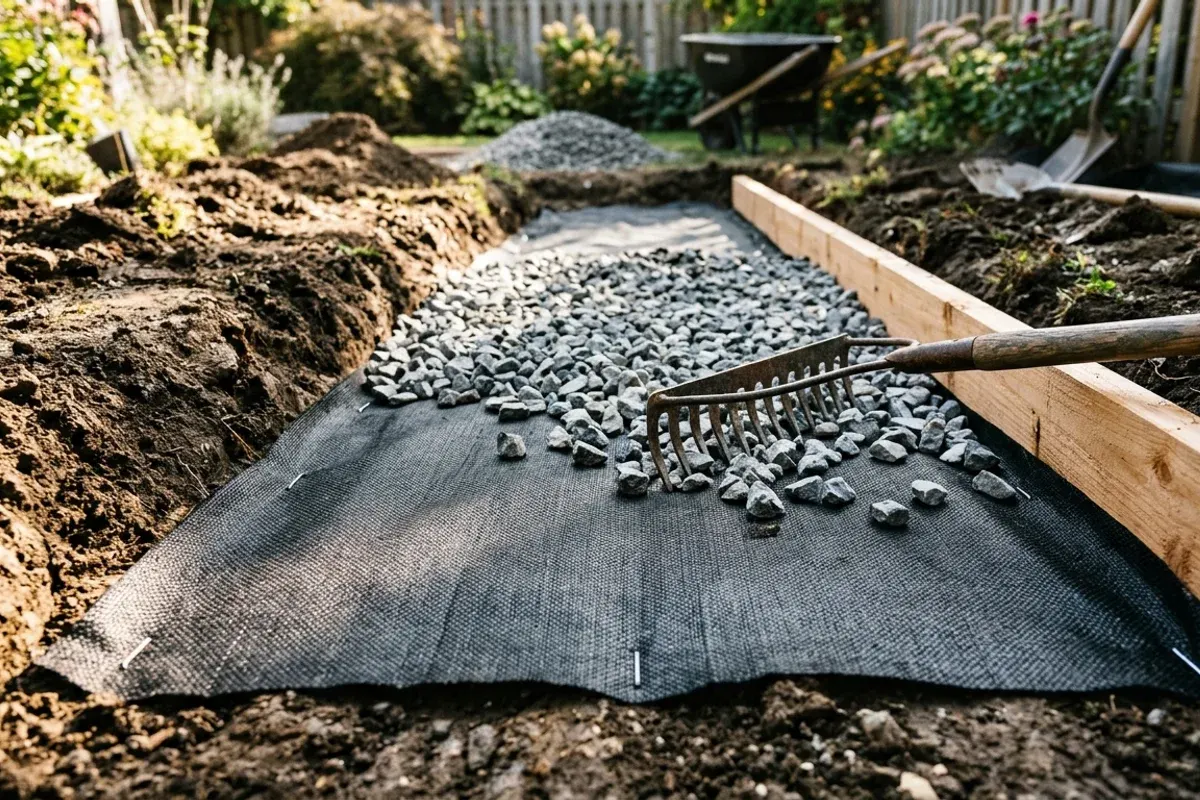
Step 3: Laying the Geotextile "Burrito" Liner
- Unroll the 4-ounce non-woven geotextile fabric down the trench.
- Press the fabric into the trench corners, leaving at least 12 inches of excess fabric flapping over both sides at the ground surface.
- Pin the fabric edges to the lawn using landscape sod staples to prevent soil from falling in during gravel pouring.
Step 4: The 2-Inch Gravel Bedding & Pipe Placement
- Bedding Layer: Pour 2 inches of clean washed #57 gravel along the fabric-lined trench floor. Never place the pipe directly on the fabric or dirt floor; the gravel bed creates an immediate water collection channel beneath the pipe.
- Lay Perforated PVC: Set your 4-inch perforated PVC pipe atop the gravel bed. Ensure the two rows of factory-drilled holes point downward at 4 and 8 o'clock.
- Glue Fittings: Solvent-weld pipe sections together with PVC primer and cement.
- Install a Surface Cleanout: At the highest (upstream) end of the drain run, glue a 90-degree elbow or sanitary tee with a vertical pipe extending to ground level, capped with a threaded brass or PVC plug. This gives permanent access to inspect or snake the line.
       PIPE HOLE ORIENTATION (End View Cross-Section)
                     ┌───────────┐
                     │           │
                     │  Top Half │
                     │  (Solid)  │
                     │           │
                     ├───────────┤
                     │ (o)   (o) │ <- Holes at 4:00 & 8:00
                     └─────┬─────┘
                           ▲
          Water enters from bottom gravel bed!
Step 5: Infilling Gravel & Closing the Wrap
- Backfill with Gravel: Pour washed #57 gravel over the pipe until it reaches within 3 to 4 inches of the lawn surface.
- Fold the Burrito: Pull the excess geotextile fabric from the sides across the top of the gravel, overlapping the flaps by at least 6 to 8 inches.
- Topsoil Cap & Sod: Cover the wrapped fabric with 3 inches of native sandy loam or topsoil. Roll back the original turf sod, or seed with turfgrass using our Grass Seed Calculator.
French Drain vs. Surface Catch Basin vs. Dry Creek Bed
| System Type | Primary Target Problem | Mechanism | Maintenance Level |
|---|---|---|---|
| French Drain | Saturated groundwater, spongy lawn, water table seepage | Perforated pipe in deep gravel trench collects rising subsurface water | Low (Cleanout flush once every 3–5 years) |
| Surface Catch Basin | Standing puddles on driveways, patios, or gutters | Solid PVC pipe catches concentrated surface water via grates | Medium (Clean leaves from grates twice per season) |
| Dry Creek Bed | Fast, high-volume torrential overland stormwater runoff | Shallow, curved rock-lined surface swale engineered with river boulders | Very Low (Occasional leaf raking) |
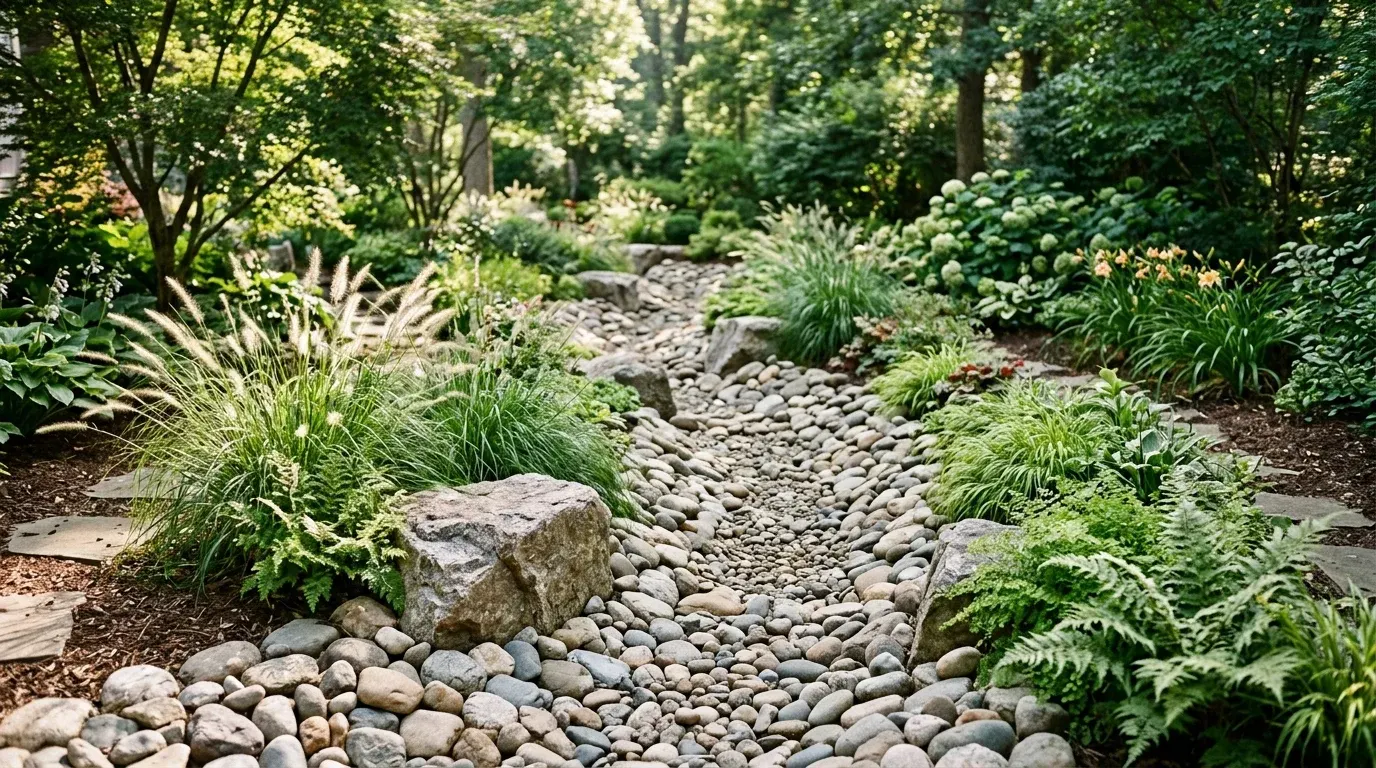
- For managing overland surface torrents, explore our guide on how to build a dry creek bed for stormwater.
Frequently Asked Questions
Can a French drain freeze in the winter?
Because water flows continuously through a pitched French drain rather than sitting stationary, freezing is rare during normal winter weather. However, in extreme northern climates (Zones 3 and 4), excavate the trench so the pipe sits near or below your local frost line, and ensure the discharge exit maintains an unobstructed downhill plunge to prevent ice dams.
Can tree roots clog a French drain?
Yes. Aggressive water-loving trees (such as willows, poplars, and red maples) will send hair-like root tendrils through fabric pores toward the moist pipe. Route French drains at least 10 to 15 feet away from mature tree canopies.
Can you use a French drain without a gravel trench?
There are prefabricated "gravel-free" bundle drains (flexible pipe wrapped in polystyrene foam peanuts). While lighter to transport, prefabricated bundles lack the structural mass and enormous void capacity of 3 tons of real crushed stone. Over 10+ years, heavy soil compaction and lawn mowers inevitably compress foam peanuts, significantly reducing water intake compared to real washed #57 stone.
FAQ
What is the minimum slope required for a French drain?
A French drain requires a minimum slope of 1% (which equals 1/8 inch of vertical drop per linear foot, or 1 inch of fall every 8 to 10 feet of trench). This gravitational pitch guarantees water flows swiftly through the pipe without pooling or depositing suspended silt particles.
Should the holes in a French drain pipe face UP or DOWN?
The holes or slots must always face DOWN (positioned at the 4 o'clock and 8 o'clock positions). Groundwater naturally rises from the saturated subsoil upward into the washed gravel bed. When the water table reaches the downward-facing holes, it enters the pipe and flushes away via gravity. Facing holes upward forces the entire trench to flood before water can enter, letting mud and debris wash directly into the line.
What is the best gravel to use in a French drain?
Use clean, washed #57 angular crushed limestone or granite stone (3/4-inch to 1-inch aggregate). Never use pea gravel, crusher run, or base gravel containing stone dust or sand fines. The angular, uniform size of #57 stone provides massive open interstitial voids (approx. 40% void space) that allow water to rush through freely.
What kind of fabric should wrap a French drain?
Use non-woven 4-ounce polypropylene needle-punched geotextile landscape fabric. Woven weed barrier fabric is completely wrong: it acts like a plastic sheet that clogs with clay fines within 12 months. Non-woven geotextile acts as an industrial sieve, allowing water to pass through at 100+ gallons per minute per square foot while permanently blocking soil particles.
Is smooth-wall PVC better than black corrugated pipe for French drains?
Yes, smooth-wall perforated pipe (SDR 35 or Schedule 40 PVC) is significantly superior to thin black corrugated tubing. Smooth PVC has zero internal ridges to trap silt, can easily be unclogged with a sewer snake or pressure washer, and withstands heavy lawn mower and vehicle traffic without crushing or sagging into low spots.