How to Build a Dry Creek Bed for Backyard Drainage

By Efraín Vega · Published November 13, 2026
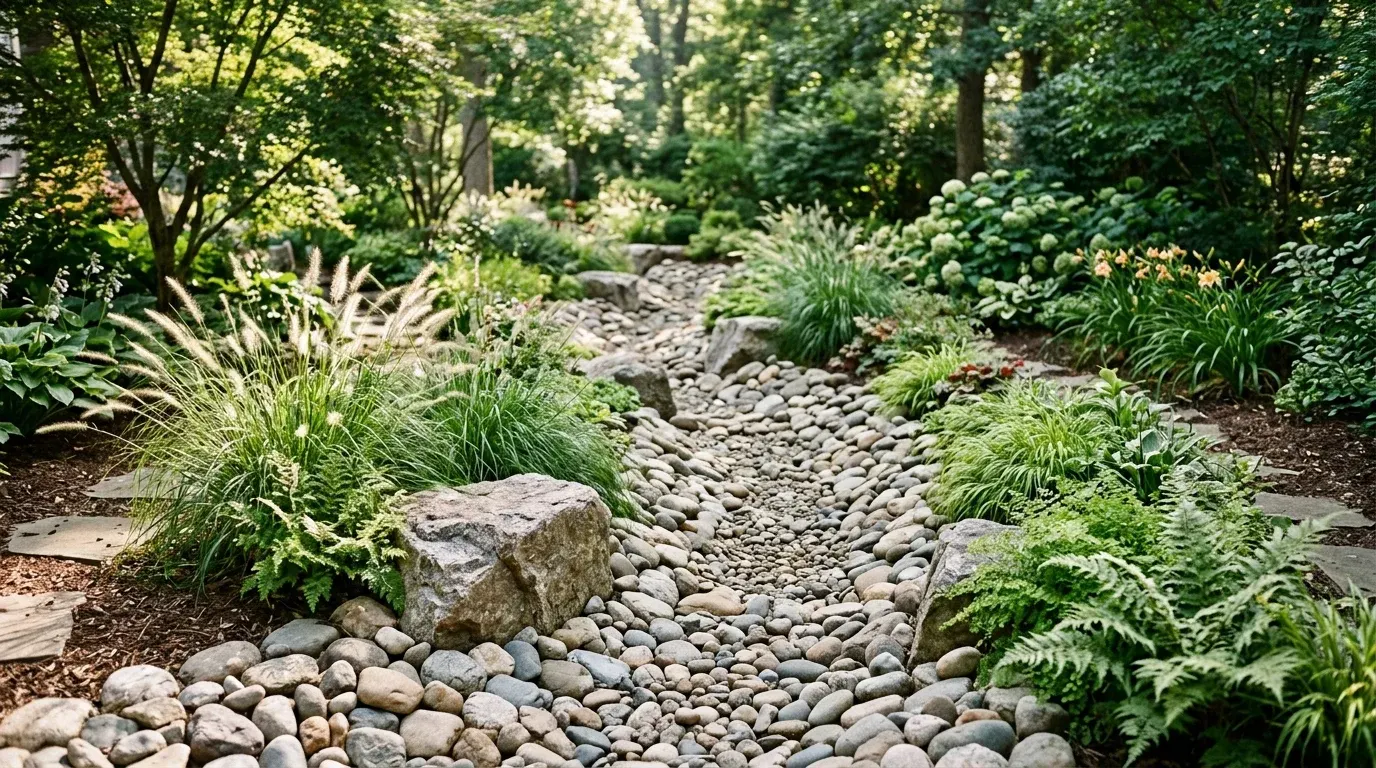
A dry creek bed (also known as an arroyo, rocky swale, or rain garden channel) is one of the most elegant and functional landscape drainage solutions for residential yards.
Instead of hiding drainage inside subterranean pipes that can clog with tree roots, a dry creek bed works with nature: it channels surface runoff away from your house foundation during torrential rains, while functioning as a gorgeous, sculpted rock garden during dry weather.
Anatomy of a Natural Drainage Channel
The secret to a dry creek bed that looks like a native mountain stream—rather than an industrial ditch—lies in meandering curves and proportional cross-sections:
                              [Parabolic Cross-Section]

  (Garden Edge)                                                     (Garden Edge)
       \                                                                 /
        \   [Large 8"-14" Boulders]               [Medium 4"-6" Cobble] /
         \__   o  O   o                                  o   o  O    __/
            \_____                                             _____/
                  \______   [Small 1"-2" River Bed]     ______/
                         \_________  o o o o  _________/
                                   \_________/
                                (Center Flow Line: 10" Deep)
  ============================================================================= (Native Soil)
  ~~~~~~~~~~~~~~~~~~~~~~~~~~~~~~~~~~~~~~~~~~~~~~~~~~~~~~~~~~~~~~~~~~~~~~~~~~~~~ (Geotextile Fabric)
- Avoid Straight Lines: Streams naturally snake across the landscape. Introduce gentle S-curves, widening the channel at the outside of bends where water velocity slows down.
- Varying Widths: Vary the creek bed width between 2.5 feet and 4.5 feet along its length to mimic natural erosion patterns.
Rock Sizing: The "Rule of Thirds"
Never dump a single size of rock into a trench; uniform gravel looks like a municipal french drain and will wash downstream during heavy flash floods.
Calculate your stone takeoffs using our River Rock Calculator and Gravel Calculator based on this volume breakdown:
| Stone Class | Diameter | Placement | Purpose |
|---|---|---|---|
| Accent Boulders | 8 to 14 inches | Outside curves, downspout outlets, focal points | Anchors soil, redirects flow, breaks water velocity |
| River Cobble | 3 to 6 inches | Sloping channel banks and transition edges | Prevents smaller gravel from washing onto banks |
| Pea/River Gravel | 1 to 2 inches | Center bottom stream bed | Permeable flow layer, comfortable to walk on |
Step-by-Step Installation Guide
[Roof Downspout] ===> [Underground 4" Pipe] ===> [Rock Splash Basin] ===> [Curving Dry Creek] ===> [Rain Garden / Sump]
Step 1: Layout and Slope Check
- Lay out the path of your creek using two garden hoses or spray marking paint. Follow natural grade depressions toward an approved drainage outlet (such as a rain garden, dry well, or street swale).
- Use a string line with a line level (or laser level) to verify a continuous 1% to 2% downward grade (1 to 2 inches of drop per 10 feet).
Step 2: Excavate the Parabolic Trench
- Excavate the channel with a rounded trenching shovel. Make the center 8 to 12 inches deep, sloping the side banks gently upward at a 3:1 or 4:1 slope.
- Pile the excavated native topsoil along the lower outer edges of the banks to build low berms, which increase the channel's flood capacity.
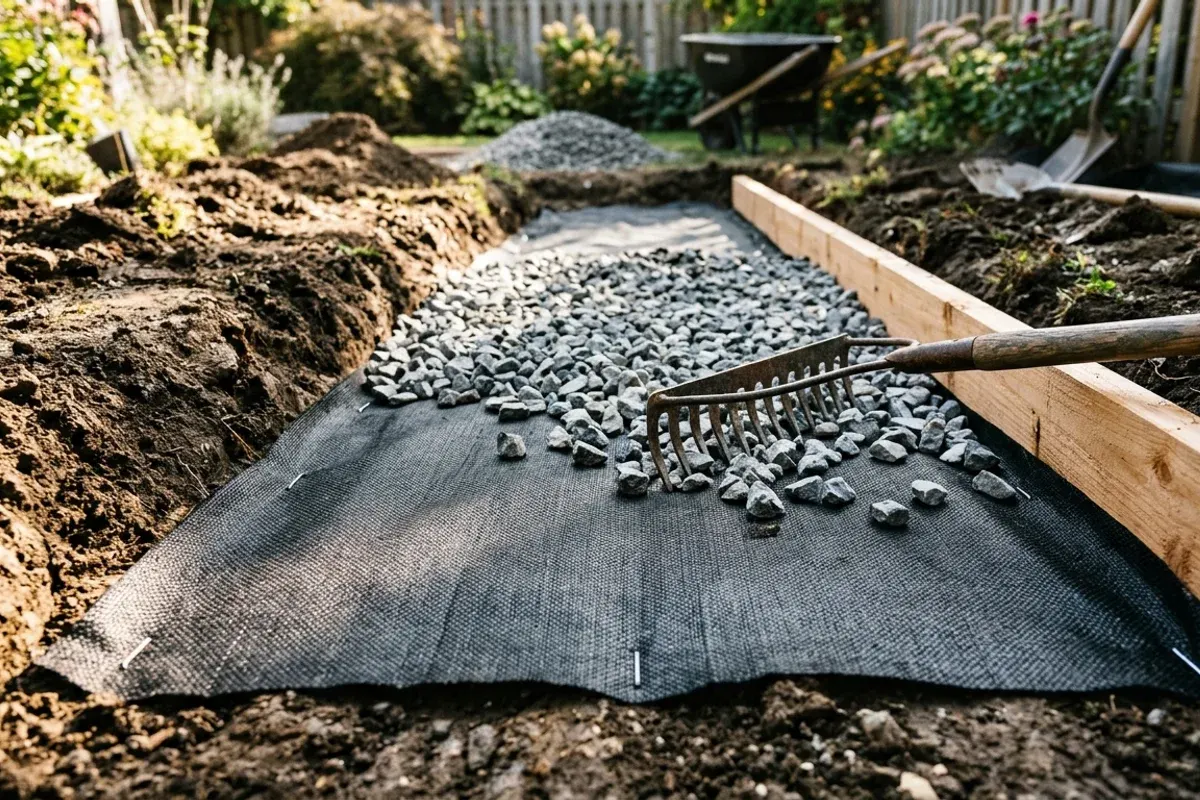
Step 3: Line with Non-Woven Geotextile Fabric
- Smooth out sharp roots and stones from the bare trench.
- Roll out heavy-duty 4- to 6-ounce non-woven geotextile fabric (see our guide on landscape fabric selection).
- Press the fabric snugly into the contours of the trench, letting at least 12 inches overlap the top rims. Secure with 6-inch steel landscape staples every 3 feet.
Avoid Woven Weed Barrier
Never use cheap black woven plastic weed barrier in a drainage swale. Water runs across woven plastic like an aqueduct instead of soaking into subsoil, and rounded river stones slide down slick plastic during heavy rain events.
Step 4: Place Boulders and Bank Stones
- Boulders First: Place your largest 8- to 14-inch granite or basalt boulders along the outer edges of curves and at the downspout discharge basin. Dig them 2 to 3 inches into the soil so they look like weathered natural outcroppings rather than rocks sitting on top of the ground.
- Side Cobble: Line the sloping banks with 3- to 6-inch river cobbles, interlocking them against the large boulders.
Step 5: Fill the Center Channel with River Gravel
- Shovel 1- to 2-inch smooth tumbled river rock into the central flow path to a depth of 2 to 3 inches.
- Trim excess landscape fabric along the edges with a utility knife, tucking the edges beneath topsoil or mulch.
Landscape Planting Along the Banks
To complete the natural stream aesthetic, soften the rocky edges with moisture-tolerant plants that thrive on periodic wet-to-dry cycles:
- Ornamental Grasses: Japanese forest grass (Hakonechloa macra), switchgrass (Panicum virgatum), and blue fescue create fluid movement mimicking flowing water.
- Moisture-Loving Perennials: Siberian iris (Iris sibirica), hostas, wild columbine, and creeping thyme nestle naturally between accent boulders.
- Ferns: Cinnamon fern and ostrich fern thrive in shaded woodland sections of the creek.
Sources: Building a Dry Creek Bed for Stormwater — University of Maryland Extension, Landscape Drainage Solutions — NC State Extension.
FAQ
How deep and wide should a dry creek bed be?
A functional residential dry creek bed should follow a parabolic, curved bowl shape: 2 to 4 feet wide across the top rim and 8 to 12 inches deep at the center flow line. Avoid digging a flat-bottomed rectangular ditch, which looks artificial and causes sediment to accumulate.
What slope is required for a dry creek bed to drain properly?
Maintain a minimum downward slope of 1% to 2% (a drop of 1 to 2 inches for every 10 linear feet). If your yard is completely flat, you must excavate deeper toward the discharge point or combine the swale with a perforated French drain pipe beneath the rock bed.
What size river rocks should you use in a dry creek bed?
Follow the landscape design 'Rule of Thirds' for natural stability: (1) One-third large 8- to 14-inch anchor boulders set along outside curves and high-velocity choke points; (2) One-third medium 3- to 6-inch river cobbles lining the sloped side banks; and (3) One-third small 1- to 2-inch smooth river gravel filling the bottom center channel.
Do you need landscape fabric under a dry creek bed?
Yes. Heavy-duty 4- to 6-ounce non-woven needle-punched geotextile fabric is essential. Without it, heavy stones will sink into saturated clay subsoil within two seasons, and weeds will invade the rocky channel from underneath. Avoid cheap woven plastic weed barrier, which becomes slick and prevents natural water infiltration.
How do you connect a roof gutter downspout to a dry creek bed?
Bury a 4-inch solid PVC or corrugated drain pipe from the downspout to the head of the creek bed. Discharge the water into a recessed 'splash basin' armored with flat, interlocking flagstones or 8-inch river boulders. The rock mass dissipates the energy of rushing water, preventing soil washout.