Permeable Pavers Base Depth & Drainage Layers (PICP Guide)

By Efraín Vega · Published November 22, 2026
Traditional paver patios and concrete slabs are completely impermeable. When heavy downpours hit, thousands of gallons of stormwater sheet off the surface, eroding lawn edges, pooling near foundation walls, and overwhelming municipal storm sewers.
Permeable Interlocking Concrete Pavement (PICP) solves this by turning your entire patio, walkway, or driveway into an environmental infiltration basin.
Rain falling on a permeable patio drains instantly through wide joint spacers into a deep, open-graded gravel reservoir underneath, filtering contaminants and recharging native groundwater without puddles or runoff.
The Stratified PICP Layer System
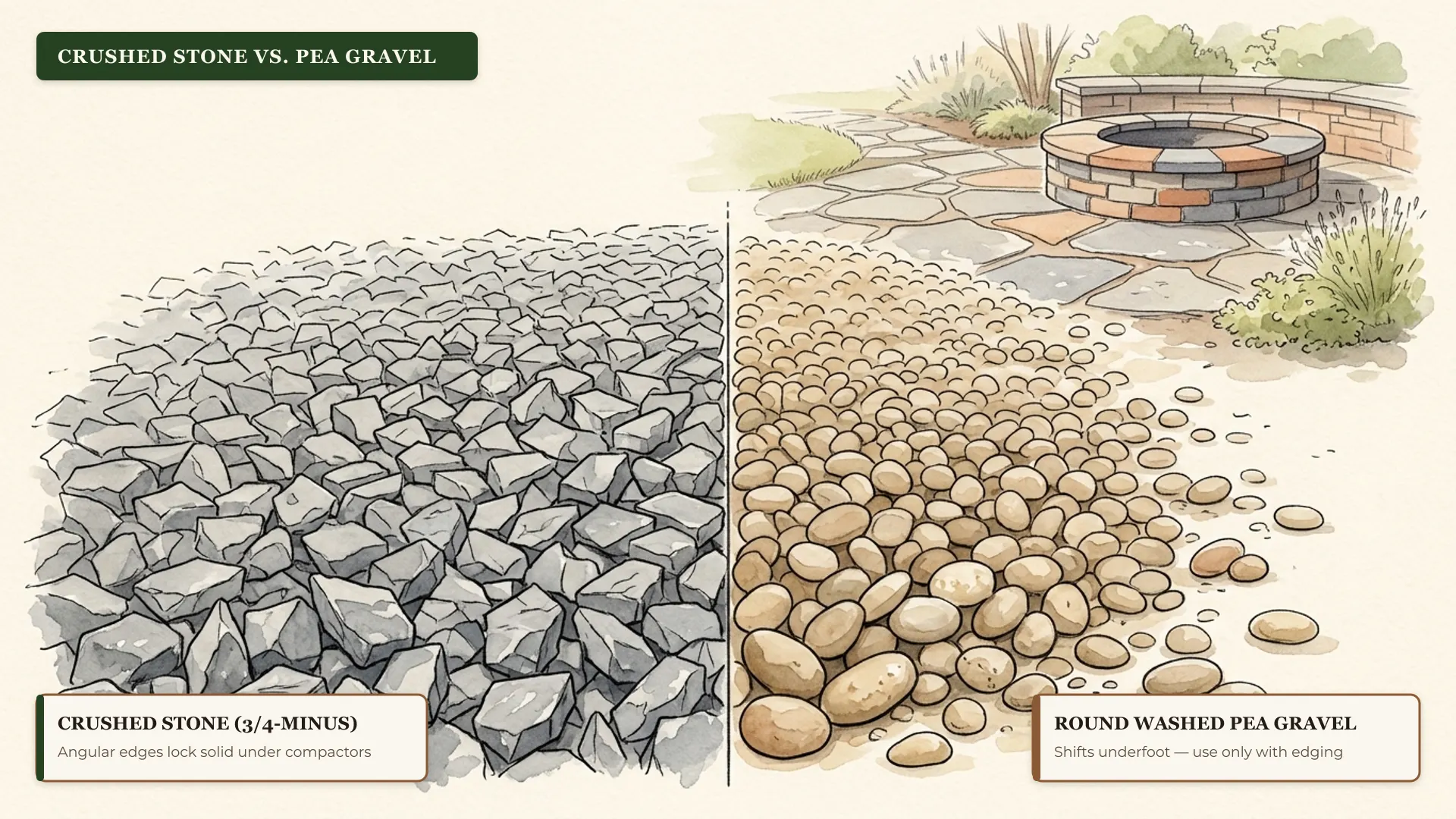
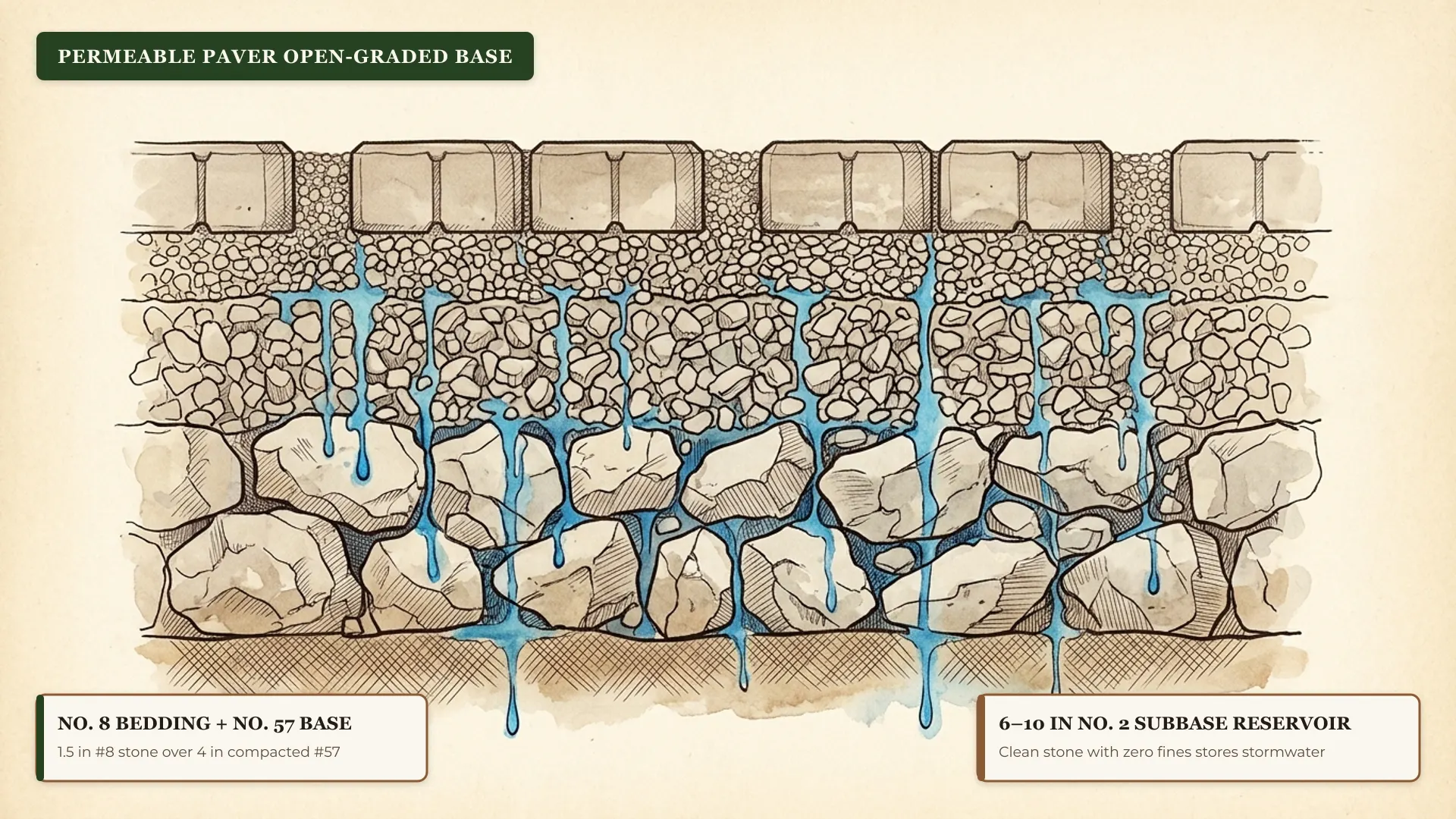
Unlike standard paver bases that require dense-graded road base with stone dust (like crusher run or #21A), permeable systems use open-graded aggregate with zero dust fines, leaving roughly 35% to 40% open air voids between clean crushed rocks.
From top to bottom, an ICPI-compliant permeable installation consists of:
1. Permeable Pavers & Joint Aggregate (Wearing Surface)
- Pavers: Specifically manufactured concrete pavers with enlarged spacer lugs creating 1/4-inch to 3/8-inch wide joints.
- Joint Fill: Clean, washed ASTM #8 or #89 angular stone chips (approx 1/8 to 3/8-inch granite or basalt chips). Swept into joints until flush with paver bevels.
2. Bedding Layer (2 Inches Deep)
- Aggregate: Clean, washed ASTM #8 crushed stone.
- Screeded completely flat. Because ASTM #8 has no fines, it will not wash away or wash down into the larger stone base below.
3. Base Reservoir Layer (4 to 6 Inches Deep)
- Aggregate: Clean, washed ASTM #57 crushed stone (1/2 to 1-inch angular stone with all fines washed out).
- Serves two functions: provides structural load-bearing capacity and acts as a rapid water transmission conduit. Compacted with a vibrating plate compactor.
4. Sub-Base Reservoir Layer (6 to 12 Inches Deep - Heavy Load / Water Storage)
- Aggregate: Clean ASTM #2 large ballast stone (1.5 to 3-inch fractured rock).
- Required for driveways, heavy snowmelt zones, or areas with low-permeability native clay soils. This layer stores up to 40% of its volume in water during severe 100-year storm events.
5. Geotextile Perimeter Lining
- Line the trench with non-woven geotextile fabric (6 to 8 oz weight) along the vertical trench edges and bottom subgrade to prevent fine clay mud from contaminating the clean aggregate reservoir.
Material Specifications: Permeable vs Traditional
| Construction Layer | Traditional Paver Patio | Permeable Paver Patio (PICP) |
|---|---|---|
| Joint Material | Polymeric sand / Fine silica | ASTM #8 / #89 clean granite chips |
| Bedding Layer | 1" Washed concrete sand (ASTM C33) | 2" Clean crushed chips (ASTM #8) |
| Base Aggregate | 4–6" Crusher run / #21A (with stone dust) | 4–6" Clean #57 stone (zero dust) |
| Water Infiltration | 0% (Water sheds off surface) | 100% permeable (> 100 in/hr drainage) |
| Winter Frost Heave | Prone to heaving if wet base freezes | Highly resistant (Void space drains water away) |
| Maintenance | Reapply polymeric sand every 3 yrs | Annual vacuum sweep of joint aggregate |
Maintenance for Permeable Patios
Permeable pavers require minimal maintenance, but organic debris must not be allowed to decompose in joints:
- Never dump soil or mulch directly on the patio: Fine dirt particles act like silt, filling the joint chips and restricting drainage.
- Vacuum sweep annually: In late autumn after leaves fall, use a stiff shop vacuum or commercial leaf blower to clear dust, pine needles, and seeds from the top 1/2 inch of joints.
- Top up joint chips: If joint chips drop more than 1/2 inch below the paver surface, sweep fresh clean ASTM #8 chips across the patio to restore full interlock.
To calculate stone base tonnages and bedding chips for your patio or walkway footprint, use our interactive Gravel Calculator or Paver Path Calculator.
FAQ
What is the difference between standard and permeable pavers?
Standard pavers have tight 1/16 to 1/8-inch joints swept with polymeric sand over a dense-graded crushed stone base with dust fines, shedding water off to the edges. Permeable interlocking concrete pavers (PICP) have wide 1/4 to 3/8-inch drainage spacer lugs, filled with clean angular stone chips (ASTM #8 or #89) over open-graded crushed rock without fines, allowing 100% of rainwater to drain directly through the patio into the groundwater.
Can you use regular sand under permeable pavers?
No. Never use concrete sand, masonry sand, stone dust, or polymeric sand with permeable pavers. Fine sand particles immediately wash into the open voids of the crushed stone base and clog the system, turning a permeable patio into a regular impermeable surface within one rainy season.
How deep should the base be for permeable pavers?
For pedestrian walkways and garden patios, the total open-graded base is 6 to 8 inches deep: 4 to 6 inches of ASTM #57 crushed stone base and 2 inches of ASTM #8 bedding chips. For permeable driveways carrying passenger vehicles, add a 6 to 12-inch reservoir layer of ASTM #2 large ballast stone beneath the #57 layer.
Do permeable pavers freeze and heave in cold winters?
No. In fact, permeable pavers have superior freeze-thaw resistance compared to traditional concrete or asphalt. Because water rapidly drains through the 35% open void space of the clean stone base rather than pooling on top, there is virtually no standing water near the surface to freeze, expand, and heave pavers.