How Deep to Set Fence Posts: Frost Line, Gravel Base & Post Length

By Efraín Vega · Published October 28, 2026
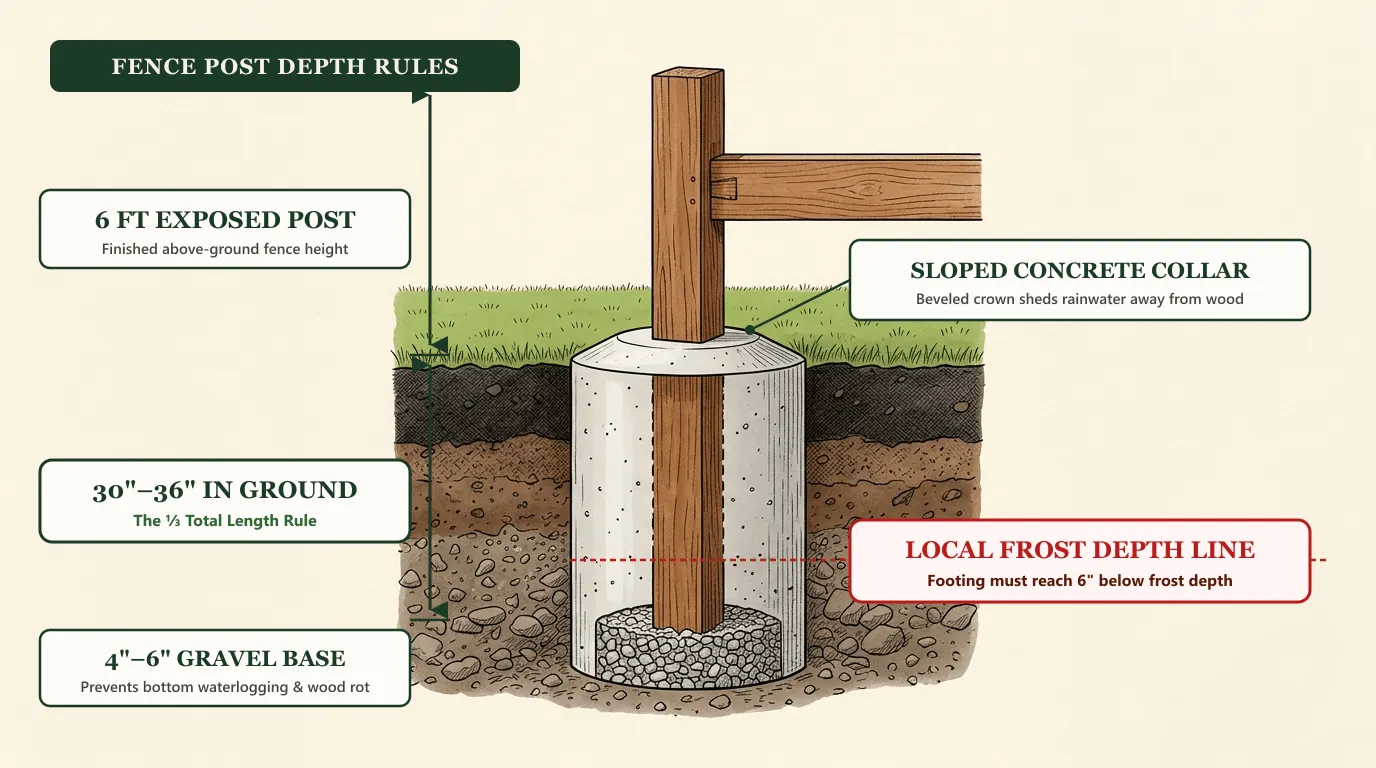
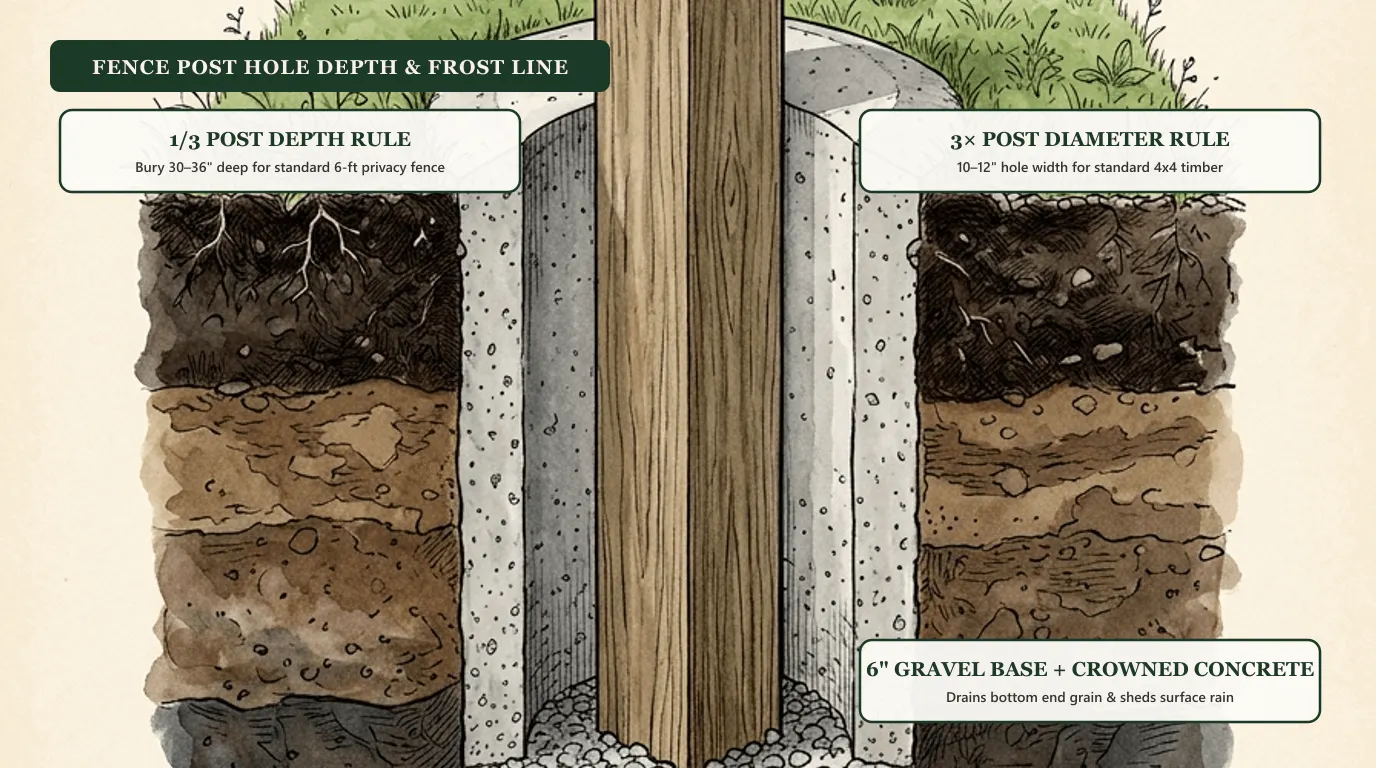
A fence post should be set with at least one-third of its total length in the ground—which means 30 to 36 inches deep for a standard 6-foot privacy fence. In cold climates, posts must extend at least 6 inches below the local frost line to prevent winter frost heaving from pushing your fence out of alignment.
Digging the hole to the right depth and width is what keeps the fence plumb through heavy wind loads, gate swings, and wet seasons.
How deep should a fence post hole be?
A fence post hole must be dug to a depth equal to one-third to one-half of the above-ground post height—meaning 30 to 36 inches deep (2.5 to 3 feet) for a standard 6-foot privacy fence. In freezing climates, the footing must extend at least 6 inches below your local frost line to prevent frost heave.
| Fence height | Recommended post length | Hole depth (mild climate) | Hole depth (frost zone) | Hole diameter (4×4 post) |
|---|---|---|---|---|
| 3 ft (garden/picket) | 5 ft | 24 in | 30–36 in (below frost) | 8 in |
| 4 ft (vegetable fence) | 6 ft | 24–30 in | 36 in | 8 in |
| 6 ft (privacy/perimeter) | 8 or 9 ft | 30–36 in | 36–48 in (below frost) | 10 in |
| 8 ft (deer/high security) | 11 or 12 ft | 36–42 in | 48 in | 10–12 in |
Note: Add 4 to 6 inches of depth to each hole for the gravel drainage base below the wood post.
The one-third rule for post length
The universal standard used across residential building codes is that one-third of the above-ground post height must be buried below grade:
- Buried Depth = Above-Ground Height ÷ 2 (or Total Post Length ÷ 3)
For example, if you want a 6-foot fence above ground, you need at least a 24 to 36-inch deep burial, requiring an 8-foot or 9-foot post. For corners, end posts, and gate posts bearing hinge tension, always step up to a 9-foot or 10-foot post buried 36 inches or deeper.
You can calculate the exact number of posts, rails, pickets, and concrete bags for your layout using our Garden Fence Calculator.
Dealing with the frost line
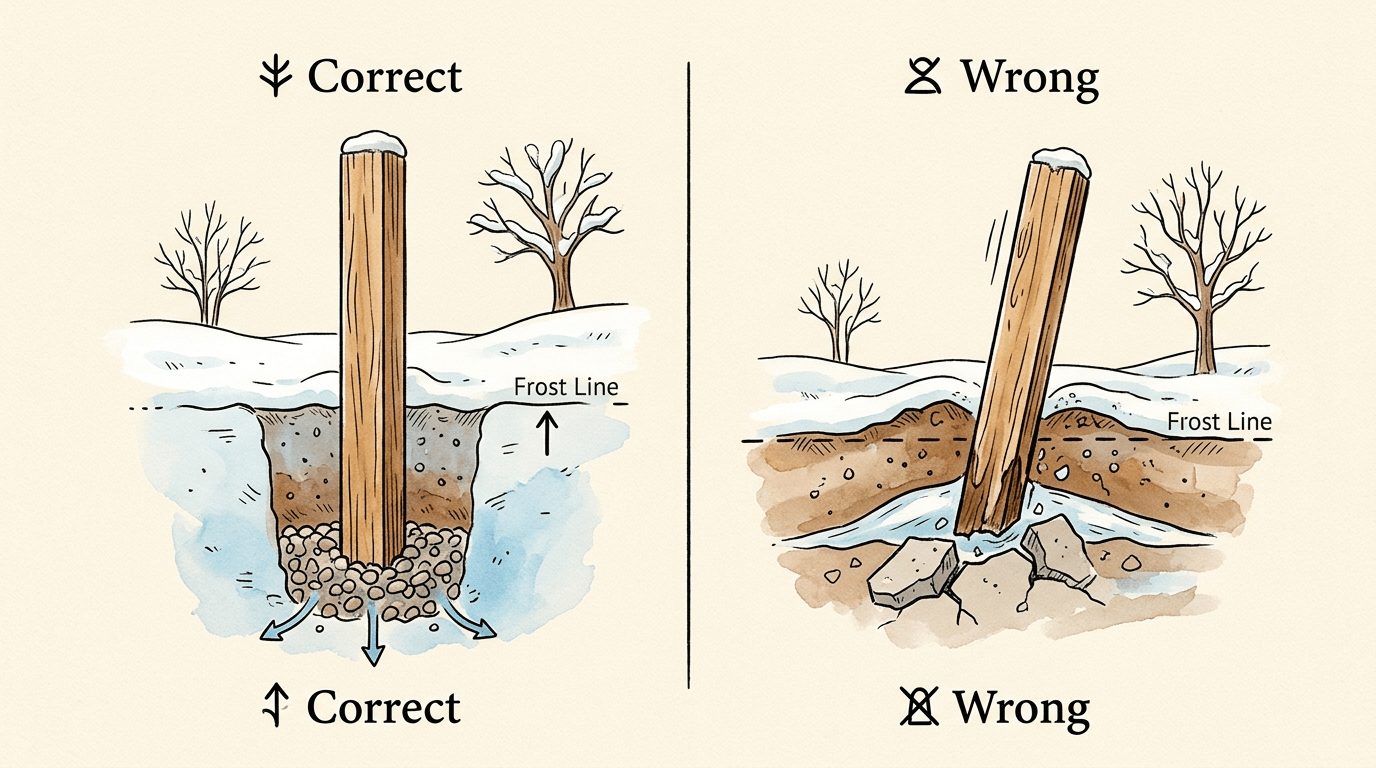
In northern and midwestern states, soil freezes deep in winter. Water expands by roughly 9% as it turns to ice. If your concrete footing ends above the frost line, the frozen ground grips the rough sides of the concrete plug and levers the post upward (frost heaving). When spring thaws arrive, the post does not settle back into place—it stays crooked.
Always check your municipal building code for your county's designated frost line:
- Southern US: 0 to 12 inches (frost depth rarely governs; the 1/3 structural rule rules).
- Mid-Atlantic & Midwest: 24 to 36 inches.
- Upper Midwest & Northeast: 36 to 48 inches or deeper.
Your post hole and concrete collar must reach 6 inches deeper than the frost line.
Always add a gravel drainage base
Never set a wooden post directly onto bare dirt or encase the bottom end completely in a concrete cup. Dig your hole 6 inches deeper than required and pour 4 to 6 inches of 3/4-inch crushed gravel at the bottom. This provides a clear drainage path so moisture can escape instead of soaking into the vulnerable bottom end-grain of the timber.
Calculating concrete volume per post
How much concrete you need depends on the hole diameter and depth:
- A standard 4×4 post (actual 3.5×3.5 in) in a 10-inch diameter hole dug 36 inches deep takes approximately 3 to 3.5 bags (50-lb or 60-lb) of quick-setting concrete.
- A corner 6×6 post in a 12-inch diameter hole dug 42 inches deep takes approximately 5 to 6 bags (60-lb).
For exact footing volume and dry bag counts, use the Concrete Footing Calculator.
Preventing post rot at ground level
Most wooden posts fail not at the bottom of the hole, but right at the ground line (0 to 3 inches below the surface), where wood, oxygen, and soil moisture constantly interact.
Follow these installation rules:
- Slope the concrete collar: When finishing the concrete pour, crown the top of the concrete 1 inch above grade and taper it outward away from the post. This sheds rainwater away from the wood.
- Use Ground Contact treated lumber: Always purchase lumber stamped UC4A (Ground Contact) rather than standard Above Ground (UC3B) pressure treatment.
- Coat cut ends: If you cut a pressure-treated post to size, always keep the factory-treated end in the ground. If you must cut the bottom, soak the cut end in copper naphthenate wood preservative before planting it.
FAQ
How deep should a fence post hole be?
The standard rule of thumb is to bury one-third to one-half of the post's total length in the ground. For a standard 6-foot fence, dig at least 30 to 36 inches deep (2.5 to 3 feet).
Do fence posts need to go below the frost line?
Yes. In freezing climates, post footings must sit at least 6 inches below your local frost line. If they sit above the frost line, freezing moisture in the soil will heave the posts upward and throw the fence out of plumb.
Should you put gravel in the bottom of a fence post hole?
Yes. Adding 4 to 6 inches of crushed drainage gravel (like 3/4-inch crushed stone) at the bottom allows water to drain away from the wooden end grain instead of letting the post stand in pooled water.
How wide should a fence post hole be?
A post hole should be three times the width of the post. For a standard 4x4 post (actual 3.5 inches), dig an 8 to 10-inch diameter hole. For a 6x6 post, dig a 12-inch diameter hole.