Fence Post Depth: The 1/3 Rule & Concrete Hole Sizing

By Efraín Vega · Published November 14, 2026
A leaning, sagging, or wobbly fence almost always traces back to a post hole that was dug too shallow, too narrow, or above the winter frost depth.
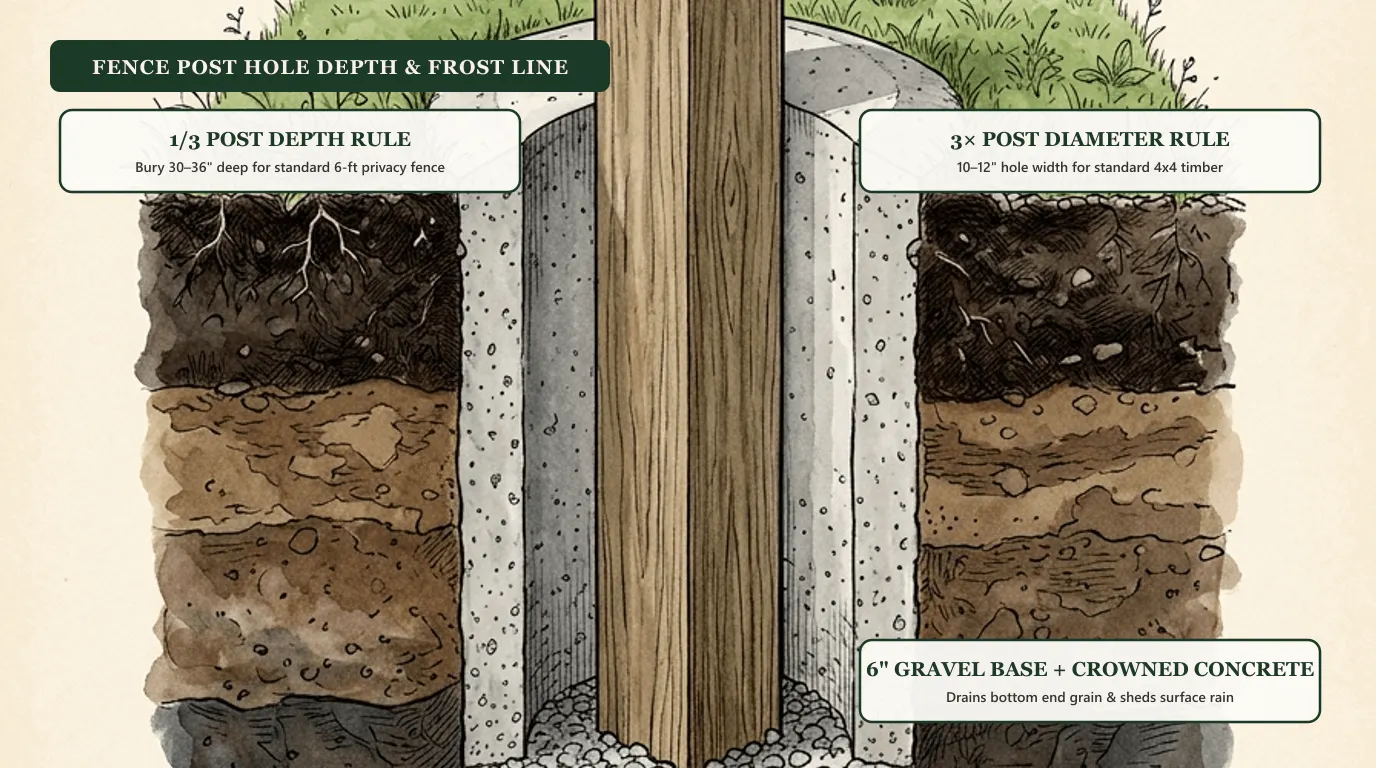
To withstand gale-force wind loads and seasonal ground movement, fence posts must follow two fundamental structural formulas: the 1/3 buried depth rule and the 3× post width diameter rule.
The 1/3 depth rule for fence post stability
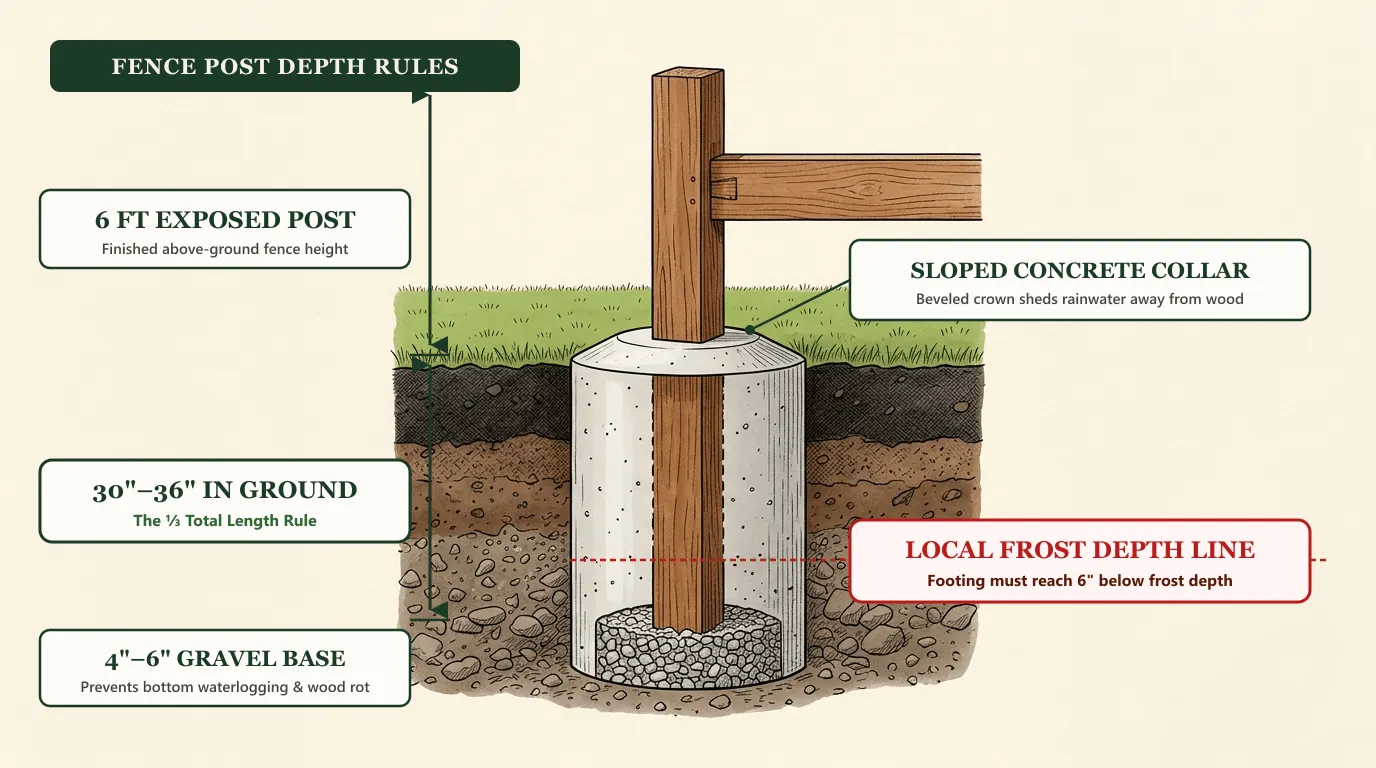
Standard building practice requires burying at least one-third of the above-ground fence height into the ground:
| Fence Height | Minimum Buried Depth | Recommended Post Length | Corner / Gate Post Depth |
|---|---|---|---|
| 3-Foot Fence (Picket) | 18 inches (1.5 ft) | 5-Foot Post | 24 inches (6-ft post) |
| 4-Foot Fence (Garden/Wire) | 24 inches (2.0 ft) | 6-Foot Post | 30 inches (7-ft post) |
| 5-Foot Fence (Pool/Yard) | 24 to 30 inches | 7 to 8-Foot Post | 36 inches (8-ft post) |
| 6-Foot Fence (Wood Privacy) | 30 to 36 inches | 8 to 9-Foot Post | 36 to 42 inches (9 to 10-ft post) |
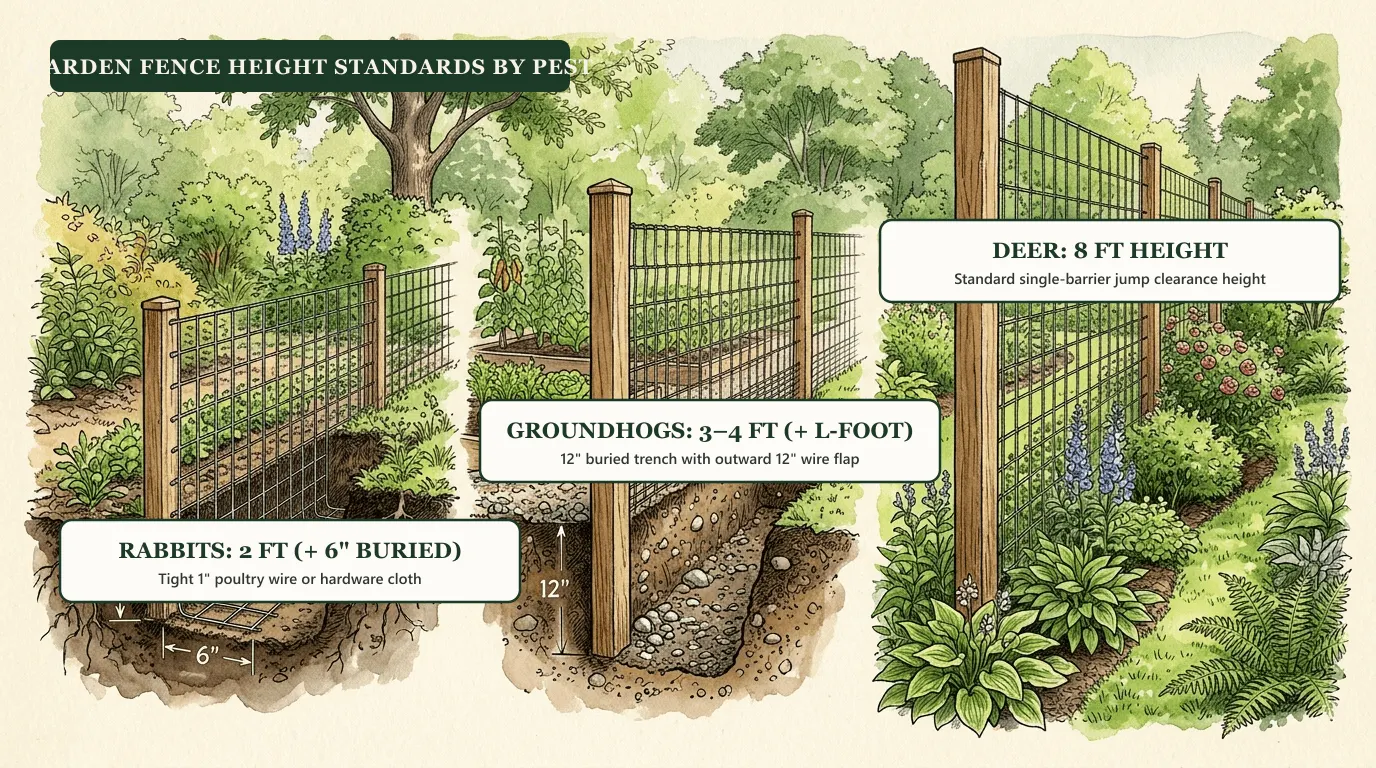
| 8-Foot Fence (Commercial/Deer) | 36 to 48 inches | 10 to 12-Foot Post | 48 inches (12-ft post) |
To calculate post counts, rail boards, pickets, and concrete bags for your entire perimeter, use our Garden Fence Calculator.
Sizing post hole diameter: the 3× rule
If a post hole is too narrow, the surrounding concrete shell will crack under lateral wind pressure.
- Formula:
Hole Diameter = Post Width × 3 - For 4×4 Posts (3.5" actual): Dig a 10 to 12-inch diameter hole.
- For 6×6 Posts (5.5" actual): Dig a 12 to 14-inch diameter hole.
Digging a bell-shaped hole (slightly wider at the bottom than the top) creates a concrete wedge that prevents ground frost from jacking the post out of the earth.
The frost depth rule for cold climates
In USDA Zones 3 through 7, winter ground freezing causes soil moisture to expand by roughly 9%, creating an upward force called frost heave.
- If your post sits inside the freeze zone, freezing soil grips the rough concrete collar and lifts the post out of the ground an inch or two every winter.
- Code Requirement: The bottom of your post hole must extend at least 6 inches below your local municipal frost line.
- In regions like the Midwest or New England with 36-to-48-inch frost depths, a 6-foot fence post hole must be dug 42 to 54 inches deep, regardless of the 1/3 rule.
Step-by-step post hole installation
- Auger or Dig the Hole: Use a 2-man power auger or heavy post hole digger to excavate to your target depth plus 6 inches.
- Add 6 Inches of Crushed Gravel: Pour 4 to 6 inches of clean crushed rock into the hole bottom and tamp it firm. Setting the post on gravel lets trapped moisture drain away from vulnerable end grain.
- Position and Plumb the Post: Place a ground-contact (UC4A rated) pressure-treated timber onto the gravel pad. Use a post level strapped to two adjacent sides to hold it dead plumb.
- Pour Concrete: Pour quick-setting dry concrete mix and water (or pre-mixed wet concrete) around the post in 6-inch lifts, tamping with a wooden stake to eliminate air pockets. Check requirements with the Concrete Footing Calculator.
- Crown the Concrete Surface: Slope the top of the concrete collar 1 inch above ground level, sloping outward like a pyramid away from the wood. This sheds surface rainwater away from the post base where rot starts.
Never encase the bottom of the post in concrete
Do not pour concrete into the hole before dropping the post in. If concrete encases the bottom end of the wood, it creates a concrete bucket that traps rainwater around the wood fibers, accelerating rot. Always place gravel first so the wood end rests on drainage rock.
Sources: International Residential Code (IRC) Section R403 (Footings); American Fence Association (AFA) Standard Post Setting Guidelines; USDA Forest Service Post & Pole Preservative Guidelines.
FAQ
How deep should a post hole be for a 6-foot fence?
Dig post holes 24 to 36 inches deep for a 6-foot wooden privacy fence. As a rule of thumb, at least 1/3 of the total post length should be in the ground (a 6-foot fence requires an 8-foot or 9-foot post buried 24 to 36 inches deep). In cold climates, the bottom of the hole must also sit 6 inches below the local frost line.
What is the 1/3 rule for fence posts?
The 1/3 rule states that at least one-third of the above-ground fence height (or 1/3 of the post's total length) must be buried underground. For a 6-foot fence, 1/3 of 6 feet is 2 feet (24 inches minimum depth). End, corner, and heavy gate posts should be buried 30 to 36 inches deep.
How wide should a fence post hole be?
The post hole diameter should be three times the nominal width of the post (3x rule). For a 4×4 post (actual 3.5 inches), dig a 10 to 12-inch diameter hole. For a 6×6 post, dig a 12 to 14-inch diameter hole.
Should you put gravel in the bottom of a fence post hole?
Yes. Add 4 to 6 inches of clean #57 crushed stone or washed pea gravel to the bottom of the augered hole before setting the post. This allows water draining down the post to escape into the subsoil rather than soaking the end grain.
How many 50 lb bags of concrete do I need for a 4x4 post?
In a 10-inch diameter hole dug 30 inches deep (with 6 inches of gravel base, leaving 24 inches of concrete), a 4×4 post requires approximately 2 to 2.5 50-lb bags of concrete (or roughly two 60-lb bags).