How Much Mulch Do I Need? Depth Guide + Coverage Chart

By Efraín Vega · Published October 13, 2026
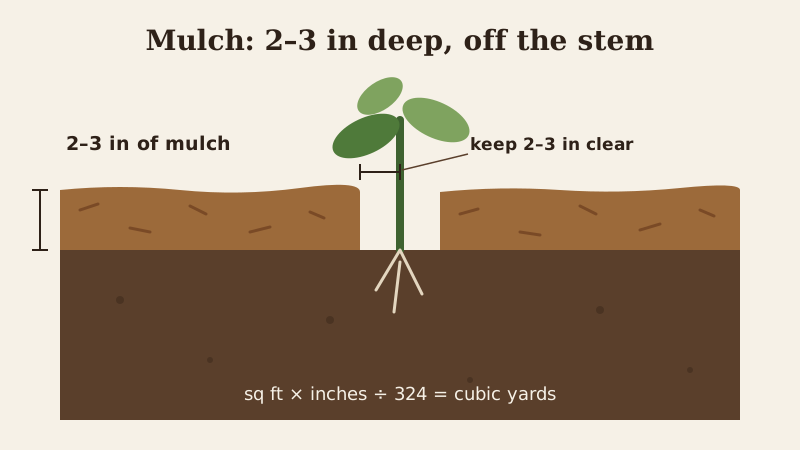
For most garden beds, spread mulch 2–3 inches deep. To find how much to buy: square feet × depth in inches ÷ 324 = cubic yards. A 10×10 ft bed at 3 inches needs about 0.93 cubic yards — 13 bags of 2 cu ft, or 14 with a 10% margin.
How deep should mulch be?
Clemson Extension recommends a 2- to 3-inch layer for most organic mulches — pine bark, pine straw, wood chips and leaves — which is enough to block weeds and hold moisture without smothering roots.
| Mulch | Recommended depth |
|---|---|
| Pine bark, wood chips, pine needles, leaves | 2–3 in |
| Coarse pine bark nuggets | Up to 4 in |
| Grass clippings, finely shredded leaves | No more than 2 in |
| Small gravel or stone | About 1 in |
Fine materials like grass clippings pack down and mat, so keep them thinner. Coarse nuggets have air gaps and can go deeper.
How do you calculate how much mulch you need?
- Measure the area in square feet: length × width. For odd shapes, split the bed into rectangles and add them up.
- Pick a depth in inches, usually 2 or 3.
- Multiply and divide by 324: square feet × inches ÷ 324 = cubic yards. That's because, as Clemson Extension notes, one cubic yard covers 324 sq ft at 1 inch deep.
- For bags, multiply cubic yards by 27 to get cubic feet, then divide by the bag size.
Example: a 6×20 ft bed at 3 inches is 120 × 3 ÷ 324 = 1.11 cubic yards — about 30 cu ft, or 15 bags of 2 cu ft.
Mulch coverage chart
| Area | 2 in deep | 3 in deep |
|---|---|---|
| 50 sq ft | 0.31 yd³ (5 bags of 2 cu ft) | 0.46 yd³ (7 bags) |
| 100 sq ft | 0.62 yd³ (9 bags) | 0.93 yd³ (13 bags) |
| 200 sq ft | 1.23 yd³ (17 bags) | 1.85 yd³ (25 bags) |
| 500 sq ft | 3.09 yd³ (42 bags) | 4.63 yd³ (63 bags) |
Exact amounts, rounded up to whole bags. Add about 10% if your beds are uneven.
Don't pile it against stems
Keep mulch 2–3 inches away from the stems of woody plants and tree trunks, and 6–12 inches from house walls (Clemson Extension). Mulch "volcanoes" piled against trunks hold moisture against the bark and invite rot and rodents.
Bagged or bulk mulch?
Bags make sense for small jobs — under about a cubic yard, or roughly 14 bags. Beyond that, bulk mulch delivered by the yard is usually cheaper and far less hauling. Compare the price per cubic foot: bulk price per yard ÷ 27, versus bag price ÷ bag size.
How often do you need to add mulch?
Organic mulch breaks down, so it needs topping up. Fine materials like grass clippings decompose within a season; Clemson Extension notes pine needles and bark usually last 2–4 years. Check the depth each spring and add just enough to get back to 2–3 inches.
Skip the math: the Mulch Calculator gives you cubic yards and bag counts for any bed, and the Gravel Calculator does the same for stone.
Sources: Mulch — Clemson HGIC.
FAQ
How much area does a bag of mulch cover?
A 2 cu ft bag covers 8 sq ft at 3 inches deep, or 12 sq ft at 2 inches. A 3 cu ft bag covers 12 sq ft at 3 inches, or 18 sq ft at 2 inches.
Can you put too much mulch down?
Yes. More than about 3 inches of organic mulch can keep water and air from reaching roots, and mulch piled against stems or trunks holds moisture there and invites rot and rodents. Clemson Extension recommends 2–3 inches for most materials, kept 2–3 inches away from woody stems.
How many bags of mulch are in a cubic yard?
13.5 bags of 2 cu ft, or 9 bags of 3 cu ft. A cubic yard is 27 cubic feet.
Should I remove old mulch before adding new?
Usually not. Check the depth first: if there's still 2 inches of old mulch, add just enough to get back to 2–3 inches. Rake matted mulch to loosen it before topping up.