Deer Fence Height & Rodent Ground Apron: 8 Ft Guide

By Efraín Vega · Published November 24, 2026
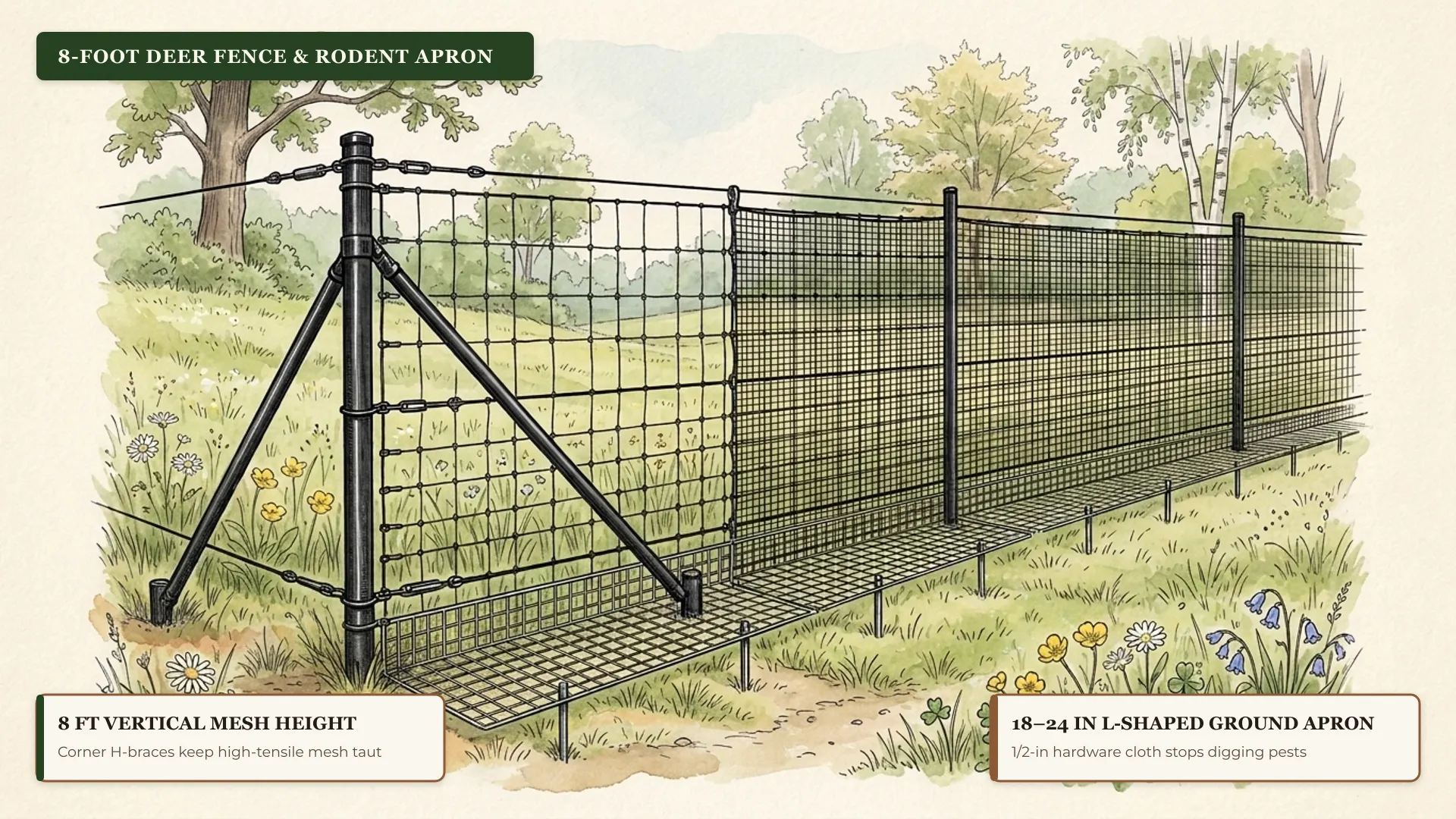
Standard 4-foot and 5-foot garden fences will keep out dogs and chickens, but hungry white-tailed deer will leap over them without breaking stride.
Furthermore, simply stringing high plastic deer netting creates a new failure point: rabbits, groundhogs, and rats quickly gnaw holes through the bottom 12 inches of plastic mesh, creating open highway tunnels for smaller pests to devour your cabbage, lettuce, and carrots.
To build a bulletproof garden perimeter, you must combine vertical height (8 feet) with a chew-proof ground apron.
1. Why 8 Feet Is the Gold Standard
White-tailed deer can easily clear a 6-foot fence from a standstill. University agricultural research shows:
- 4 to 5-foot fences: Offer zero protection; deer treat them as mild stepping hurdles.
- 6-foot fences: Stop casually grazing deer, but are frequently breached whenever food is scarce or when deer are startled.
- 8-foot fences (96 inches): The proven threshold. Even when pressured, deer will not attempt to jump an 8-foot vertical plane unless trapped.
The 3D Double Fence Alternative (For Low-Profile Gardens)
If local HOA rules or city zoning prohibit 8-foot tall fences in your neighborhood, build a 3D double fence:
- Install two parallel 4-foot fences separated by a 4-foot buffer corridor.
- Deer possess wide lateral vision but very poor depth perception. When confronted with two staggered fences, they cannot gauge their landing zone and refuse to jump the obstacle.
2. Anatomy of the Chew-Proof Ground Apron
Polypropylene deer mesh is lightweight, nearly invisible from 20 feet away, and UV-resistant. However, rodents (groundhogs, cottontail rabbits, squirrels, and mice) will chew clean through plastic netting in minutes.
The professional solution is an L-shaped galvanized steel rodent barrier:
        |  (8 ft Black Poly Deer Netting)
        |
        |=== Tension Wire (3 ft above ground)
        |
        |[#] (1/2" Galvanized Hardware Cloth / Welded Wire)
========+============= (Ground Level)
        \____________ (12" Apron flared outward along exterior turf)
               ^
          Steel Ground Staples every 24"
Installation Steps for the Apron:
- Fasten a 24-inch or 36-inch roll of 16-gauge, 1/2-inch or 1-inch galvanized welded wire to the lower portion of your posts.
- Allow the bottom 12 inches to flare horizontally outward along the exterior grass facing away from your garden.
- Pin the apron flat to the turf using 12-inch heavy-duty steel ground staples spaced every 2 feet.
- Within two months, grass roots grow up through the wire mesh, permanently anchoring the apron into the soil. When an animal attempts to burrow under the fence line, its claws hit impenetrable steel mesh.
3. Post Sizing & Tensioning
An 8-foot fence exerts tremendous wind sail leverage during autumn storms and winter gales:
| Post Type | Recommended Specs | Spacing | Setting Method |
|---|---|---|---|
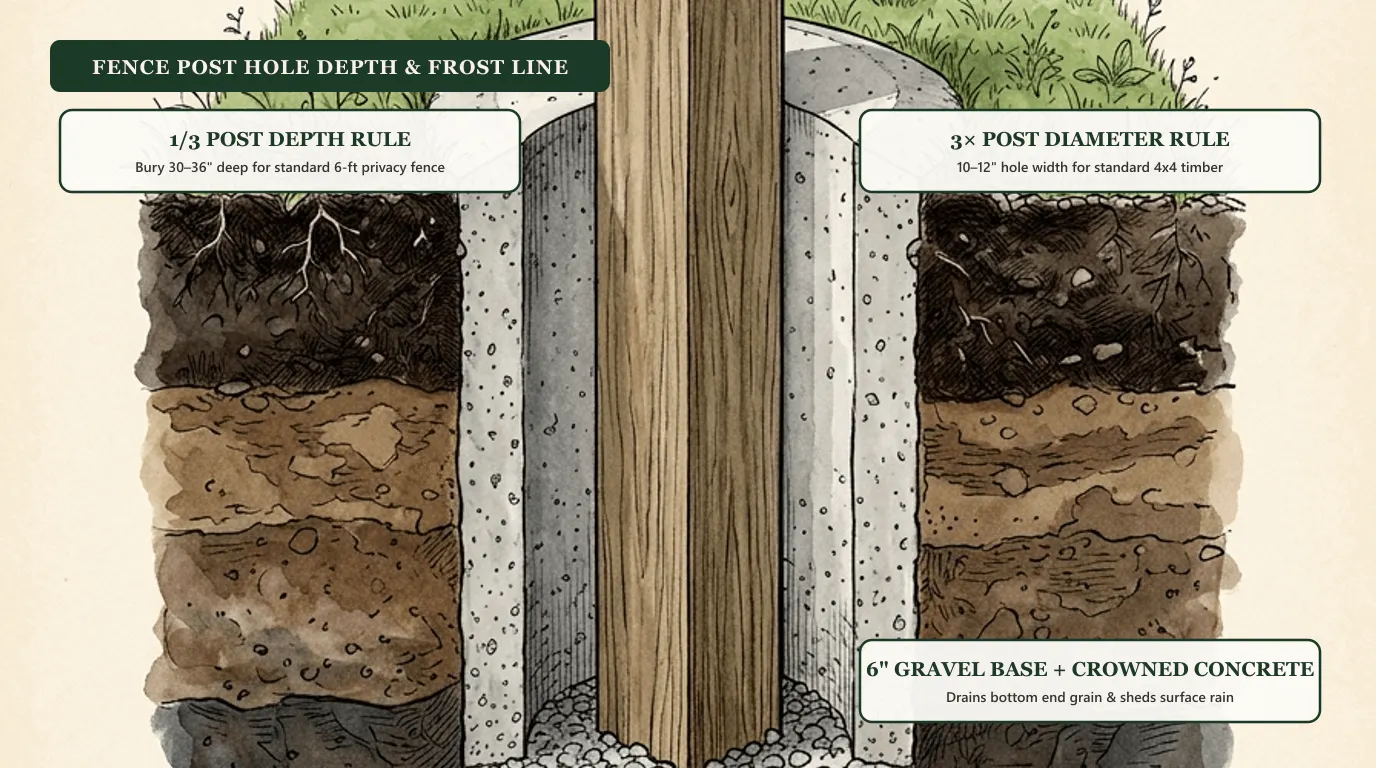
| Wood Corner Posts | 4×4 or 6×6 Pressure Treated (12 ft length) | Corners & gates | 36–42" deep in concrete with diagonal H-bracing |
| Metal Line Posts | 1-5/8" to 2" Galvanized Steel pipe (11–12 ft) | 10–12 ft on-center | Driven 36" into ground with post driver or sleeves |
| Heavy-Duty T-Posts | 10 ft Heavy Duty 1.33 lb/ft studded T-post | 10 ft on-center | Driven 24–30" with manual post pounder |
Top & Bottom Tension Wire
Never hang deer netting without high-tensile wire:
- Run a 12.5-gauge galvanized or black vinyl-coated steel tension wire along the very top of the posts (at 8 feet) and another at the 3-foot mark.
- Pull the wire taut using inline ratcheting wire tighteners.
- Hog-ring or zip-tie the deer netting to the tension wire every 12 inches to prevent netting from sagging over time.
Plan materials, corner posts, and hardware for your perimeter using our Garden Fence Calculator.
FAQ
Can a deer jump a 6-foot fence?
Yes, easily. An adult white-tailed deer can clear a 6-foot fence from a standing start and can jump nearly 8 feet when running. To reliably exclude deer from a garden plot, wildlife biologists and agricultural extension services recommend an 8-foot vertical fence (or a slanted 45-degree outrigger design).
What is a rodent apron on a deer fence?
A rodent apron is a 24 to 36-inch tall strip of heavy galvanized welded wire or hardware cloth (1/2-inch or 1-inch mesh) installed along the bottom of the fence. The bottom 12 inches is bent at a 90-degree angle to lay flat along the exterior ground and pinned with steel stakes. It prevents rabbits, groundhogs, and voles from chewing through the plastic mesh or burrowing under the fence.
How far apart should posts be on an 8-foot deer fence?
Space intermediate line posts 10 to 12 feet apart for metal T-posts or heavy-duty round steel pipes. If using wooden 4×4 posts with top and bottom rails, 8 to 10-foot spacing is standard to prevent sagging under wind loads and snow accumulation.
What is a 3D double fence for deer?
A 3D deer fence consists of two parallel 4-foot or 5-foot fences spaced 4 to 5 feet apart. Because deer have poor depth perception and binocular vision, they hesitate to jump a barrier when they cannot judge where their landing hooves will touch down between the two wire lines.